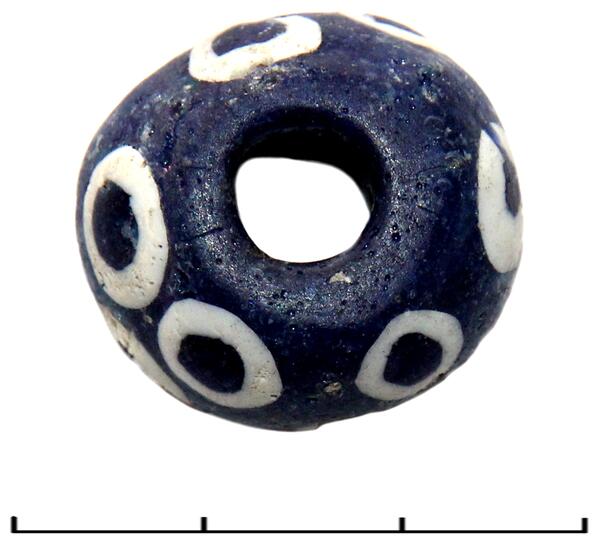
A round-shaped bead is presented in the museum’s collection. Such items began to be made back in the Bronze Age and became widespread in Eurasia in the subsequent era — the Early Iron Age. The production centers were located in China, Iran, and Central Asia. Such jewelry was also known in Europe. In the cultures of the Scythian world, this was one of the typical objects present in the graves of the nobility.
The technology of manufacturing such products was quite complex. A disk-shaped drop (dot) was placed on a core in the shape of a cone or pyramid and soldered into a bead, usually protruding on its surface. Beads with flat “eyes” were created, probably with the use of the technique of pressing glass when it still had a soft, not solidified core.
Such objects were not decorations in the usual sense. Most likely, they were not intended to demonstrate social status and material well-being. According to researchers, “eyed” beads were made and worn as a means of protection against diseases, various kinds of misfortunes and the evil eye.
The object was obtained during the archaeological study of a single mound Bolsherechye-I. The monument was studied in 2020 by the joint expedition of the Museum-Reserve “Starina Sibirskaya” (“Antiquity Siberian”) and the Laboratory of Archaeology, Ethnography and Museology of the IAET SB RAS (Institute of Archeology and Ethnography of the Siberian Branch of the Russian Academy of Sciences) under the general supervision of Philip Sergeevich Tataurov.
The mound is located next to the Bolsherechye work
settlement on thebedrock terrace of
the left bank of the Irtysh River on a burial field with 14 more mounds. They
were left by representatives of the Sargat archaeological culture that existed
in Western Siberia in the 5th century BCE — the 4th century CE. It was a
culture of nomadic pastoralists. It belongs to the so-called Scythian world — a
set of cultures which occupied the area from the Black Sea region to Mongolia,
united by the Scythian triad: the Scythian-Siberian animal style, weapons
(especially the akinak iron sword) and horse equipment (bits and bit shanks).
The main occupation of the Sargats was nomadic animal husbandry — breeding of
large and small cattle, horses.