Font
Color
Graphics
Изображение точки

To see AR mode in action:

1. Install ARTEFACT app for iOS or Android;

2. Find the exhibition «The Ethnography of Transbaikal»

3. Push the «Augmented reality» button and point your phone's camera at the exhibit;

Скрыть точки интересаПоказать точки интереса
Показать в высоком качестве

Buryat women’s costume, men’s costume, knife

0
Open in app
#1
Buryat women’s costume, men’s costume, knife
#2
Buryat women’s costume
#3
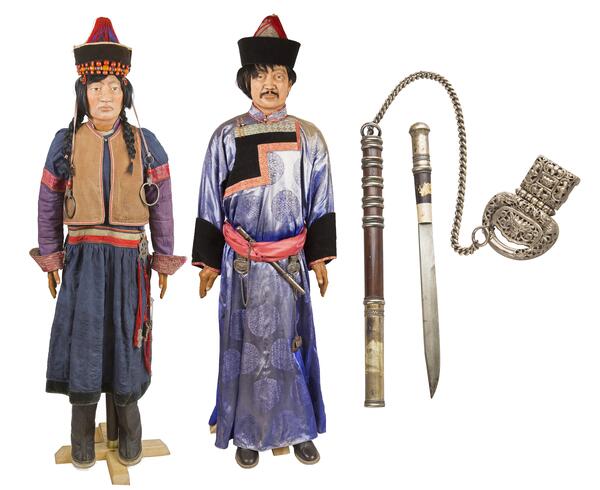
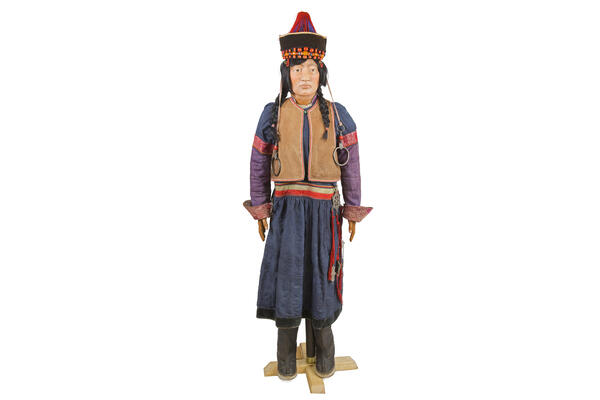
A Buryat female costume is displayed in the Transbaikal Regional Museum of Local Lore. By its cut and additional elements, one could tell the age of the owner, as well as her family status and wealth.

Buryat girls wore long dresses or winter coats belted with a wide piece of fabric. At the age of 14–15 they had to change the hairstyle and wear a dress of a different cut: the previous one was cut along the waistline and a new skirt was attached to it, with a decorative braid covering the seam line.

The costume of a young woman consisted of a shirt, pants and a robe, which was worn over the rest of the clothes. The outfit was complemented by a sleeveless jacket, an obligatory element for married women in all Buryat tribes. The eastern Buryats wore one short vest. In western regions, a gathered skirt was sewn onto the back. The sleeveless jacket was decorated in the front with silver coins or mother-of-pearl buttons.

Women wore round hats which covered their heads. Red tassels were attached at the top, they symbolized sunrays in the sky. The lower part was decorated with beads, people believed this element of the hat to be connected with the earth. Pendants and earrings were attached to the headdress and fell down on the chest. They represented stars, the Sun, the Moon, rain or snow and were up to 75 centimeters in length.

An important part of the costume was intricate multi-piece jewelry, most often silver with coral, turquoise and amber inlays. Rings were worn on all fingers except the middle one, sometimes in several rows. Women wore silver bracelets on both hands and earrings in their ears.

Buryat women wore silver medallions of a square, triangular or round shape on their chests. Various ornaments were depicted on them, and prayers written in the Tibetan language were kept inside. The Khorinsky Buryats sowed shoulder ornaments on their robes or sleeveless jackets. They had a silver base with a coral inlay in the center. Threads made of beads, coral and pearls or silver chains with silk tassels fell down to the edges on both sides.
#4
Полное наименование: Buryat women’s costume
Техника: sewing
Коллекция: Ethnography
Размер: Female dressing gown length 113 cm, sleeveless jacket w. — 53.5 cm, h. — 43 cm, headdress for brushes — 16 cm, d. — 22 cm, in. — 17 cm
Дата создания: late XIX — early XX centuries
Место создания: Trans-Baikal Territory (Trans-Baikal Region)
#5
Buryat men’s costume
#6
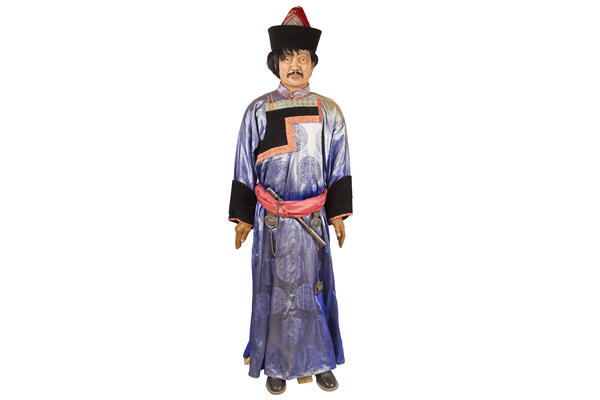
A national Buryat men’s costume is displayed in the Museum of Local Lore. It consists of a headdress (malgay), a wide pink belt and a blue robe. The chest part was decorated with an enger — a quadrangular inlay of three colored stripes: red, black and yellow-green. The costume was complemented by a knife in a scabbard and a tinder-box, which was used to start a fire.

The malgay was worn by all men, children and women, regardless of age. It was a conical hat trimmed with velvet or fur. It was decorated with a silver tip and red beads and red silk tassels. By the décor of the malgay, it possible to determine where the owner came from and to which clan they belonged.

Traditional Buryat clothing items were practical, comfortable and easy to make. Depending on the season and wealth, the Buryats used fur, wool, leather, silk, brocade, velvet, cloth and cotton fabrics.

In the east and west of the region, costumes differed in silhouette, cut, materials, texture, sewing method and decorations. The difference in clothing was influenced by the mythological beliefs of the tribes about the world.

For example, the cult of the sky was prevalent among the Eastern Buryats. That is why the main color of their costume was dark blue, while some elements were red, white and black. The clothes were decorated with an enger and a belt.

The West Asian Buryats worshipped the Sun. For their costumes, they used materials of brown and yellow shades: smoked fur, sheepskin, kamus — skin from the foreleg of a deer or elk. Ornaments and plaques were made in the form of gold or silver circle, sometimes with coral beads. The decorative elements were covered with floral ornaments or images of birds.

The colors in the Buryat costume had a sacred meaning. Yellow, especially deep, rich golden yellow was the color of harvest, ripe grain, material and spiritual wealth. Its symbolism was borrowed from Buddhism. Black was associated with the ground, home and homeland. Red was the color of fire and vital energy, and blue represented clear, eternally blue sky.
#7
Полное наименование: Buryat men’s costume
Техника: sewing, embroidery
Коллекция: Ethnography
Размер: L. — 118 cm, hem width — 84 cm, sleeve length — 63 cm
Дата создания: XX century
Место создания: Trans-Baikal Territory (Trans-Baikal Region)
#8
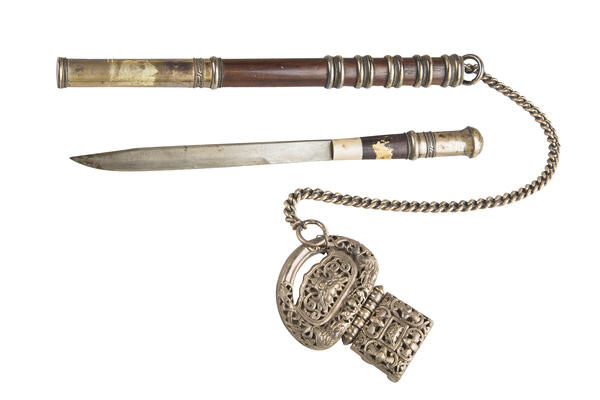
Buryat knife
#9
A knife was an element of the traditional Buryat male costume. However, both men and women wore it: the tool was necessary in everyday life. The sheath was attached to the belt with a pendant chain. The first Buryat knives were used for domestic purposes only — for butchering livestock and cutting up meat.

For slaughtering, nomadic tribes used an ancient method: the master would stab the blade sharply into the narrow place at the base of the skull so that the animal would not have time to become frightened. Knives were created with special blades for a more precise strike: long, straight and narrow. In addition, sharp knives were used to carve the carcass, to skin and to separate joints.

Over time, the Buryats developed new tools for household chores, and the knife became a decorative item. The sheath and handle were adorned with metal plates, semi-precious stones and embossed patterns. Knives were decorated with silver and, less often, with melchior. Buryat tribes did not use gold, as it was an expensive metal which was to find.

The Buryat knife was carried on a belt with a tinder-box, used to start a fire, which consisted of a firesteel (fire striker), a piece of flint and tinder. To ignite a fire, the owner hit the fire striker against the rock, the metal became heated and sparks appeared. The sparks had to fell on the tinder — pieces of paper, cotton, moss and other materials that are easily flammable — to start a small fire.

The flint and tinder were kept in a flat leather pouch similar to a purse. It was small: about 4 to 5 centimeters in length and 7 to 10 centimeters in width. It had a steel fire striker attached to the bottom.

The front side of the bag was decorated with silver plaques with embossed patterns. Most often, these were images of animals, plants and geometric patterns.

In Buryat tribes, it was customary to hand down the knives from generation to generation. When a son was born, his father would commission a knife for him to pass on to his children. The tool was considered a symbol of the owner’s soul and life energy. Therefore, the item could not be given or passed on to other people.
#10
Полное наименование: Buryat knife
Размер: 31.4×2.5 cm
Техника: metal; casting, forging
Коллекция: Ethnography
Дата создания: XX century
Место создания: Trans-Baikal Territory (Trans-Baikal Region)
#11
read morehide
00:00
00:00
1x

Buryat women’s costume, men’s costume, knife

0
Point your smartphone camera to open in the app
Share
VkontakteOdnoklassnikiTelegram
Share on my website
Copy linkCopied
Copy
Open in app
To see AR mode in action:
  1. Install ARTEFACT app for 
  2. iOS or Android;
  3. Find and download the «Paintings in Details» exhibition
  4. Push the «Augmented reality» button and point your phone's camera at the painting;
  5. Watch what happens on your phone screen whilst you flip through the pictures.
 
We use Cookies
Cookies on the Artefact Website. We use cookies to ensure that we give you the best experience on our website. If you continue without changing your settings, we'll assume that you are happy to receive all cookies on the Artefact website. However, if you would like to, you can change your cookie settings at any time.
Learn more about useHide
Content is available only in Russian

X

Нашли опечатку?...

%title%%type%