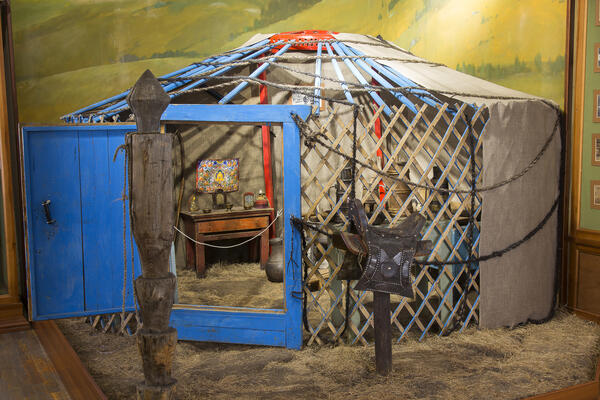
The Buryats were a nomadic people who often moved from one place to another. So as not to build houses anew, they carried with them small semicircular dwellings — yurts. One of them is displayed in the Transbaikal Regional Museum of Local Lore.
Yurts were made of felt and wood. They were composed of more than 60 elements that could be easily disassembled and transported on horseback to a new location. The proportions of the house were small, adjusted to the height of a human.
The walls of the dwelling were made of collapsible wooden grids, which were bound with horsehair ropes. By tightening or loosening them, the height and diameter of the yurt could be adjusted. The roof was made of flexible wooden poles. There was a hole of about one meter in diameter at the top, which provided light during the day and served as a flue.
The yurt was covered with felt — a thick milled wool material — on the sides. It let in fresh air well, but at the same time retained heat inside. Additionally, felt was soaked in a special antiseptic solution of tobacco, sour milk and salt. First, the southwest part of the yurt was covered with it, then the southeast part and only after that — the rest. Such order was associated with the direction of the cold wind: it blew from the northwest.
Inside, the yurt was divided into zones which resemble modern rooms. The northwestern side of the dwelling had a home altar where a table with drawings and statues of Buddhist gods stood. The left side of the house was considered the man’s side and the right — the woman’s one. There was a fireplace in the center.
Yurts were set up only in sunny spots, and the entrance to it was south-facing. The Buryats determined the time by the shadow inside the room: it was the longest in the morning and the shortest in the afternoon.
In the Buryat culture, there was a large number of rituals and traditions connected to the houses. For example, one could not receive guests on the left side of the house or step on the threshold when entering — it kept away evil spirits from the outside. If a visitor deliberately stepped on it, he thus communicated his evil intentions and was considered an enemy of the family. Guests also had to leave their knives and guns outside before entering the yurt.
Yurts were made of felt and wood. They were composed of more than 60 elements that could be easily disassembled and transported on horseback to a new location. The proportions of the house were small, adjusted to the height of a human.
The walls of the dwelling were made of collapsible wooden grids, which were bound with horsehair ropes. By tightening or loosening them, the height and diameter of the yurt could be adjusted. The roof was made of flexible wooden poles. There was a hole of about one meter in diameter at the top, which provided light during the day and served as a flue.
The yurt was covered with felt — a thick milled wool material — on the sides. It let in fresh air well, but at the same time retained heat inside. Additionally, felt was soaked in a special antiseptic solution of tobacco, sour milk and salt. First, the southwest part of the yurt was covered with it, then the southeast part and only after that — the rest. Such order was associated with the direction of the cold wind: it blew from the northwest.
Inside, the yurt was divided into zones which resemble modern rooms. The northwestern side of the dwelling had a home altar where a table with drawings and statues of Buddhist gods stood. The left side of the house was considered the man’s side and the right — the woman’s one. There was a fireplace in the center.
Yurts were set up only in sunny spots, and the entrance to it was south-facing. The Buryats determined the time by the shadow inside the room: it was the longest in the morning and the shortest in the afternoon.
In the Buryat culture, there was a large number of rituals and traditions connected to the houses. For example, one could not receive guests on the left side of the house or step on the threshold when entering — it kept away evil spirits from the outside. If a visitor deliberately stepped on it, he thus communicated his evil intentions and was considered an enemy of the family. Guests also had to leave their knives and guns outside before entering the yurt.