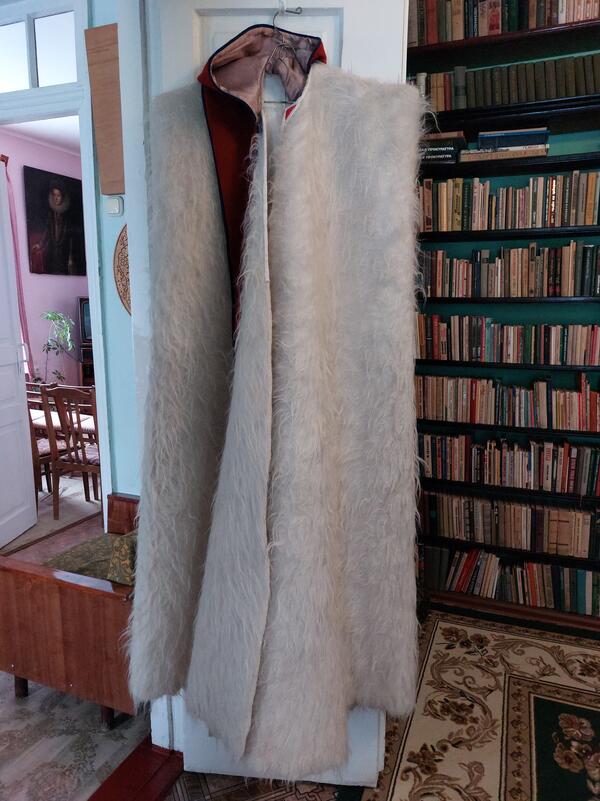
This white ceremonial burka was given to Vitaly Zakrutkin by the Bagayev Cossacks. His fellow countrymen often presented the writer with handmade souvenirs, baked pies and festive kalachi, and brought trees and rose bushes to plant on his estate.
Zakrutkin greatly appreciated the attention of his friends and admirers of his talent. He sincerely thanked them for their congratulations and found a special place for each gift in his spacious home.
The ceremonial burka displayed in the writer’s office captures the keen attention of every visitor to the memorial museum. Made of white sheep wool with a long pile on the outside and measuring almost two meters in length, this burka was intended for commanders who led regiments and battalions during ceremonial formations or parades.
During the festive celebration in honor of the writer’s anniversary, the Bagayev Cossacks draped a ceremonial white felt cloak over Vitaly Zakrutkin’s shoulders, allowing him to feel like a parade commander.
As a journalist, Zakrutkin traversed a challenging combat path from the Don region to Berlin. He visited nearly all sections of the Caucasian Front, participated in battles, and was awarded military orders and medals, including the Order of the Red Star and a medal “For the Defense of the Caucasus” in 1943.
In 1942, on one section of the Caucasian Front, Alexey Gordeyevich Selivanov, the commander of the Don Cossacks, presented the war correspondent Zakrutkin with a well-made black felt field cloak. It was not particularly long, as such a coat should not interfere with movement. It could be used as a tent without additional support and served as protective clothing against wind, cold, and rain; raindrops and wet snow rolled off its surface easily. In field conditions, the burka was used as a blanket and a bed, with weapons stored under its wide flaps. The dark burka-cape made the rider less visible and could even provide some protection from bullets, dagger or saber blows. It could also be used to carry wounded soldiers away from the battlefield.
Vitaly Zakrutkin greatly
appreciated the gift from his friend Alexey Selivanov and kept the military-style
burka, which helped many during the post-war years.