Banknote rubles were in circulation in the Russian Empire from 1769 to 1785, from 1785 to 1818 and from 1818 to 1843. Auxiliary initially, they later became the main monetary units.
The need to replace coinage with a more compact equivalent was already evident in the 18th century. When Mikhail Vasilyevich Lomonosov received 2,000 rubles in copper for his “Ode on the Day of the Ascension to the All-Russian Throne of Her Majesty the Empress Elisaveta Petrovna”, he had to take the award home in several carts. Wagons were also used to collect and transport tax money.
The first attempt to introduce banknotes was initiated by Peter III back in 1762. However, the idea failed to be implemented, first due to distrust of the “venture” by the aristocracy, and then due to the coup d’état. After ascending the throne, Catherine II returned to the project in 1769.
During the Russo-Turkish War the state treasury incurred great losses, because internationally all payments were made only in silver and gold coins. The idea of “assignats” was borrowed from France, which found itself in a similar situation during the French Revolution. So, in 1769 the first Assignation Bank appeared in Russia. It stocked 500 thousand rubles in copper coins and issued banknotes of 25, 50, 75 and 100 rubles to the amount of one million rubles.
Initially, the banknotes differed from each other only by their denomination. Counterfeiters were quick to take advantage of this, as they learned to erase some numbers and replace them with others. To stop the crooks, banknotes were made in different colors. Money was printed in the Senate Printing Office on special paper produced in the factory of Karl Efimovich Sievers in Krasnoye Selo. From 1866 the State Printing Office started to produce banknotes with portraits of statesmen.
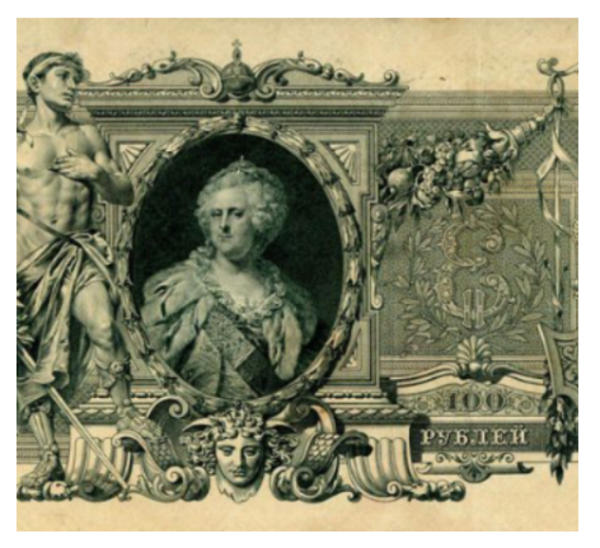
The 1910 one-hundred-ruble banknote on display was popularly nicknamed “katenka” because of the portrait of Catherine II that adorned it. The Art Nouveau design of the banknote included many small, finely drawn elements that flowed one into the other. In the upper right corner is a Horn of Plenty as a symbol of state prosperity, to the left of the portrait of the Empress is a warrior representing strength, the head of a satyr below symbolizes the flourishing culture. The portrait of Catherine II herself is remarkable for the vividness of her features. It was almost impossible to forge such an image.
The need to replace coinage with a more compact equivalent was already evident in the 18th century. When Mikhail Vasilyevich Lomonosov received 2,000 rubles in copper for his “Ode on the Day of the Ascension to the All-Russian Throne of Her Majesty the Empress Elisaveta Petrovna”, he had to take the award home in several carts. Wagons were also used to collect and transport tax money.
The first attempt to introduce banknotes was initiated by Peter III back in 1762. However, the idea failed to be implemented, first due to distrust of the “venture” by the aristocracy, and then due to the coup d’état. After ascending the throne, Catherine II returned to the project in 1769.
During the Russo-Turkish War the state treasury incurred great losses, because internationally all payments were made only in silver and gold coins. The idea of “assignats” was borrowed from France, which found itself in a similar situation during the French Revolution. So, in 1769 the first Assignation Bank appeared in Russia. It stocked 500 thousand rubles in copper coins and issued banknotes of 25, 50, 75 and 100 rubles to the amount of one million rubles.
Initially, the banknotes differed from each other only by their denomination. Counterfeiters were quick to take advantage of this, as they learned to erase some numbers and replace them with others. To stop the crooks, banknotes were made in different colors. Money was printed in the Senate Printing Office on special paper produced in the factory of Karl Efimovich Sievers in Krasnoye Selo. From 1866 the State Printing Office started to produce banknotes with portraits of statesmen.
The 1910 one-hundred-ruble banknote on display was popularly nicknamed “katenka” because of the portrait of Catherine II that adorned it. The Art Nouveau design of the banknote included many small, finely drawn elements that flowed one into the other. In the upper right corner is a Horn of Plenty as a symbol of state prosperity, to the left of the portrait of the Empress is a warrior representing strength, the head of a satyr below symbolizes the flourishing culture. The portrait of Catherine II herself is remarkable for the vividness of her features. It was almost impossible to forge such an image.