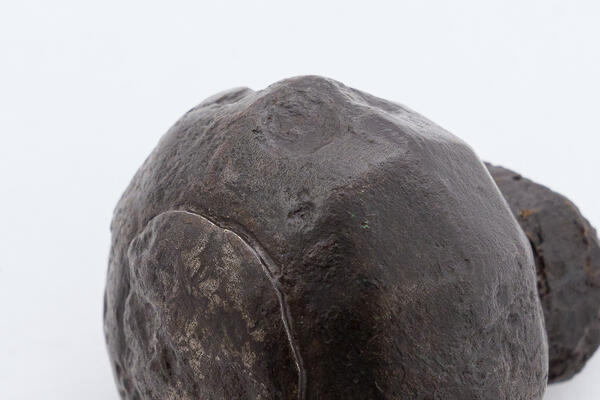
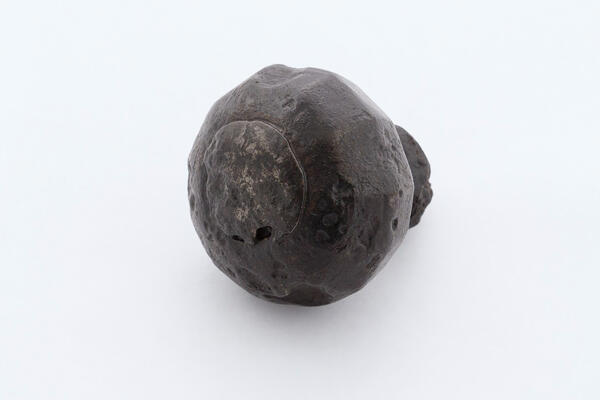
The mace on display at the museum-reserve is a part of the offensive weaponry of a warrior from the 14th–15th centuries. It has a rounded shape with edges and a low, cylindrical sleeve at its base for better attachment to the wooden handle. A small piece of the handle has been preserved in the sleeve.
The mace is one of the oldest types of offensive weapons invented by humans. It evolved from the wooden cudgel, a weapon used by primitive people. But as wood dries out, it becomes fragile, so maces were provided with heads, initially made of stone and later of metal (bronze).
The path of evolution of the mace is long. The first ones appeared in Eastern Europe in the early 10th century and only in the 12th century did they begin to gain popularity due to their simplicity of manufacture. Until the beginning of the 14th century, most maces were made of bronze.
Since the second half of the 14th century, there was a significant increase in the weight of armor throughout Eurasia, from the Atlantic to the Pacific. This was due to a major leap in metalworking technology. As a result, offensive weapons began to evolve rapidly. The older forms and types of swords, spears, axes, and maces that had been used before were no longer effective against the new types of armor that had emerged. Instead, other weapons became popular — those with a greater piercing power (such as pikes, picks, stilettos) or a greater striking force (axes, maces, war hammers).
In the era of the Battle of Kulikovo, maces had already been entirely made of iron and their weight had increased significantly. Their shape had also become more angular, so that when they hit the enemy, they could inflict maximum damage, regardless of the direction of impact.
In the late Middle Ages, maces were found everywhere, both with the Russian military and those of the Horde. The latter was particularly characterized by flanged (six-bladed) maces, which were also a status symbol.
Maces similar to the item on display are also known from archaeological materials in Veliky Novgorod.