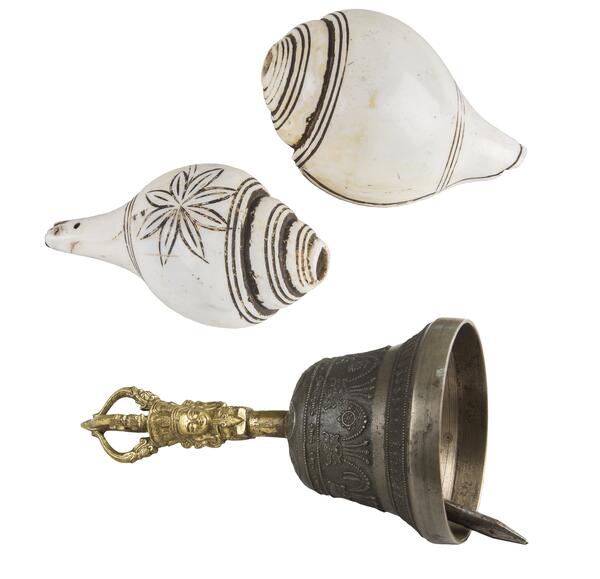
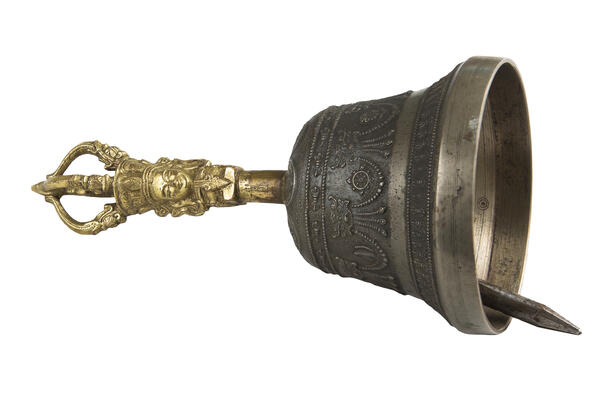
The Transbaikal Regional Museum of Local Lore houses a 19th–century Khonkho bell. It was used during Buddhist worship to ward off evil spirits and demons.
The Khonkho bells were of different sizes, but the proportions of the parts always remained the same: the height, diameter of the base, and the length of the handle were the same size.
The bell and the handle were made separately. The body was cast in bronze or its alloy with silver, bismuth, or copper. Molten metal was poured into special molds made of dense sand mixed with a thickener — radish juice or unprocessed brown sugar. The item was cooled down, and then patterns and symbols were applied on top using bas-relief seals.
The lower part of the bell was decorated with vertical images of vajras — ritual weapons similar to scepters. Eight “faces of victory” — heads of mythical creatures — are depicted in the middle part of the khonkho. They were interconnected by garlands of jewels and emblems of Eight Great Bodhisattvas. In Buddhism, Bodhisattvas are enlightened people who have decided to take the Buddha title. They are symbolized by a wheel, a lotus, a vajra, a sword, and a jewel. The upper part of the case is complemented with pearl beads and horizontal vajras.
The khonkho handle was cast in bronze using paraffin or wax molds, and then it was attached to the body with sticky resin. There also were bells with a screwed handle. Some masters additionally covered them with gold, like the exhibit displayed in the museum.
The long bell handle from the museum collection is crowned with a vajra — a scepter. Lotus petals are depicted in the places where the handle is attached to the body. The central part is shaped to look like a bumpa vase — a vessel with the nectar of longevity. Above it, there is an image of the Buddhist goddess Prajnaparamita in a crown with five ornaments. Each of them symbolizes her wisdom. Around Prajnaparamita’s neck hang four lotus petals and pearl prayer beads.
Some bells had a ring on the handle to wear it on the ring finger. Most often, the khonkho was used in the final part of worship.
The Khonkho bells were of different sizes, but the proportions of the parts always remained the same: the height, diameter of the base, and the length of the handle were the same size.
The bell and the handle were made separately. The body was cast in bronze or its alloy with silver, bismuth, or copper. Molten metal was poured into special molds made of dense sand mixed with a thickener — radish juice or unprocessed brown sugar. The item was cooled down, and then patterns and symbols were applied on top using bas-relief seals.
The lower part of the bell was decorated with vertical images of vajras — ritual weapons similar to scepters. Eight “faces of victory” — heads of mythical creatures — are depicted in the middle part of the khonkho. They were interconnected by garlands of jewels and emblems of Eight Great Bodhisattvas. In Buddhism, Bodhisattvas are enlightened people who have decided to take the Buddha title. They are symbolized by a wheel, a lotus, a vajra, a sword, and a jewel. The upper part of the case is complemented with pearl beads and horizontal vajras.
The khonkho handle was cast in bronze using paraffin or wax molds, and then it was attached to the body with sticky resin. There also were bells with a screwed handle. Some masters additionally covered them with gold, like the exhibit displayed in the museum.
The long bell handle from the museum collection is crowned with a vajra — a scepter. Lotus petals are depicted in the places where the handle is attached to the body. The central part is shaped to look like a bumpa vase — a vessel with the nectar of longevity. Above it, there is an image of the Buddhist goddess Prajnaparamita in a crown with five ornaments. Each of them symbolizes her wisdom. Around Prajnaparamita’s neck hang four lotus petals and pearl prayer beads.
Some bells had a ring on the handle to wear it on the ring finger. Most often, the khonkho was used in the final part of worship.