Font
Color
Graphics
Изображение точки

To see AR mode in action:

1. Install ARTEFACT app for iOS or Android;

2. Find the exhibition «Yamal: the Past and the Present»

3. Push the «Augmented reality» button and point your phone's camera at the exhibit;

Скрыть точки интересаПоказать точки интереса
Показать в высоком качестве

Child: hat,kisy, malits; Shoulder basket, Maiden

0
Open in app
#1
Child: hat, kisy, malits; Shoulder basket, Maiden
#3
Ekaterina Katkileva
Child’s fur hat
#4
The main raw material for the clothing of the indigenous small peoples of the North was reindeer skins. The outerwear, hats and shoes were sewn so that the peculiarities of the structure of the skin and hair of this ungulate would be taken into account.

The reindeer tolerates severe frosts very well. Each hair of his fur is a tube that contains air. The hairs adhere tightly to one another and create strong thermal insulation. From such skins, you can sew clothes with fur both outward and inward.

The human body feels the heat from reindeer fur even at moments when a small condensation accumulates from temperature changes. The micropores of the wool absorb this moisture and easily part with it when drying. Thus, a thing made of reindeer fur, with proper care, does not deteriorate and serves for a long time.

When Nenets women prepared and cut the material in order to sew hats, outerwear or other products from it, for example, the bags or the nukes to cover the chum, the skins were selected so that the pile was always directed downward. On such a pile, the drops of rain and wet snow rolled down, and the skin did not rot.

In cold climate, it was impossible to survive without a hat. The material and shape of the headdresses of the northern peoples were adapted to the harsh climatic conditions and nomadic life. Women sewed hats soft, light, and warm, spacious enough. These hats were comfortable both when riding reindeer and during other activities related to the nomadic way of life — guarding the herd and hunting.

Baby’s clothing in most cases did not differ from that of an adult. This can be also applied to the fur hat that the mother or grandmother sewed for the baby.

The child’s fur hat was part of the malitsa fur coat. The hat was sewn like a hood, or a separate hood covering the head from all sides. For the child’s fur hat, the soft skin from the forehead of a deer was used. It had the natural outlines of the eye sockets, holes from the horns and ears left. These parts were decorated with ornaments, contrasting stripes of fur or bright cloth. Thus, in clothes, the connection between a person and an animal was emphasized since the animal helped people to survive in the conditions of the Arctic tundra.
#5
Полное наименование: Child’s fur hat. Homaku
Автор: Ekaterina Dmitrievna Katkileva
Дата создания: 2009
Technics: hide, fox fur, sewing, handmade
Место создания: YaNAO (Yamalo-Nenets Autonomous District), Muravlenko
Размеры: 32×24 cm
Коллекция: Ethnography
Правообладатель изображений: MBIC “Muravlenko Ecological and Local History Museum”
№ Госкаталога: 14215159
#6
Child’s kisy
#7
The indigenous people of the North sewed winter clothes from different parts of the reindeer hide. The structural features of the skin and hair of this animal allowed clothes made from its fur to withstand any cold.

The winter shoes of the Khanty, Mansi and Nenets were special boots called “kisy”. They were made mainly of “kamus” — the skin taken from the leg of a deer. This fur was considered the most suitable for shoes, since the hair was quite tough, repelled snow and dirt, and did not absorb moisture. Proper knee-high kisy were able to keep the feet warm and dry even at temperatures below 50–60 degrees.

Kamus was usually processed separately from large skins. Unlike the thicker skins of elk or wild boar, thin deer skins could be dried even in winter. To free the skin from excess moisture, the kamuses were taken out into the cold and stretched a little. This ensured that the skin did not shrink.

Before the tanning, the skin was moistened and softened from the side of the flesh — the layer of subcutaneous tissue. To make the skin pliant, the Khanty used fish or deer fat, the contents of a deer’s stomach, and later began to use sour dough. Then, they took the softened kamus and carefully scraped the skin with scrapers, trying not to break the skin. From time to time, it was kneaded with hands — the longer, the better. Well-made kamus became soft, elastic and retained heat better.

Kamuses were often hung over the hearth during the manufacturing process so that they were smoked. It was believed that the smoked leather repelled water better and was not attacked by insects.

Kisy were sewn exclusively with fur on the outside, sometimes leaving a little fleece inside the shoe. The strips of kamus were sewn with reindeer tendon threads. The sole was made of “brushes” (the skins between the small and large hooves of a deer), a simple piece of kamus or the thick skin from the forehead of a deer. The latter was used only for the manufacture of men’s shoes, and in women’s shoes such an element was prohibited.

Both adults and children had their kisy decorated with fur mosaics, beaded sewing and embroidery. Often, for additional durability, structural seams were reinforced with multi-colored cloth — a dense woolen or half-woolen fabric.
#8
Полное наименование: Child’s kisy
Дата создания: 1998
Техника: deer hind, sewing, handmade
Место создания: YaNAO (Yamalo-Nenets Autonomous District), Muravlenko
Размеры: 60×22.5 cm
Коллекция: Ethnography
Правообладатель изображений: MBIC “Muravlenko Ecological and Local History Museum”
№ Госкаталога: 13640410
#9
Ekaterina Katkileva
Children’s malitsa. Goose
#10
The indigenous peoples of the North had a special attitude towards children. They were considered a gift from heaven and a great joy for the whole family, so the best materials were used to sew children’s clothes.

At the age of one to five or six years, the child was dressed in a fur coat cut from a whole piece and called “malitsa.” It was most often sewn in two layers, with fur both inward and outward. The malitsa consisted of a base (a fastened front part and a back) and a warm hood, sleeves, a hem and a lining.

Before cutting and sewing the malitsa, it was necessary to select and prepare the material. When choosing fur, it was necessary to take into account its color, as well as the texture and length of the pile. The children’s malitsas were sewn only from soft light skins. They were thoroughly scraped — cleaned of films and subcutaneous tissue with a special scraper. This process was repeated three or four times, with the skins dried and kneaded by hand during the intervals.

The skins were sewn in such a way that the pattern and direction of the fur would make them seem a single whole. To connect the parts, tendon threads, most often deer, were used.

The malitsa was comfortable because the hood and mittens were sewn to its base, so the robe did not leave a single open area of the body. Also, thanks to this design, the fur coat did not swing open during outdoor games and walks.

The hood, made of the skin from the head of a deer, preserved the natural outlines of the eye sockets, holes from the horns and ears of the animal. All these parts were decorated with national patterns, stripes of fur, bright cloth. In the Nenets tradition, such preservation of all the details on the skin from the deer head reminded that man and deer are inseparable and are the basis of life for each other.

Small bells or amulets were sewn to the sleeves of the malitsa from below. Legend has it that they drove evil spirits away with a melodic ringing of the metal.

With age, starting from six to seven years, girls and boys received different variants of clothes, which externally and functionally were already divided into women’s and men’s clothes. With these outfits, children were given certain social roles and tried to live up to them in everyday life.
#11
Полное наименование: Children’s malitsa fur coat. Goose
Автор: Ekaterina Dmitrievna Katkileva
Дата создания: 1998
Техника: hind, beads, handmade
Место создания: YaNAO (Yamalo-Nenets Autonomous District), Muravlenko
Размеры: 70×40 cm
Коллекция: Ethnography
Правообладатель изображений: MBIC “Muravlenko Ecological and Local History Museum”
№ Госкаталога: 13640394
#12
Fyokla Bondarenko
Shoulder basket
#13
The indigenous small peoples of the North used homemade birch bark containers — boxes, bodies, vessels — to store various household items. These boxes could vary in size and shape — they could be round, oval, rectangular, with overhead flat or convex lids. They were used to store tools, clothes, dishes, and food.

Such light and durable items were also common among the Khanty, the Ugric people living in the north of Western Siberia. The Khanty led a semi-sedentary lifestyle, and their main sources of food were reindeer husbandry and fishing. They often had to travel from place to place and when seasons changed, they moved from winter camps to summer ones and vice versa.

The Khanty used large rectangular or trapezoidal shoulder baskets to carry relatively light-weight loads. They were convenient when carrying fish, berries, meat and other luggage. Large boxes and baskets were also used to store food.

In addition to large shoulder baskets, there were small ones. The Khanty used them for collecting berries. Boxes for low-growing berries were hung from a belt and fastened with a bone or a piece of wood. And if tall-growing berries were picked, the basket as hung around the neck with a strap.

The shoulder basket from the Muravlenko museum collection was made by the craftswoman Fyokla Bondarenko in 2012. She made the container from a long strip of birch bark, which she folded across. She folded the bottom corners into the form of an envelope and clipped them to the sides.

The flat round lid is also made of birch bark. To make it more durable, the craftswoman stitched it with a cedar root and strengthened it with a bird cherry twig. And on top she sewed a dark smoked birch bark and thus created a pattern.

The strap is made of tarpaulin; it is attached to the sides with the help of reindeer “rovduga” — a hide that is similar in properties to suede. To get it, the skin of the deer is first grounded — the subcutaneous tissue is scraped off — then the fur is removed and impregnated with various substances in order to loosen it and prevent collagen from sticking in the fibers. Only after that, the skin is crumpled and dried, and in winter it is frozen. At the last stage of making a “rovduga”, the skin is treated with the smoke of smoldering rotten wood and coals. This is how it gets its color and becomes waterproof.
#14
Полное наименование: Shoulder basket
Автор: Fyokla Semyonovna Bondarenko
Дата создания: 2012
Техника: birch bark, handmade, assembly
Место создания: YaNAO (Yamalo-Nenets Autonomous District)
Размеры: 43×31×14 mm
Коллекция: Ethnography
Правообладатель изображений: MBIC “Muravlenko Ecological and Local History Museum”
№ Госкаталога: 14221498
#15
Ekaterina Katkileva
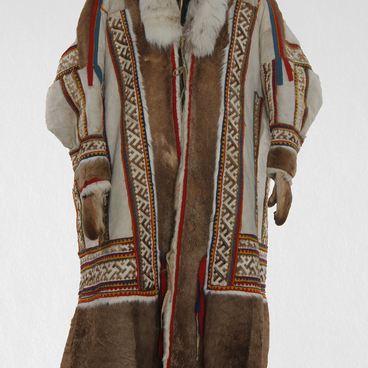
Maiden fur coat
#16
In the North, a woman’s skill in sewing was determined, among other things, by the fur clothes she wore.

For example, in winter Nenets women wore a fur coat made of reindeer skins. It was called the yagushka and was an analogue of the men’s malitsa. Unlike the malitsa, the yagushka was fastened in front and lacked a hood.

The yagushka was sewn from the fur of a three-four-month-old deer. The skins were carefully selected according to the height and location of the pile, after which the parts were cut out and sewn together. The lining was also made of reindeer fur, but the hide of an older animal was used — four or five months old.

Paired rovduga straps were sewn to the sides of the fur coat at some distance from each other, which served as strings — about 14 pieces. They were tied from the inside.

The collar was more often sewn from the fur of a fox or sable, less often from deer fur. The most elegant were the yagushkas made of white reindeer fur with a wide dark edge — a “panda” — made of short-haired summer fur.

The main decoration of the yagushka was a traditional geometric pattern, which was located along the bodice, not reaching the bottom, and encircled the fur coat between the waist and a wide sewn-on strip at the hem. In addition, there were patterned vertical inserts in the seams on the sides and on the back. Cuffs and shoulder seams were also decorated.

The bottom patterns were complex and had many geometric elements. The width of the ornament was usually four to five centimeters.

One yagushka could be decorated with different motifs. For example, the hem was decorated with the traditional “antlers” pattern, which resembled a deer’s head decorated with antlers, “fox elbows” were placed on the bodice — stylized images of foxes legs bent in the way when the animal is running, “heads” on cuffs, a row of triangles with their tops down.

Since the fur coat did not have a hood, it was worn with a hat. Most often, the headdress was sewn in the color of the main clothing and decorated with traditional ornaments and metal pendants. If there was an opportunity, an imported bright cashmere scarf was tied on top.

The mittens were sewn to the sleeves from the back. So they could be quickly thrown off, but at the same time not lost in the cold.

When a Nenets woman had to be in the cold for a long time, for example, while riding on sleds in search of a new camp, she would tie her yagushka at the waist with a belt woven from thick wool or simple colored threads. The belt was adorned with a large metal round buckle.
#17
Полное наименование: National maiden fur coat
Автор: Ekaterina Dmitrievna Katkileva
Дата создания: 1998
Technics: hide, beads, handmade, sewing
Место создания: YaNAO (Yamalo-Nenets Autonomous District), Muravlenko
Размеры: 126×40 cm
Коллекция: Ethnography
Правообладатель изображений: MBIC “Muravlenko Ecological and Local History Museum”
№ Госкаталога: 13640404
#18
read morehide
00:00
00:00
1x

Child: hat,kisy, malits; Shoulder basket, Maiden

0
Point your smartphone camera to open in the app
Share
VkontakteOdnoklassnikiTelegram
Share on my website
Copy linkCopied
Copy
Open in app
To see AR mode in action:
  1. Install ARTEFACT app for 
  2. iOS or Android;
  3. Find and download the «Paintings in Details» exhibition
  4. Push the «Augmented reality» button and point your phone's camera at the painting;
  5. Watch what happens on your phone screen whilst you flip through the pictures.
 
We use Cookies
Cookies on the Artefact Website. We use cookies to ensure that we give you the best experience on our website. If you continue without changing your settings, we'll assume that you are happy to receive all cookies on the Artefact website. However, if you would like to, you can change your cookie settings at any time.
Learn more about useHide
Content is available only in Russian

X

Нашли опечатку?...

%title%%type%