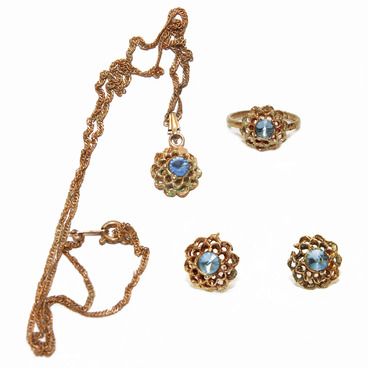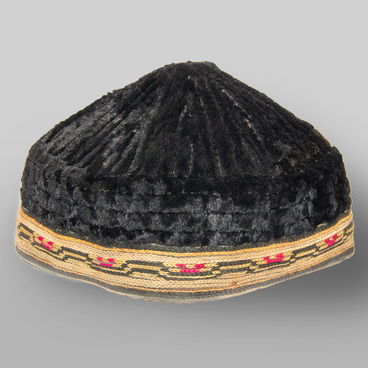
The jewelry of Tatar women was very diverse. The range of women’s jewelry was wide due to the Muslim tradition when a man’s fortune was determined by the rich garments and the amount of precious jewelry belonging to his wife.
From the age of three to the time they marry, girls wore simple silver earrings and modest smooth rings. The pectoral decoration of most maidens consisted of coin brooches “tenkele pin”. Having reached the age of marriage — 15 or 16 years old — the girls put on a complete set of silver jewelry on holidays: earrings, breast jewelry, bracelets and rings. After marriage, a modest girl’s dress was replaced by numerous massive rings, earrings and belt plaques. Women between the ages of 50 and 55, as a rule, put on simple jewelry again, and handed out their expensive jewelry to their daughters and young relatives.
Siberian Tatars had a characteristic decoration — a combination of metal with various kinds of inserts, or stones (“kuslar”). Most often, turquoise, corals, mother-of-pearl, malachite, carnelian, amethyst, aquamarine, and ruby were used, but basically it was an imitation of natural materials in mass-produced jewelry.
The most numerous were neck and breast decorations — collar (“yaka chilbyry”) and belt clasps (“kaptyrma”), necklaces (“muensa”), brooches, bibs (“izyu”), and bandages (“hasite”). They were a purely practical element of clothing. Brooches were used as a decorative and utilitarian item for fastening the chest section of a shirt.
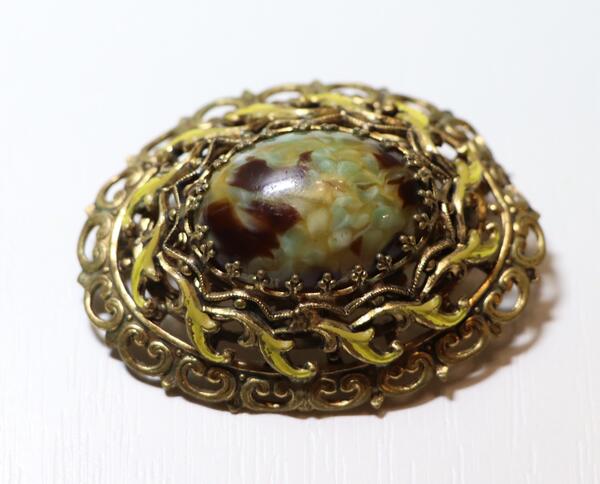
In the middle of this oval-shaped brooch from the exhibition there is a green Ural natural stone. It is secured in the simplest way, which is called a bezel setting: the insert is fixed by uniformly pressing its walls with metal from all sides. As a rule, only stones with a smooth lower surface are secured in a bezel setting, which should be underlain by the bottom of the setting from below. A bezel setting provides a secure fastening, but the light can only fall on it from above, which is why mostly opaque stones are attached this way. The clasp type of this brooch is a pin.
From the age of three to the time they marry, girls wore simple silver earrings and modest smooth rings. The pectoral decoration of most maidens consisted of coin brooches “tenkele pin”. Having reached the age of marriage — 15 or 16 years old — the girls put on a complete set of silver jewelry on holidays: earrings, breast jewelry, bracelets and rings. After marriage, a modest girl’s dress was replaced by numerous massive rings, earrings and belt plaques. Women between the ages of 50 and 55, as a rule, put on simple jewelry again, and handed out their expensive jewelry to their daughters and young relatives.
Siberian Tatars had a characteristic decoration — a combination of metal with various kinds of inserts, or stones (“kuslar”). Most often, turquoise, corals, mother-of-pearl, malachite, carnelian, amethyst, aquamarine, and ruby were used, but basically it was an imitation of natural materials in mass-produced jewelry.
The most numerous were neck and breast decorations — collar (“yaka chilbyry”) and belt clasps (“kaptyrma”), necklaces (“muensa”), brooches, bibs (“izyu”), and bandages (“hasite”). They were a purely practical element of clothing. Brooches were used as a decorative and utilitarian item for fastening the chest section of a shirt.
In the middle of this oval-shaped brooch from the exhibition there is a green Ural natural stone. It is secured in the simplest way, which is called a bezel setting: the insert is fixed by uniformly pressing its walls with metal from all sides. As a rule, only stones with a smooth lower surface are secured in a bezel setting, which should be underlain by the bottom of the setting from below. A bezel setting provides a secure fastening, but the light can only fall on it from above, which is why mostly opaque stones are attached this way. The clasp type of this brooch is a pin.