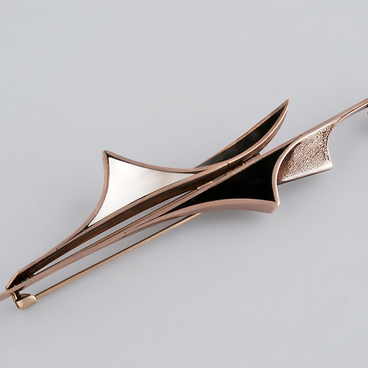
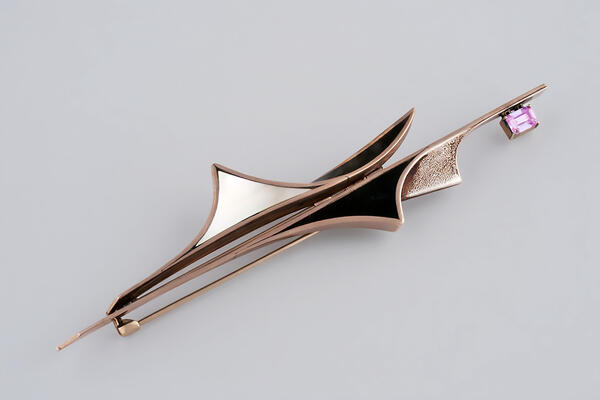
The “Constellation” brooch, created by the Ural jeweler Timargali Kamalovich Yamaletdinov, belongs to the constructivist tradition in art jewelry. It is characterized by geometric shapes and a restrained color palette. The style of the brooch on display can be described as a harmonious combination of high-tech and futurism, which gives it a look that is both uniquely expressive and crisp.
The piece features a rigid frame and its composition is built upon clean lines. Its abstract form consists of two nested triangles made of ebony, in a melchior bezel setting. The inner triangle is adorned with rows of sparkling cubic zirconia that symbolize a star cluster. This design imbues the brooch with not only decorative appeal but also deep symbolic meaning.
For the brooch, the artist used melchior, an alloy of copper and nickel that resembles silver. In the USSR, melchior was widely used in jewelry-making for its durability and wear resistance. It does not deform and retains its original appearance for decades, making it particularly valuable to jewelers. Interestingly, this alloy was known as “white copper” as early as the 3rd century BCE, though it was eventually forgotten. It was rediscovered and popularized in the 19th century by the French scientists Maillot and Chorier, after whom this alloy was named.
The black inserts are made of ebony, an exceptionally dense wood that can be polished to a mirror shine. These properties eliminate the need for additional varnishes, preserving the material’s natural texture and making the pieces more natural-looking and durable.
Additional accents are provided by small metal triangles set with colorless, faceted cubic zirconia, resembling a scattering of stars. Cubic zirconia is a synthetic crystal renowned for its strength and brilliant luster. As a lab-grown diamond alternative, it is an ideal material for jewelry.
Like other works by Timargali Kamalovich Yamaletdinov, the “Constellation” brooch is not merely a piece of jewelry but a work of art that combines geometric rigor, durable materials, and deep symbolism. It demonstrates how a modern artisan can organically blend traditional techniques with innovative solutions to create unique pieces of art.