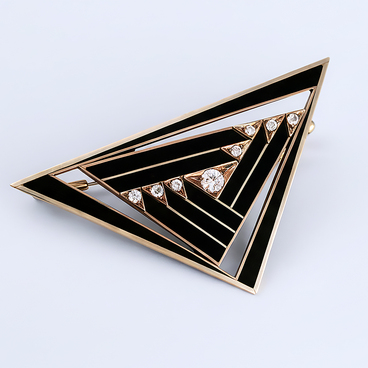
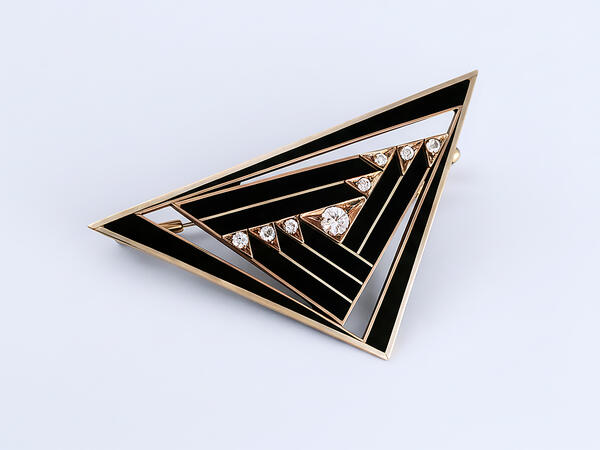
Created by the Ural jeweler Timargali Kamalovich Yamaletdinov, the “Flight” brooch is a striking piece that belongs to the constructivist tradition in art jewelry. It is characterized by geometric shapes and a restrained color scheme. The style of the brooch on display can be described as a harmonious combination of high-tech and futurism.
The brooch features a rigid frame and a composition built on sharp, precise lines, which gives it a look that is both uniquely expressive and crisp. Its abstract form, reminiscent of an arrow, symbolizes freedom and flight, reflecting an aspiration for new heights and independence. Thus, this brooch may appeal to connoisseurs of meaningful jewelry who value symbolism.
The brooch is crafted from melchior — an alloy of copper and nickel that resembles silver. In the USSR, melchior was widely used in jewelry-making because items made from it resisted deformation and could last for decades. Interestingly, this alloy was known as “white copper” as early as the 3rd century BCE, though it was eventually forgotten. It was rediscovered and popularized in the 19th century by the French scientists Maillot and Chorier, after whom this alloy was named.
At the top of the brooch, there is a rectangular, transparent faceted cubic zirconia. This artificial material is prized for its strength and brilliant luster, making it a popular choice in art jewelry. On the side, a triangular protrusion features an insert of mother-of-pearl plates — an organic material produced by some mollusks as an inner shell layer. The mother-of-pearl provides a delicate shimmer to the piece, adding a touch of sophistication and elegance. Renowned for both its beauty and durability, mother-of-pearl has been used in jewelry since ancient times, and its unique iridescent quality remains highly sought after to this day.
Like other works by Timargali Yamaletdinov, the “Flight” brooch is more than an accessory; it is a work of art that masterfully blends modern technology with centuries-old traditions. The artist was born in 1947 in the town of Rezh, Sverdlovsk Region, and studied at a graphic design school in Yekaterinburg. He began his career in jewelry in 1978 and participated in city, regional, national, and international exhibitions. In 1989, he was admitted into the Union of Artists.
Yamaletdinov’s works are kept in the Armory of the Moscow Kremlin, in the largest museums in Moscow, St. Petersburg and other cities, as well as in private collections in the USA, France, Germany and Great Britain.