The brooch is one of the oldest jewelry items invented by mankind. Over the millennia, it has changed and evolved, experienced extreme popularity and oblivion, has been in different ways, and the techniques and materials have changed.
The history of the brooch is inextricably linked with the evolution of clothing. As soon as people began to cover themselves with cloth, they needed something to fasten it to the body, so initially the function of the brooch was exclusively practical. The brooch consisted of a needle, a needle holder and a case. When the most ancient brooch, the fibula, began to be made of metal, it became a symbol of the owner’s social status: poorer people wore bronze clasps, and wealthy people wore precious metals. The fibula was common from the Bronze Age to the early Middle Ages.
When people learned to sew pieces of fabric together, brooches ceased to be so necessary, but received a few additional properties. Firstly, they were used as decorations, not only for women’s outfits, but also for men’s. Secondly, they were a certain symbol of belonging to a group, clan, family, or profession. The widespread use of buttons and hooks had practically deprived the brooch of its utilitarian function, making it instead mainly a decorative item. Since then, a large number of variants of brooches have appeared, distinguished by the type of material and decorative techniques.
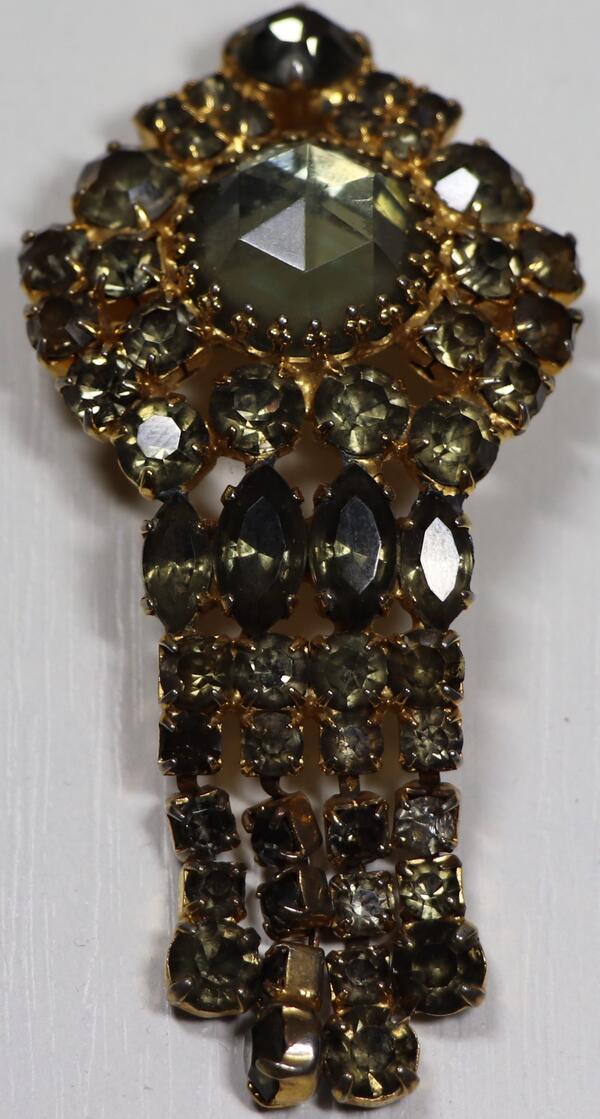
The exhibition features a glass brooch with suspensions — it was made at a factory in the 1960s–1970s. Four pendants are attached to the overlaid plate, in the center of the brooch there is a flower in a frame, bordered by two rows of smaller stones. The plate is decorated with an ornament of flattened wire forming an openwork pattern.
The dress and sleeves of a Tatar woman had to be long, the head had to be covered with a kalfak and a shawl, and on the chest there was usually a hand-made izyu — a cloth breastplate. This was the place for the brooch. The brooch was a gift from the husband and had a sacred meaning. The woman received such a brooch when she gave birth to a child, to commemorate a significant date, or as a sign of deep respect and love.
The history of the brooch is inextricably linked with the evolution of clothing. As soon as people began to cover themselves with cloth, they needed something to fasten it to the body, so initially the function of the brooch was exclusively practical. The brooch consisted of a needle, a needle holder and a case. When the most ancient brooch, the fibula, began to be made of metal, it became a symbol of the owner’s social status: poorer people wore bronze clasps, and wealthy people wore precious metals. The fibula was common from the Bronze Age to the early Middle Ages.
When people learned to sew pieces of fabric together, brooches ceased to be so necessary, but received a few additional properties. Firstly, they were used as decorations, not only for women’s outfits, but also for men’s. Secondly, they were a certain symbol of belonging to a group, clan, family, or profession. The widespread use of buttons and hooks had practically deprived the brooch of its utilitarian function, making it instead mainly a decorative item. Since then, a large number of variants of brooches have appeared, distinguished by the type of material and decorative techniques.
The exhibition features a glass brooch with suspensions — it was made at a factory in the 1960s–1970s. Four pendants are attached to the overlaid plate, in the center of the brooch there is a flower in a frame, bordered by two rows of smaller stones. The plate is decorated with an ornament of flattened wire forming an openwork pattern.
The dress and sleeves of a Tatar woman had to be long, the head had to be covered with a kalfak and a shawl, and on the chest there was usually a hand-made izyu — a cloth breastplate. This was the place for the brooch. The brooch was a gift from the husband and had a sacred meaning. The woman received such a brooch when she gave birth to a child, to commemorate a significant date, or as a sign of deep respect and love.