Font
Color
Graphics
Изображение точки

To see AR mode in action:

1. Install ARTEFACT app for iOS or Android;

2. Find the exhibition «History of My Land»

3. Push the «Augmented reality» button and point your phone's camera at the exhibit;

Скрыть точки интересаПоказать точки интереса
Показать в высоком качестве

Fibula brooch

Creation period
the late 19th — early 20th centuries
Place of сreation
Boturussky ulus, Yakutsk region, Russian Empire
Dimensions
8,8x3,5 cm
Technique
white metal; forging, riveting, casting, planar engraving, soldering, artisanal production
0
Open in app
#2

The history of the people is manifested, among other things, through their traditional crafts. Jewelry art which originates from blacksmithing has a special place in Yakut culture.

One of the most representative examples of the development of jewelry craftsmanship in Yakutia is the history of traditional women’s jewelry made of metal. One jeweler could make more than 40 different items from silver, as well as gold rings, earrings and bracelets.

Both ancient original forms and elements that date back to later periods were combined in Yakut jewelry, constituting harmonious sets. Thus, they were a mix of tradition and modernity.

The preservation of many archaic elements made metallic jewelry a characteristic ethnic feature of traditional Yakut costume in the 19th century.

Thus, the fibula brooch was common in the 19th century. It fastened the collar cut of a woman’s dress, and also served as an ornament for national clothing.

There are several types of such items found in museum collections, varying in both shape and style. Some brooches have a round shape and side protrusions. They consist of two or three parallel circles. Others are rectangular and slightly tapered towards the middle.

The brooch from the museum collection, also called “tiil timekh”, was made by Pavel Pavlov, a Sakha jeweler. Most likely, the piece was made to order.

This piece of jewelry is made up of three disks that are joined together. The two outermost plates slightly overlap the center plate.

The fibula is made by casting, forging and engraving. The craftsman was able to create an integral composition with a clear, simple, but non-standard ornament on a small piece. The carved pattern consists of concentric circles. In the middle of the rosette there is an engraved flower: on the outermost disks — with six petals, in the center — with four, and in the grooves of the latter there are rhombuses. The flowers on the two disks are bordered by an eight-pointed figure made of arcs.
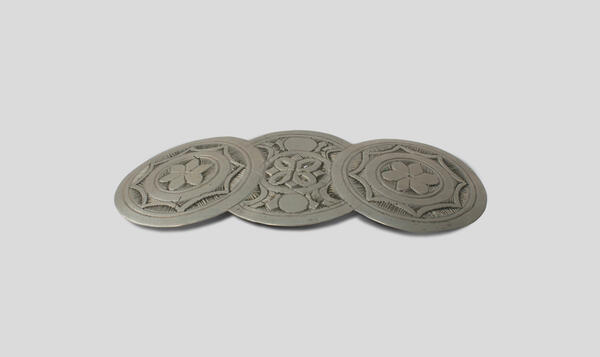
The shape of the brooch, as well as the circular lines of the pattern and the deep short touches of the chisel, which diverge on the circles with radiance, symbolize the sun.

#4
Fibula brooch
#3
View in the State Catalogue
read morehide
00:00
00:00
1x

Fibula brooch

Creation period
the late 19th — early 20th centuries
Place of сreation
Boturussky ulus, Yakutsk region, Russian Empire
Dimensions
8,8x3,5 cm
Technique
white metal; forging, riveting, casting, planar engraving, soldering, artisanal production
0
Point your smartphone camera to open in the app
Share
VkontakteOdnoklassnikiTelegram
Share on my website
Copy linkCopied
Copy
Open in app
To see AR mode in action:
  1. Install ARTEFACT app for 
  2. iOS or Android;
  3. Find and download the «Paintings in Details» exhibition
  4. Push the «Augmented reality» button and point your phone's camera at the painting;
  5. Watch what happens on your phone screen whilst you flip through the pictures.
 
We use Cookies
Cookies on the Artefact Website. We use cookies to ensure that we give you the best experience on our website. If you continue without changing your settings, we'll assume that you are happy to receive all cookies on the Artefact website. However, if you would like to, you can change your cookie settings at any time.
Learn more about useHide
Content is available only in Russian

X

Нашли опечатку?...

%title%%type%