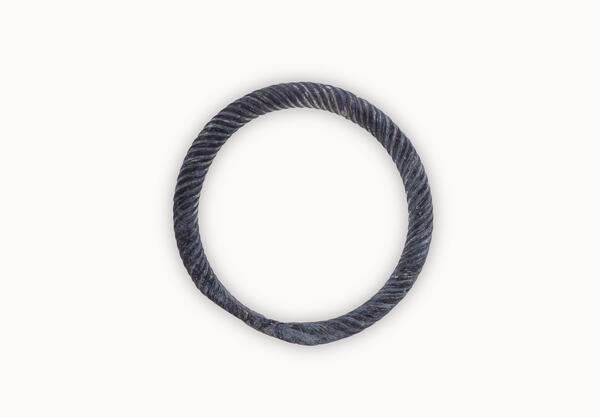
The Kursk Regional Museum of Archaeology keeps a twisted glass bracelet. It was found by the archaeologist Vladimir Vasilievich Enukov during the excavations of the ancient Russian settlement near the village of Lipino (Oktyabrsky district, Kursk region).
A young woman’s skeleton was found by archaeologists on the floor of a dwelling that burned down in the late 12th — early 13th centuries. She was probably trying to hide in the basement of the house during an enemy attack on the settlement. But the house caught fire, and the girl was buried under collapsed logs. Despite the fact that the enemy attack most likely took place on a weekday, archaeologists found bronze and glass bracelets on the bones of the skeleton’s hands. The woman kept them on even while she was going about her daily chores. There were four bracelets in total on her hands. On the left hand she had three twisted glass bracelets: purple (intact), brown and pinkish. The last two are heavily damaged. On the right hand there is a partially preserved bronze bracelet, twisted from three wires. An iron ferrule and a false twist bronze ring were found near the head of the victim.
In Old Russia bracelets were called “zapyastje” or “obruchje”. Glass bracelets in the form of solid hoops of smooth or twisted glass were very popular and are often found during excavations of ancient Russian cities. In rural areas they were less common — probably because of their fragility and frailty. The tradition of making glass bracelets came to Russia from Byzantium. Russian craftsmen usually used two types of glass: potassium-lead-silica glass in Kiev and lead-silica glass in Polotsk, Smolensk and Novgorod.
As a rule, Russian ornaments are painted in purple, turquoise, blue, yellow, green, and brown (olive) colors. Thanks to numerous finds of well-preserved intact bracelets in a number of mounds in Kiev, the Moscow region and on the territory of the Merya tribe who lived in the Upper Volga, scientists have been able to reconstruct the precise process of their manufacture. Without these findings, it would be impossible to determine the place and time of the production of these bracelets just by the shards. Most bracelets were made of a piece of rod drawn from the heated glass mass. It was then cut off and the ends were fastened. The seam formed in the place of fastening was often decorated with various ornaments.
A young woman’s skeleton was found by archaeologists on the floor of a dwelling that burned down in the late 12th — early 13th centuries. She was probably trying to hide in the basement of the house during an enemy attack on the settlement. But the house caught fire, and the girl was buried under collapsed logs. Despite the fact that the enemy attack most likely took place on a weekday, archaeologists found bronze and glass bracelets on the bones of the skeleton’s hands. The woman kept them on even while she was going about her daily chores. There were four bracelets in total on her hands. On the left hand she had three twisted glass bracelets: purple (intact), brown and pinkish. The last two are heavily damaged. On the right hand there is a partially preserved bronze bracelet, twisted from three wires. An iron ferrule and a false twist bronze ring were found near the head of the victim.
In Old Russia bracelets were called “zapyastje” or “obruchje”. Glass bracelets in the form of solid hoops of smooth or twisted glass were very popular and are often found during excavations of ancient Russian cities. In rural areas they were less common — probably because of their fragility and frailty. The tradition of making glass bracelets came to Russia from Byzantium. Russian craftsmen usually used two types of glass: potassium-lead-silica glass in Kiev and lead-silica glass in Polotsk, Smolensk and Novgorod.
As a rule, Russian ornaments are painted in purple, turquoise, blue, yellow, green, and brown (olive) colors. Thanks to numerous finds of well-preserved intact bracelets in a number of mounds in Kiev, the Moscow region and on the territory of the Merya tribe who lived in the Upper Volga, scientists have been able to reconstruct the precise process of their manufacture. Without these findings, it would be impossible to determine the place and time of the production of these bracelets just by the shards. Most bracelets were made of a piece of rod drawn from the heated glass mass. It was then cut off and the ends were fastened. The seam formed in the place of fastening was often decorated with various ornaments.