The architecture was designed in the style of Petrine Baroque, combining colorfulness with some restraint. The stone church belonged to the octagon-on-cube type: it had a quadrangle as the lower part and two tapering octagons as the upper part. It also had three altars and a refectory with two chapels.
In 1722, according to the clerical register of 1782, there were fifty courtyards at the church.
In 1803, a chapel in honor of the Nativity of the Theotokos was added to the left side of the Church of Saints Boris and Gleb (consecrated in 1805); in 1832, the central chapel was called the Theotokos Chapel, and the side one was consecrated in honor of Saints Boris and Gleb. The right chapel was consecrated in honor of St. John the Baptist. From a written source of the same year, it appears that “according to the clergy register… four people served there: a priest, a deacon, a sexton and a verger.”
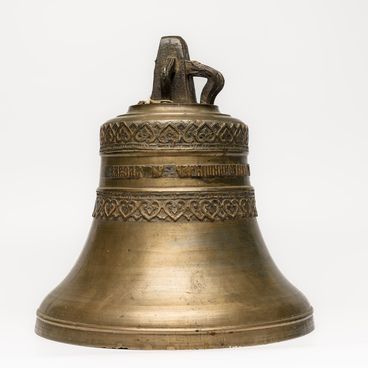
The inventory of 1848 allows us to visualize the appearance of the church: it was a brick building, whitewashed with yellow ocher, with an iron green roof and iron gilded crosses on a dome covered with an iron sheet; two domes of the chapels “are placed… one on the right side, the other on the left, they are covered with iron sheets and painted yellow.” Special mention is also made of an iron door and two wooden ones “with locks and latches”, and a bell tower with nine bells, a dome and a spire.
In 1852–1884, Alexander Alekseyevich Plotnikov, a merchant of the 1st guild, a generous donor, served as the head administrator of the church. Plotnikov’s mansion stood close to it. In 1902, the merchant Nikolay Dmitrievich Sokolov took over the duties, and for his service he was awarded, among other things, the silver St. Stanislav medal (December 1907).
In 1930, it was decided to demolish the church as it interfered with street traffic. Considering the value of the building as an architectural monument of the 18th century, the demolition was canceled, but the church was converted into a cinema. At the same time, the parish moved to the nearby Intercession Church. In the late 1940s, the building was destroyed.