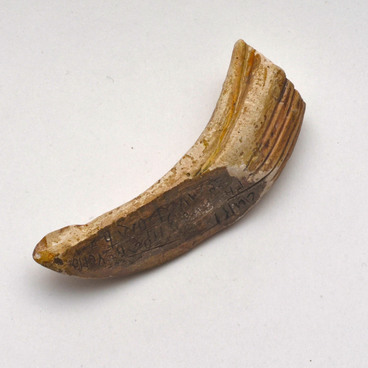
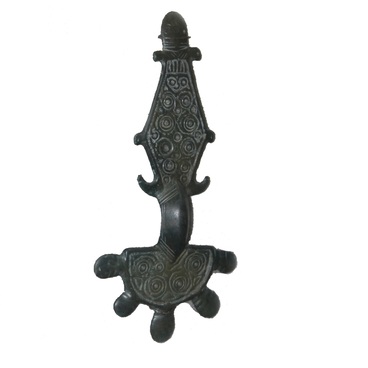
The tip of the crossbow arrow - the bolt - was found during excavations on Pokrovskaya Hill, in the historical center of Bryansk city. In the 12th century, a fortified settlement was located there. Here, archaeologists have also found ceramic vessels, glass jewelry, fragments of horse harness, knives, beads made of precious stones, a mouth harp and other objects belonging to different centuries.


#1
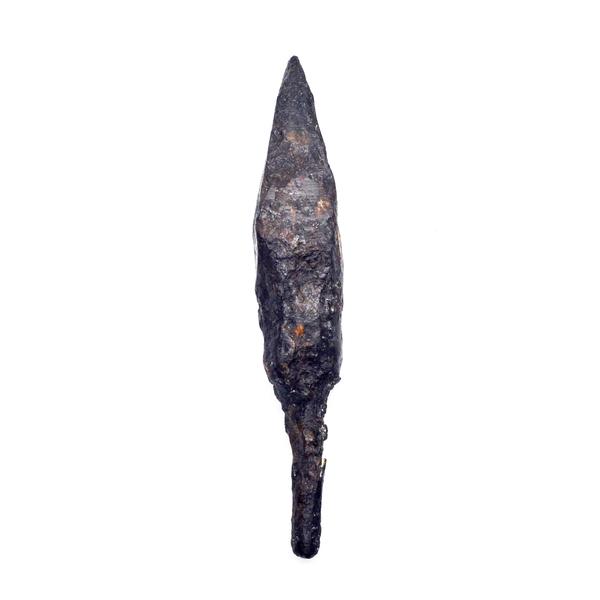
Crossbow bolt
#2
#3
In Russia, crossbows were called ‘self-shooters’. Such weapons replaced the traditional bow. The first annalistic references to crossbows date back to the middle of the 13th century. For example, the Ipatiev Chronicle says of the ancient city of Kholm:
#4
‘It is impossible to take this city, because boyars and people of kindness are in it who defend the city with catapults and crossbows’.
#5
Near the city of Izyaslavl, archaeologists found the oldest crossbow hook in Europe which was used to stretch the crossbow. Crossbows were expensive, so only wealthy warriors could afford them for armament.
#6
Crossbow arrows were called bolts. They had a short thick shaft and no fletching, as the flight path was set by the heavy forged tip. Crossbow bolt weighed more than an ordinary arrow, 18 to 50 grams. Its average length was 30 to 40 centimeters; some types of bolts could be longer.
Scientists dated the tip of the bolt discovered on Pokrovskaya Hill as belonging to the 14th century. It was forged from iron and rather roughly processed, receiving a tetrahedral shape, square in cross section. Such bolts could pierce ring armor shirts. Later, when plate armor appeared, the shape of the crossbow tips changed: they became diamond-shaped in cross section.
#8
Depending on the method of attachment to the shaft, crossbow bolts fell into two types: tanged and sleeve-like. The arrowhead from the Bryansk Antiquities collection belongs to the first type. It ends with a long stem which had to be hammered into a shaft, after which the joint was bandaged. By the end of the 14th century, such bolts were rarely used: they were replaced by sleeve tips that were mounted on a shaft and fastened to it with one or two nails.
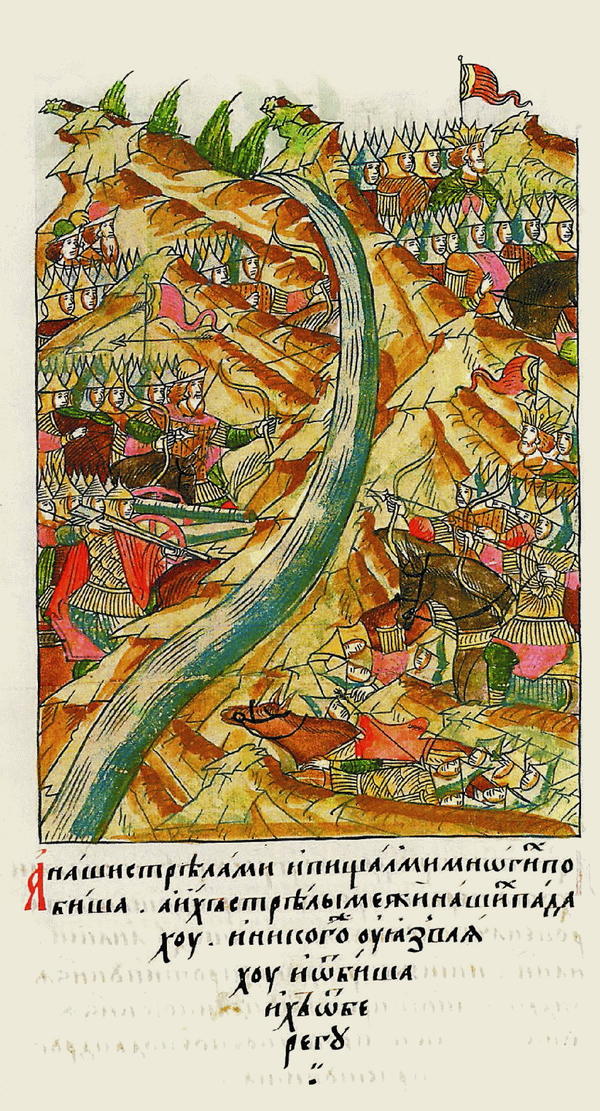
The warriors with the rossbows in Miniature in Russian chronicle. XVI century. Source: ru.wikipedia.org
#9
The length of the crossbow tip from Pokrovskaya Hill is 8 centimeters. These were usually made for hand-held crossbows. Stationary crossbows needed larger and heavier arrows.
#10
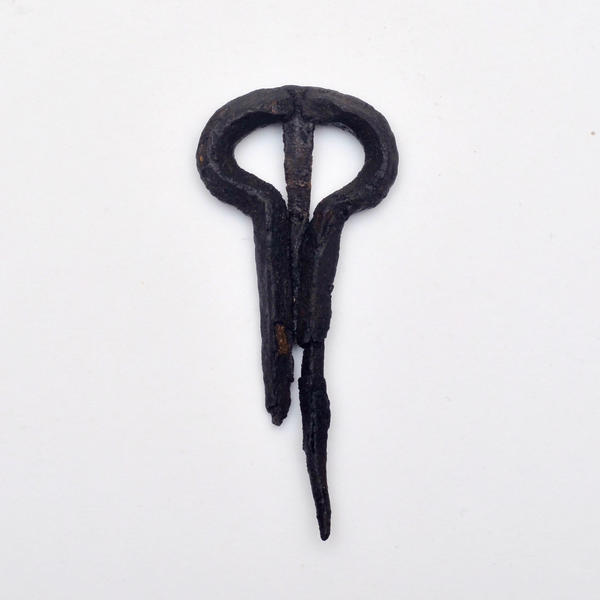
Vargan (mouth harp)
#11
The mouth harp is an ancient musical instrument of various peoples: the Yakuts, the Evenks, the Udmurts, the Chuvash, Mari people. It was often used for rituals, it was believed that the sound of the mouth harp could ward off evil spirits, cure diseases, lure animals for hunters or change the weather.
#12
Mouth harps were made from iron, cut from bones, wood or cane. Metal instruments were solid and lasted the longest; with their loud and pure sound, they often served ritual purposes. Wooden or bone mouth harps were used to play traditional songs and dance melodies, children used to play with them. Such instruments were brittle, so few of the earliest mouth harps made from these materials have survived to the present day.
The iron mouth harps were of three types, depending on the technique of their manufacturing: some were wrought in the required shape, in others, half-wrought, a pre-made blank was then shaped into the instrument, still others were bent from a thick metal wire.
#13
The mouth wrap consisted of a U-shaped frame that looked like a horseshoe with extended ends and a flexible steel tongue in the middle. Musicians would grasp the frame’s ends with their lips and pull the harp’s tongue with their fingers to the rhythm. The loudness and pitch of the sound depended on the breath and lips position: compressed or semi-opened. Most often, the mouth harp would be played solo, but sometimes it was accompanied by a flute, spoons, or other musical instruments. People also used to sing along without word, mouthing a melody. This was called ‘singing to the tongue music’.
#14
The frame for the mouth harp which is displayed in the Bryansk State Regional Ethnography Museum was forged from a single piece of iron. Its tongue was cast separately and then welded to the finished frame. At its root, there is a connecting weld.
#15
Archaeologists have only found two instruments like this in the Bryansk region. One of them, manufactured in the 12th century, was discovered at the excavation site of the Old Russian city of Vschizh. The other one, displayed in the Bryansk Antiquities collection, was found in 1971 at the Pokrovskaya Gora settlement site in Bryansk. That harp was made more recently - in the 13th or 14th century.
Both musical instruments are fairly well preserved. The Vschizh harp suffered from corrosion on the extended ends of the frame, while the Bryansk one had its steel tongue damaged. The museum’s restoration artists have cleaned it from corrosion and treated it with a special substance to protect the material from further corrosion.
#16
Bryansk State Regional Ethnography Museum, a State budgetary cultural institution
read morehide
00:00
00:00
1x
Crossbow bolt, Vargan (mouth harp)
Creation period
XIII–XIV века
Collection
Exhibition
0
 Point your smartphone camera to open in the app
Open in app
Share