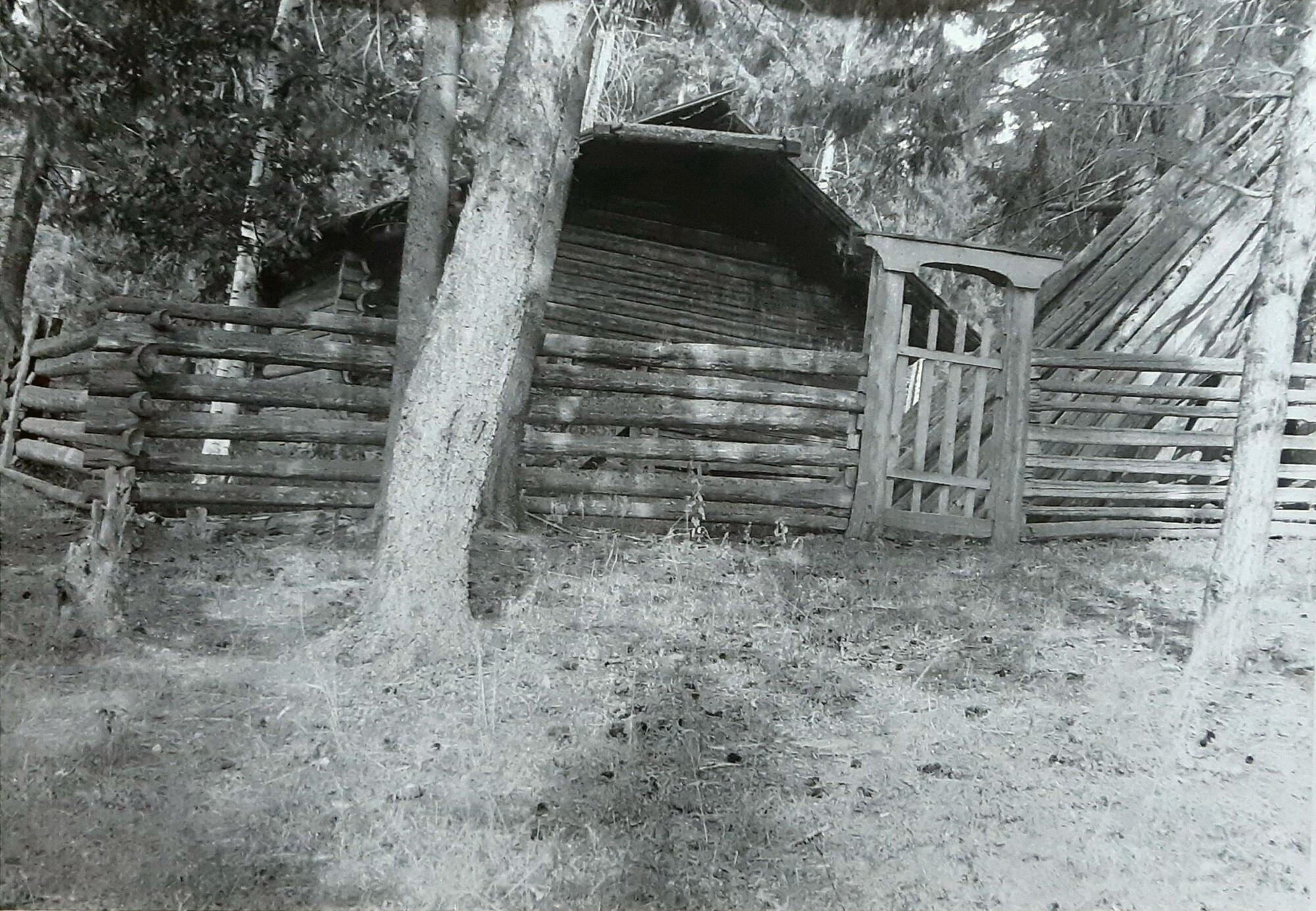


Family and clan cults played an important role in the pagan beliefs of the Udmurts. They were displayed in the cult of vorshud: it was a family sacred place, a guardian of the family. The Udmurts believed that vorshud lived in a kuala. Kuala could be large for a tribal community called Bydzym Kuala, or a small one for a family called Pokchi Kuala. They were the same in appearance but different in size. A kuala was a log construction with a gable roof. Slopes of the roof were not tightly connected. The gap between them served as a smoke flap. One could enter through a low door. There were no windows in the structure.
Three or four prayers were annually held in the family kuala: on Easter (Bydzym Nunal), the Feast of Saints Peter and Paul, and Pokrov Day. Only then, people were allowed to enter the kuala, so the ceremony was called kuala pyron, i.e. entering the kuala. The longest prayer lasted almost a week. It was held in fall, on Pokrov Day (October, 14). The head of the family with his wife held the ceremony in a family kuala, while an elected priest, called Vasyas' (verbally ‘a man who prays’) held the ceremony in the tribal kuala. He was elected for 12 years, or even for a lifetime. The priest’s mandatory attributes were a headdress and birch branches descending from the shoulders.
The prayers were attended by taro, a man respected by everyone in a family. Taro did not participate in the prayer, but the ceremony could not take place without him. The priest’s wife sewed ritual towels and tablecloths, decorated the kuala with fresh branches, baked bread, and cooked kumyshka (home-made alcoholic drink) for the prayer. In the late 1920s - early 1930s, people visited the village kuala twice a year: in spring before the field work (gery potton) and in winter, during the Christmastide (tol vozho).
Together with vorshud, sacred objects in the kuala were the hearth and the chain hanging over it. If some family members resettled, they took a portion of the ashes and three stones from the hearth in the old kuala. Sometimes they planed off a few chips from the hook above the hearth and took them to a new place. At present, one can see a family kuala of the Udmurts in the ‘Ludorvay’ Architectural and Ethnographic Museum Preserve.
Christianity appeared the northern regions of Udmurtia back in the 13th century. However, the local population could not fully accept it because of incomprehensible rituals of baptism, reading of long and difficult prayers, and lack of knowledge of the language of the church service. Therefore, the majority of the population remained pagans for a long period of time. But it was typical for the northern part, where the influence of Russia was strong.
The southern part of Udmurtia was under the Turki influence for a long time, until the defeat of the Khanate of Kazan in 1552. The Udmurts that were a part of Volga Bulgaria, experienced particular religious pressure. However, they were so devoted to paganism that they did not change their faith even under the strong pressure of Islam. The first recorded case of baptism took place only in 1557. Then Ivan the Terrible granted privileges to 17 baptized Udmurt families.
Three or four prayers were annually held in the family kuala: on Easter (Bydzym Nunal), the Feast of Saints Peter and Paul, and Pokrov Day. Only then, people were allowed to enter the kuala, so the ceremony was called kuala pyron, i.e. entering the kuala. The longest prayer lasted almost a week. It was held in fall, on Pokrov Day (October, 14). The head of the family with his wife held the ceremony in a family kuala, while an elected priest, called Vasyas' (verbally ‘a man who prays’) held the ceremony in the tribal kuala. He was elected for 12 years, or even for a lifetime. The priest’s mandatory attributes were a headdress and birch branches descending from the shoulders.
The prayers were attended by taro, a man respected by everyone in a family. Taro did not participate in the prayer, but the ceremony could not take place without him. The priest’s wife sewed ritual towels and tablecloths, decorated the kuala with fresh branches, baked bread, and cooked kumyshka (home-made alcoholic drink) for the prayer. In the late 1920s - early 1930s, people visited the village kuala twice a year: in spring before the field work (gery potton) and in winter, during the Christmastide (tol vozho).
Together with vorshud, sacred objects in the kuala were the hearth and the chain hanging over it. If some family members resettled, they took a portion of the ashes and three stones from the hearth in the old kuala. Sometimes they planed off a few chips from the hook above the hearth and took them to a new place. At present, one can see a family kuala of the Udmurts in the ‘Ludorvay’ Architectural and Ethnographic Museum Preserve.
Christianity appeared the northern regions of Udmurtia back in the 13th century. However, the local population could not fully accept it because of incomprehensible rituals of baptism, reading of long and difficult prayers, and lack of knowledge of the language of the church service. Therefore, the majority of the population remained pagans for a long period of time. But it was typical for the northern part, where the influence of Russia was strong.
The southern part of Udmurtia was under the Turki influence for a long time, until the defeat of the Khanate of Kazan in 1552. The Udmurts that were a part of Volga Bulgaria, experienced particular religious pressure. However, they were so devoted to paganism that they did not change their faith even under the strong pressure of Islam. The first recorded case of baptism took place only in 1557. Then Ivan the Terrible granted privileges to 17 baptized Udmurt families.