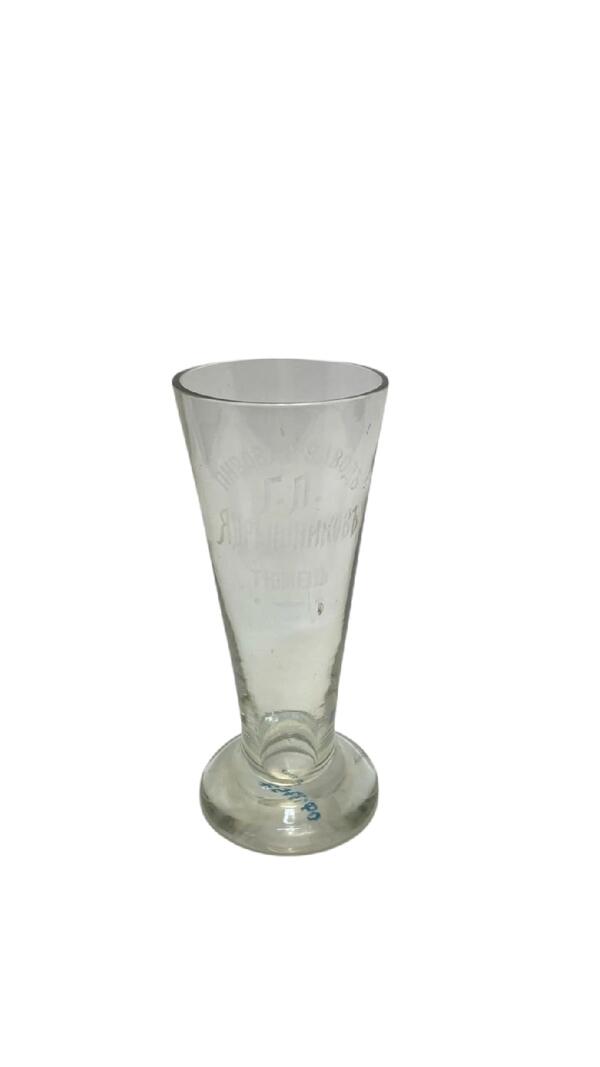
This beer glass was most likely made at the plant of artificial mineral and fruit waters of Grigory Petrovich Yadryshnikov in Tyumen.
Grigory Petrovich was a hereditary merchant. His father, Petr Grigoryevich Yadryshnikov, was a merchant of the 1st guild and produced cloth. And his younger son Grigory was engaged in the production of mineral and fruit waters and brewing. Together with Shitov, Grigory Petrovich organized the partnership “Shitov and Yadryshnikov” and received permission from the city council to build a brewery “provided that devices would be arranged according to the instructions of the specialists that would ensure the cleanliness of the outside air and all factory sewage before pouring it into the river.”
The deputies of the city council were worried about the waste from the plant, since the water intake location was downstream. They demanded, “that the descent of water from the malt house into the Tura River would not cause the river bank failure, and would not spoil the water obtained from city reservoirs for public use. In case of damage to the shore, the partnership is obliged to fix it at its own expense.” Grigory Petrovich and A. Shitov, the manager of the trading house, gave an explanation: “Brewer’s spent grain will be used to feed the cattle, water from the malt house will pass through a filter pit, and only then enter the river, and scrap glass will be collected in boxes and sent to the glass factory. The room with the fermenting vet will be made from bricks.”
The plant was built on Irkutskaya (now Chelyuskintsev) Street, and in 1914 beer shops were set up on Vodoprovodnaya and Tomskaya streets (now Osipenko). Perhaps this glass was purchased in one of these shops. The plant was small, but profitable, as evidenced by the documents: “The annual productivity was 31,560 rubles, there are 10 workers and a horse-power.” Water for production was taken from wells near the Voynovka River and Gilevskaya grove.
After the revolution, in 1919, Yadryshnikov’s brewery was nationalized and renamed NEP No. 2.
Grigory Petrovich was a hereditary merchant. His father, Petr Grigoryevich Yadryshnikov, was a merchant of the 1st guild and produced cloth. And his younger son Grigory was engaged in the production of mineral and fruit waters and brewing. Together with Shitov, Grigory Petrovich organized the partnership “Shitov and Yadryshnikov” and received permission from the city council to build a brewery “provided that devices would be arranged according to the instructions of the specialists that would ensure the cleanliness of the outside air and all factory sewage before pouring it into the river.”
The deputies of the city council were worried about the waste from the plant, since the water intake location was downstream. They demanded, “that the descent of water from the malt house into the Tura River would not cause the river bank failure, and would not spoil the water obtained from city reservoirs for public use. In case of damage to the shore, the partnership is obliged to fix it at its own expense.” Grigory Petrovich and A. Shitov, the manager of the trading house, gave an explanation: “Brewer’s spent grain will be used to feed the cattle, water from the malt house will pass through a filter pit, and only then enter the river, and scrap glass will be collected in boxes and sent to the glass factory. The room with the fermenting vet will be made from bricks.”
The plant was built on Irkutskaya (now Chelyuskintsev) Street, and in 1914 beer shops were set up on Vodoprovodnaya and Tomskaya streets (now Osipenko). Perhaps this glass was purchased in one of these shops. The plant was small, but profitable, as evidenced by the documents: “The annual productivity was 31,560 rubles, there are 10 workers and a horse-power.” Water for production was taken from wells near the Voynovka River and Gilevskaya grove.
After the revolution, in 1919, Yadryshnikov’s brewery was nationalized and renamed NEP No. 2.