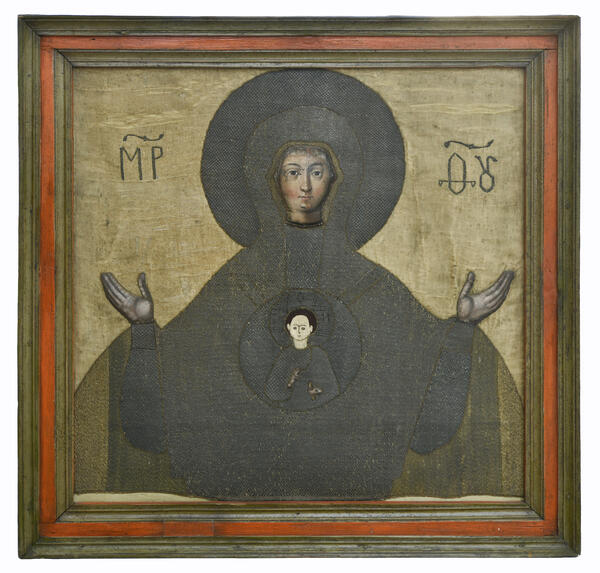
The icon ‘Our Lady of the Sign’ in the collection of the Bishop’s House comes from the Ioanno-Vvedensky Convent. The image belongs to the traditional iconographic type “Oranta” or “Praying”. According to this canon, the Virgin was depicted half-length, with her hands raised in prayer and her palms open. Christ is painted on the chest of the Blessed Virgin in a round medallion. He is depicted not as a baby, like on other icons, but as a child older than seven years. This iconographic type was called “Emmanuel” — from the Hebrew expression, which translates as “God is with us”. One of His hands is raised in a blessing gesture, and he holds a scroll in the other.
The upper edge of the icon is made of golden-brown satin fabric. On it, on either side of the figure of the Mother of God, letters are embroidered — abbreviations from the Greek words for “Mother of God”. There are titlos above the letters — curved diacritical marks, with which abbreviations were indicated in Church Slavonic texts.
The halos and robes of Christ and the Virgin are made in the gold embroidery technique. Nuns (mainly of noble descent) were skilled craftswomen who excelled at this ancient needlework technique. They embroidered elements of icons, priestly vestments, temple curtains, and bookmarks for the Gospel with gold and silver threads. The training period lasted for about seven years. The craftswomen used metalized threads, as well as pearls, semi-precious stones, and webbing in their work.
The Ioanno-Vvedensky Convent, where the icon was made, appeared in the middle of the 17th century and became famous far beyond the borders of Siberia for its gold-sewing and art workshops. Canonical dresses were made in it, church flags and shrouds were embroidered, icons were painted and valuable icon settings were made for them.
The upper edge of the icon is made of golden-brown satin fabric. On it, on either side of the figure of the Mother of God, letters are embroidered — abbreviations from the Greek words for “Mother of God”. There are titlos above the letters — curved diacritical marks, with which abbreviations were indicated in Church Slavonic texts.
The halos and robes of Christ and the Virgin are made in the gold embroidery technique. Nuns (mainly of noble descent) were skilled craftswomen who excelled at this ancient needlework technique. They embroidered elements of icons, priestly vestments, temple curtains, and bookmarks for the Gospel with gold and silver threads. The training period lasted for about seven years. The craftswomen used metalized threads, as well as pearls, semi-precious stones, and webbing in their work.
The Ioanno-Vvedensky Convent, where the icon was made, appeared in the middle of the 17th century and became famous far beyond the borders of Siberia for its gold-sewing and art workshops. Canonical dresses were made in it, church flags and shrouds were embroidered, icons were painted and valuable icon settings were made for them.
Finished products were most often sold at the Irbit Fair, one of the largest in the Russian Empire. Sometimes the monastery received private orders for high-ranking nobles. In 1891, when Cesarevitch Nikolai Alexandrovich visited Tobolsk, he was presented with a gold-embroidered image of the Pochaev Mother of God.