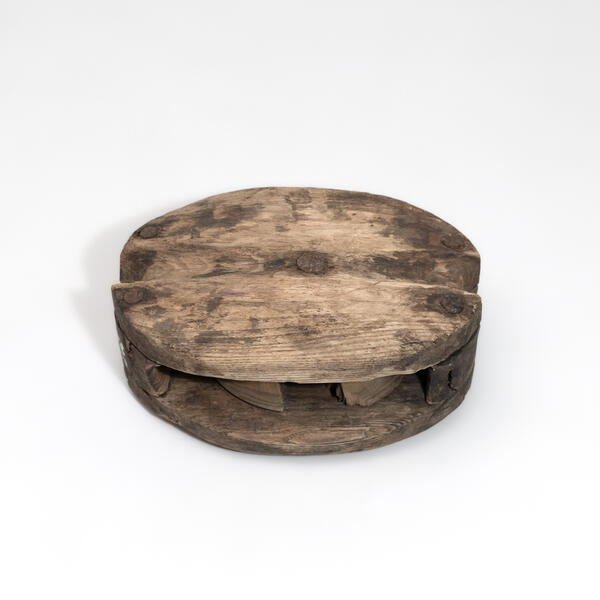
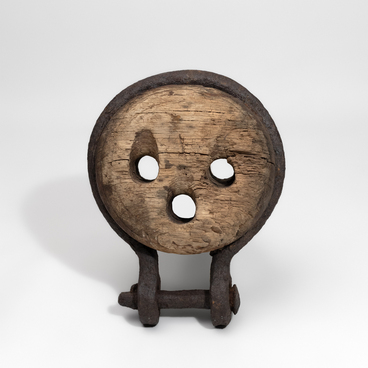
This wooden block with a pulley for lifting weights was made in the early 20th century. The oval-shaped block has a groove to locate the rope. The museum exhibit originated from the Kirillovskaya village in the Onega Uyezd of the Arkhangelsk Governorate.
The size of wooden blocks was determined by the length of their cheeks in inches, while the size of metal ones was dependent on the diameter of the pulley. If a pulley was made of wood, sturdy timber was typically used. To prevent wooden pulleys from breaking, a copper sleeve was inserted in the middle.
A pulley is a wheel mounted on an axle or shaft enabling a cable or belt to move and change direction while transferring power between the axle and the cable. The sheave of the pulley may feature a groove or grooves to locate the cable or belt. The drive element of a pulley system can be a rope, cable, belt, or chain.
Pulleys are assembled to form a block and tackle in order to reduce the effort needed to lift heavy loads. A block is a set of pulleys (wheels) assembled so that each pulley rotates independently from every other pulley. Two blocks with a rope attached to one of the blocks and threaded through the two sets of pulleys form a block and tackle.
A block and tackle is assembled so one block is attached to the fixed mounting point and the other is attached to the moving load. The simplest theory of operation for a pulley system assumes that the pulleys and lines are weightless and that there is no energy loss due to friction. In equilibrium, the forces on the moving block must sum to zero. In addition, the tension in the rope must be the same for each of its parts. This means that the two parts of the rope supporting the moving block must each support half the load.
The earliest evidence of pulleys dates back to Ancient Egypt in the Twelfth Dynasty (1991–1802 BCE) and Mesopotamia in the early 2nd millennium BCE. Plutarch’s Parallel Lives recounts a scene where Archimedes proved the effectiveness of compound pulleys and the block-and-tackle system by using one to pull a fully laden ship towards him as if it was gliding through water.