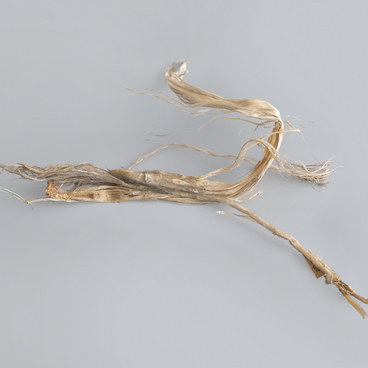
The tag with numbers presented in the exhibition is part of reindeer herding gear. The Sami used such tags to keep track of the reindeer herd.
At the end of the 19th — early 20th century, the total number of animals did not exceed 50. The herds did not move more than 200 kilometers on average, and they changed from two to four pastures per year. The reindeer husbandry of the Kola Sami people had a special aspect: unlike the Nenets, for example, they did not live near their herds.
It was also established that the herding of large numbers of animals ran counter to the tradition of Sami reindeer husbandry, which was based on free grazing of reindeer. The free grazing (pust chuedz — free herd) means that the reindeer herder limited his care for the herd to the gathering period in the fall, supervision in the winter, and participation in the calving period in the spring. After calving, the reindeer, as the Sami put it, were “set free” and were on their own throughout the summer.
Large-scale reindeer husbandry among the Sami began to emerge in the early 20th century under the strong influence of the Izhma-Komi reindeer herders who came from the Pechora basin. Many farms owned less than ten reindeer. However, the number of animals increased to 25 thousand already in 1891 and to 41 thousand animals in 1909.
The situation with reindeer husbandry became clearer when the first cooperative reindeer herding societies were established in 1927, and collective farms from 1929. By 1940, the Sami population was organized into 11 collective farms, and the first state-owned farms were created: the Ponoy Reindeer State Farm and the Murmansk Zonal Experimental Reindeer Herding Station.
The counting of reindeer took place in a special enclosure, which has two separate names in the Kildinsky dialect — “yurrk” and “karall”. There is also the phrase “puaz logkem sayi”, which means “reindeer counting place”.
According to the Murmansk “Polarnaya Pravda”, by 1934, the Sami people had already used a Latin-based writing system for three years, partially replacing “earmarks”, “ushepyatna”, “tags” and “keikola”.
The presented tag entered the museum in 1928.