#1
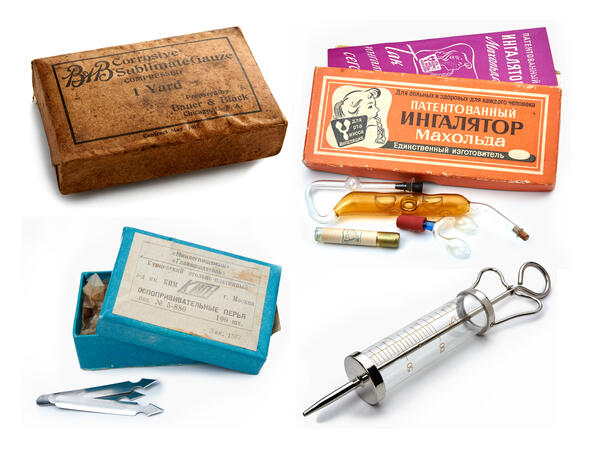
Bandages, Inhaler, Vaccination pen, Janet’s syringe
#2
#3
#4
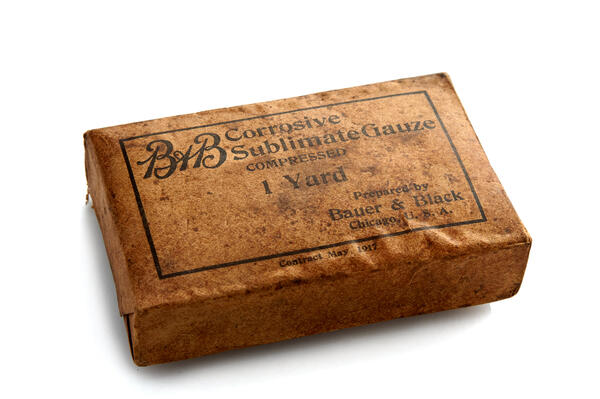
Corrosive sublimate is mercury chloride, a poisonous white powder. The bandages with corrosive sublimate presented in the exhibition were made in the American company ‘Bauer and Black’ in 1917. Such bandages could be found in a military doctor’s belt kit among other medicines and medical instruments. They were kept in a cardboard box, which was covered with a layer of paraffin. The paraffin protected the contents from moisture. Each package contained two bandages 50 cm long. It was the dressing material that was used in the most severe cases of injury during the First World War.
The word ‘bandage’ comes from the German binde — ‘bandage’. In ancient Egypt, healers used clean strips of bleached canvas soaked in medicinal compositions, including honey, oils, wine, and resins obtained from frankincense and myrrh, to treat wounds. Hippocrates recommended using a cloth that easily absorbs liquid, as a dressing material. In ancient Rome, thin plates made of various metals and alloys were used for dressing wounds, but with the obligatory presence of copper in the composition. The Romans believed that copper stops the blood. Medieval doctors made bandages with almond and olive juice, turpentine, herbal infusions for better healing. They also used lard, freshly removed skin, cobwebs, urine, and animal droppings.
In the 18th century, doctors noticed that, unlike dense fabrics, light cotton fabrics absorbed liquids faster. So thin and expensive ‘bandages’ came into use. Gauze, from which modern bandages are made, appeared at the end of the 18th century. Gauze is called ‘marlya’ in Russian — the name comes from the French ‘marli’, which means ‘muslin’ — a thin airy fabric. Initially, the gauze served only as a bed-curtain. But soon doctors appreciated its absorbent properties. By the middle of the 19th century, a Russian military surgeon Nikolai Pirogov began using bandages soaked in a solution of phenylic acid according to the method of the English surgeon Joseph Lister.
The bandages presented in the exhibition are soaked in toxic poison. For a long time, drugs made based on mercury were not considered dangerous for people. It was added to ointments for various skin diseases treatment. In the late 19th — early 20th centuries, it was considered an indispensable tool for the treatment of syphilis. Doctors also offered their patients steam baths: inhaling mercury vapor was considered the best way to treat it. In Russia, mercury-based medicines were actively used in homeopathy for the treatment of eye diseases, diseases of the digestive tract, and tumors. Mercury-based drugs were given to babies as an analgesic for teething.
#5
Full name: Box with the inscription “Corrosive sublimate gauze compressed”
Date: 1917
Technique: printing (b/w)
Place: Chicago
Copyright: Tula Historical and Architectural Museum
Dimensions: 4,5×8×1,5 cm
Date: 1917
Technique: printing (b/w)
Place: Chicago
Copyright: Tula Historical and Architectural Museum
Dimensions: 4,5×8×1,5 cm
#6
Makhold’s Inhaler
#7
#8
Inhalation (from the Latin inhalo — ‘inhale’) — this is a method of administering medicines through the respiratory tract. One can use gas, vapor, or smoke. Inhalation can be natural — at sea resorts, in the forest — and artificial, with the use of special devices — inhalers. This method of treatment was used even in the distant past. The ancient Roman physician and philosopher Galen first described the benefits of sea air containing salt particles. Mint and eucalyptus vapors were popular means for inhalation at that time as well.
The first pressurized inhaler was created much later — in 1858 in France. In it, the manual pump worked on the principle of a bicycle pump. Then, an inhaler with a steam drive was invented in Germany. A blast of steam was a source of energy for the operation of the device, and it was used to treat tuberculosis patients with resins and antiseptics. Of course, such inhalers were bulky and not very convenient. In the 1930s, a professional glassblower Oskar Makhold from Germany created a portable inhaler to improve the functioning of the respiratory system and prevent the diseases, because the lungs are a working tool of a glassblower.
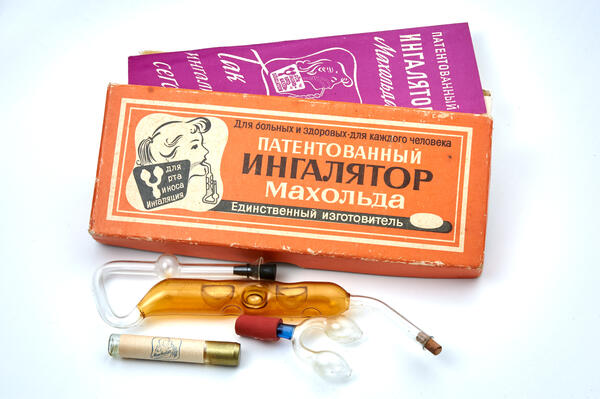
In configuration Makhold’s inhaler is similar to a small saxophone, only instead of keys it has an expansion tube, and instead of a bell from which the sound comes, there is a funnel for supplying medicinal brew. The design of Makhold’s inhaler is simple and therefore easy to operate.
Oskar Makhold received the patent in 1932, and almost 20 years later, in 1954, his son Walter founded the company in Thuringia. Together with his brother Kurt, he finalized the design of the inhaler: it was possible now to use both herbal infusions, and essential oils with it. The company still exists today, it is managed by the third generation of Makholds. Today, such inhaler is produced by many enterprises. Just like 100 years ago, each inhaler is blown by a master glassblower manually from heat-resistant impact-resistant glass. The package consists of an inhaler, an adapter for breathing through the nose, several capsules with essential oils, and a pipette. It is also used for aromatherapy. Makhold’s invention can still be purchased in pharmacies.
#9
Full name: Makhold’s Inhaler
Date: 1972
Technique: combined
Place: Frankenhain
Copyright: Tula Historical and Architectural Museum
Dimensions: 2,5×8×19 cm
Date: 1972
Technique: combined
Place: Frankenhain
Copyright: Tula Historical and Architectural Museum
Dimensions: 2,5×8×19 cm
#10
Vaccination pen
#11
#12
Natural smallpox, also called pox, is a very contagious viral disease with a mortality rate of about 30%. In the 19th century, it was one of the most common diseases in Europe. Every year, smallpox claimed tens of thousands of human lives and until the end of the 18th century remained the cause of 8-20% of all deaths in European countries. The survivors were left with deep scars from pocks. Often the disease led to blindness. ‘From smallpox, as well as from love, only a few people survive, ’ said an old German proverb.
In the 18th century, it was noticed that people who had had less severe cowpox were immune to smallpox. On May 14, 1796, Edward Jenner inoculated James Phipps with cowpox — the eight-year-old son of his gardener — and documented this fact. Then Jenner infected the boy with smallpox more than 20 times, but he never got sick. Thus, the effectiveness of vaccination was proved. The word ‘vaccine’ itself comes from the Latin ‘vacca’ — ‘cow’.
When in 1768, another smallpox epidemic broke out in Russia, Catherine II, contrary to the persuasions of courtiers and advisers, invited the famous English vaccinator, Dr. Thomas Dimsdale. He successfully vaccinated the Empress and the heir to the throne, Pavel Petrovich, the future Emperor Paul I, with pox. For his good work, Dimsdale was awarded the title of baron.
Despite the positive effect of vaccinations, both in Russia and in Europe, the procedure was treated with caution. In Russia, smallpox committees were created, in which teachers and midwives were told how to vaccinate, and were also kept records and registration of vaccinated people. However, the common people considered vaccination a sin, and the scar left on the hand was the seal of the Antichrist. Mainly pupils of orphanages and cadet corps got vaccinated.
On April 10, 1919, the Council of People’s Commissars adopted a decree ‘On mandatory smallpox vaccination’. By the middle of the 20th century, the USSR practically got rid of the deadly disease. The outbreak of the smallpox epidemic in Moscow in the 1959–60-s, when the virus was imported from India, prompted the Soviet delegation at the next session of the World Health Assembly to give the smallpox vaccine to 45 countries of the world.
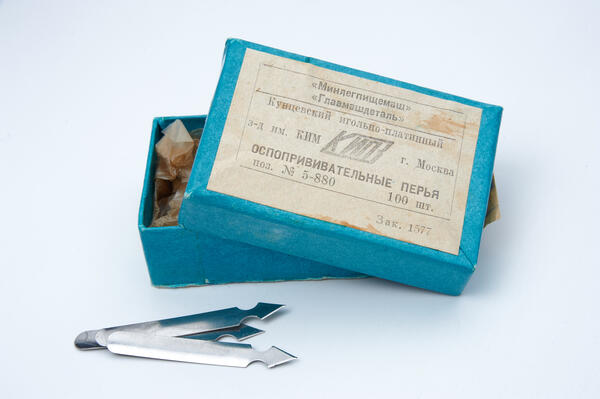
The exhibition presents a set of smallpox vaccination pens. During vaccination, the skin was first wiped with alcohol, then a few drops of the vaccine were applied, and then incisions were made with a dry pen directly through the droplets. Then the vaccine was rubbed in and left to dry.
#13
Full name: Vaccination pen
Date: 1971
Technique: plant production
Place: USSR
Copyright: Tula Historical and Architectural Museum
Dimensions: 2×7×5 cm
Date: 1971
Technique: plant production
Place: USSR
Copyright: Tula Historical and Architectural Museum
Dimensions: 2×7×5 cm
#14
Janet’s syringe
#15
#16
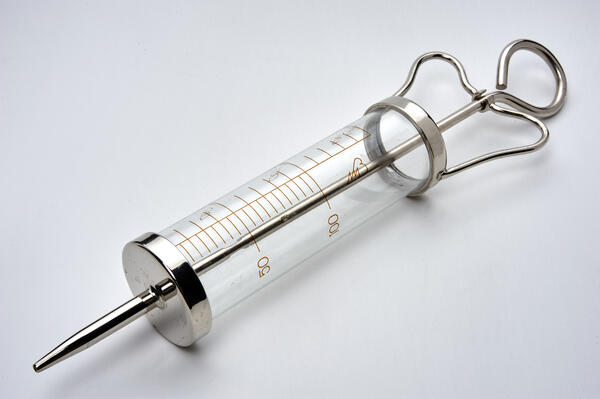
The exposition of the Tula Historical and Architectural Museum presents one of the few syringes that are not intended for injection. It was designed by the French psychologist and psychophysiologist Pierre Marie Felix Janet.
Pierre Janet was born in 1859. He graduated from the University of Paris, where, like Sigmund Freud, he studied in the group of the famous psychiatrist of that time Jean Martin Charcot. At first, Janet worked in Le Havre, then moved to Paris. Since 1890, he headed the psychological laboratory at the Salpetriere Hospital in Paris. Two years later, he defended his dissertation ‘The mental state of hysterics’, and in 1898 began teaching at the Sorbonne. In 1904, Janet founded the ‘Journal of Normal and Pathological Psychology’ — one of the leading publications on psychology in France. In 1936, he was awarded an Honorary Doctorate from Harvard University. Janet died of a serious illness in 1947 and was buried nine kilometers from Paris, in the city of Bourg-la-Reine.
The medical device developed by Janet has a large volume — from 150 to 500 milliliters — and is the largest syringe of all existing ones. It is used for irrigation. For example, in otolaryngology, Janet’s syringe is used to treat tonsils and ear passages. With its help, nutritional mixtures and solutions are administered into the body if a person cannot eat properly. At home, Janet’s syringe can be used for quick and accurate rinsing of abrasions and deep scratches.
Janet’s syringe can be both disposable and reusable. Disposable ones are made of a special kind of plastic. It is easily disposed of by remelting. Reusable syringes, where strength and neutrality to infections are especially important, are made of special glass. Such a syringe is to be sterilized after each application.
Janet’s syringe also appeared in movies. Thus, in the ‘The Caucasian Captive’ film, with its help, one of the heroes named Byvaly (Experienced) is allegedly given an intramuscular injection. The idea of using a large syringe on the set was suggested by actor Yuri Nikulin, who brought it from the circus. In reality, injections are not made with such syringes.
#17
Full name: Janet’s syringe for irrigation in the package
Date: the 1970s
Technique: combined
Place: Moscow
Copyright: Tula Historical and Architectural Museum
Dimensions: 27×5×5 cm
Date: the 1970s
Technique: combined
Place: Moscow
Copyright: Tula Historical and Architectural Museum
Dimensions: 27×5×5 cm
#18
Ministry of Culture of the Russian Federation
read morehide
00:00
00:00
1x
Bandages,Inhaler,Vaccination pen,Janet's syringe
Exhibition
0
 Point your smartphone camera to open in the app
Open in app
Share