#23
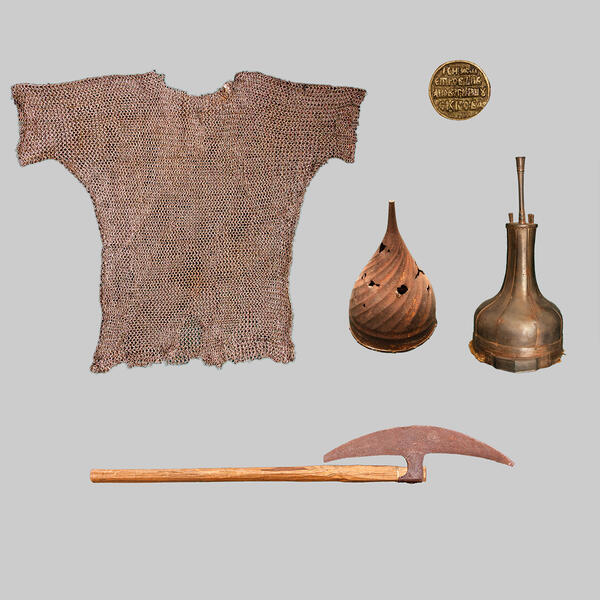
Berdiche, helmets, chain mail, sign
#2
#3
#4
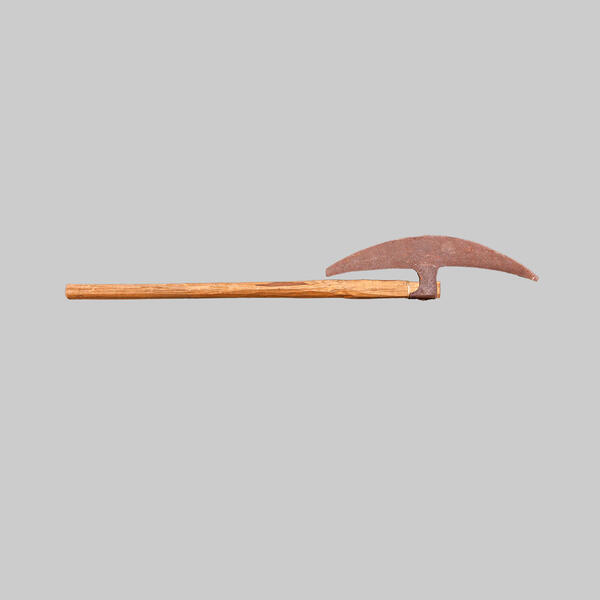
In the 16th–17th centuries, an important element of the Russian soldiers’ weaponry was berdiche. This is a broad-bladed battle axe with an elongated month-like cloth, which was mounted on a wooden shaft (in some sources it is called a “spear staff”). The length of the shaft was about 2 sazhens, which is about one and a half meters, when converted to modern measures of length. In the lower part, the blade evolved into a metal plate-string, which was either tied to the shaft or nailed. Thus, the axe was double-fastened to the spear staff — by a “string” and a lug. The sample presented in the exhibition of the Tobolsk Museum Reserve does not have a string, obviously it was lost.
The main number of berdiches was produced in the European part of the Muscovy, from there they were already distributed on weapons of various types of troops — streltsy, soldiers, dragoons and militia members.
These weapons were imported to Siberia, historians do not know about the existence of any major center for the production of berdiches beyond the Urals – there is no accurate data on their manufacture in local forges. But there was a mass production in European Russia, while berdiches were produced by both city and village blacksmiths, and specially trained craftsmen at Tula and Kashir factories. For example, in the documents of the 17th century gunsmiths-professionals “blacksmiths of berdiches” were mentioned.
However, weapons were not delivered yet beyond the Urals systematically and regularly. Because of that, there was a situation of uneven distribution of berdiches across the Siberian garrisons. According to written sources, their number could reach several hundreds in some arsenals, and in others they were not even available. A berdiche was probably not the most convenient “camping” weapon, it could only be used effectively in personal combat with the enemy on foot, in the defense of cities and ostrogs. For that very reason berdiches were needed most in the taiga regions of Western and Central Siberia, as well as when defending the fortresses.
The main number of berdiches was produced in the European part of the Muscovy, from there they were already distributed on weapons of various types of troops — streltsy, soldiers, dragoons and militia members.
These weapons were imported to Siberia, historians do not know about the existence of any major center for the production of berdiches beyond the Urals – there is no accurate data on their manufacture in local forges. But there was a mass production in European Russia, while berdiches were produced by both city and village blacksmiths, and specially trained craftsmen at Tula and Kashir factories. For example, in the documents of the 17th century gunsmiths-professionals “blacksmiths of berdiches” were mentioned.
However, weapons were not delivered yet beyond the Urals systematically and regularly. Because of that, there was a situation of uneven distribution of berdiches across the Siberian garrisons. According to written sources, their number could reach several hundreds in some arsenals, and in others they were not even available. A berdiche was probably not the most convenient “camping” weapon, it could only be used effectively in personal combat with the enemy on foot, in the defense of cities and ostrogs. For that very reason berdiches were needed most in the taiga regions of Western and Central Siberia, as well as when defending the fortresses.
#5
Date: 16th century
Technique: forging, engraving
Place: Russia
Dimensions: 46,3×14,5 cm
Collection: Weaponry
Copyright: Tyumen Province State Autonomous Cultural Institution “Tyumen Museum and Educational Association”, Structural Division “Tobolsk Historical and Architectural Museum Reserve” Автор: unknown
Goskatalog Number: 5901347
Technique: forging, engraving
Place: Russia
Dimensions: 46,3×14,5 cm
Collection: Weaponry
Copyright: Tyumen Province State Autonomous Cultural Institution “Tyumen Museum and Educational Association”, Structural Division “Tobolsk Historical and Architectural Museum Reserve” Автор: unknown
Goskatalog Number: 5901347
#6
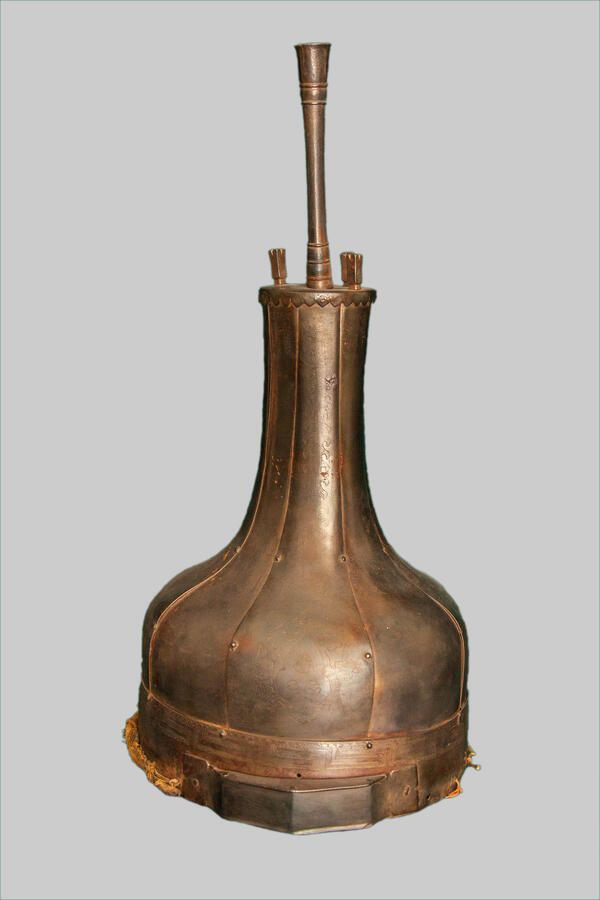
Helmet with a tube for the sultan
#7
#8
There was no developed production of defensive weapons on the territory of Western Siberia during the late Middle Ages — Modern Ages. Local nobility often used products made on the territory of Central Asia. The helmet, which is kept in the exhibition of the Tobolsk Museum Reserve, is also of Asian descent. Mongolian and Dzungarian helmets of that time, known from the Museum collections of Russia, Mongolia and China, are divided into two types by the shape of the dome — sphero-conical and spherical with a cylindrical crown. The sample from the Tobolsk Museum Reserve belongs to the second type. This is a unique helmet, since it has no analogues in famous collections.
The helmet is made of iron. Its crown is riveted from 8 plates, from the bottom it is tied with a wide hoop, in which holes are made for attaching a camail — a flexible cape that protects the neck and shoulders of a warrior. This part of the armour is almost completely lost, only small fragments of cloth and narrow leather straps for fastening have survived. Camail was made by mail weaving, but the presented sample probably had a plate one. The top of the plate was bent and riveted to a flat round crest, on which other details were fixed: a high tube in the center, and on the sides — four (one lost) small bushes for plumages. A visor and a nasel were attached to the hoop on the front (it also did not survive), which went through the visor and was held by a screw. The helmet is decorated with an engraved ornament.
Such ‘fanciful-shaped’ helmets are presented in the collection of the Armoury Museum in Moscow. There they date back to about the 17th-18th centuries, they are attributed to the protective weapons of Oirat and Mongol warriors. Due to this similarity, historians suggest that the exhibit of the Tobolsk Museum Reserve actually belonged either to the Oirats who had been living in Sredniy Priirtysh for almost the entire 17th century, or to local Tatar lords who tried to find help from the Dzungarian Khanate during the struggle against Russian colonization. The latter version seems more likely, since the bulk of weapons items was delivered to the Museum’s funds in the early 20th century from local residents.
The helmet is made of iron. Its crown is riveted from 8 plates, from the bottom it is tied with a wide hoop, in which holes are made for attaching a camail — a flexible cape that protects the neck and shoulders of a warrior. This part of the armour is almost completely lost, only small fragments of cloth and narrow leather straps for fastening have survived. Camail was made by mail weaving, but the presented sample probably had a plate one. The top of the plate was bent and riveted to a flat round crest, on which other details were fixed: a high tube in the center, and on the sides — four (one lost) small bushes for plumages. A visor and a nasel were attached to the hoop on the front (it also did not survive), which went through the visor and was held by a screw. The helmet is decorated with an engraved ornament.
Such ‘fanciful-shaped’ helmets are presented in the collection of the Armoury Museum in Moscow. There they date back to about the 17th-18th centuries, they are attributed to the protective weapons of Oirat and Mongol warriors. Due to this similarity, historians suggest that the exhibit of the Tobolsk Museum Reserve actually belonged either to the Oirats who had been living in Sredniy Priirtysh for almost the entire 17th century, or to local Tatar lords who tried to find help from the Dzungarian Khanate during the struggle against Russian colonization. The latter version seems more likely, since the bulk of weapons items was delivered to the Museum’s funds in the early 20th century from local residents.
#9
Date: 17th century
Place: Dzungaria
Technique: forging, riveting, engraving
Dimensions: 46×20×20 cm
Collection: Weaponry
Copyright: Tyumen Province State Autonomous Cultural Institution “Tyumen Museum and Educational Association”, Structural Division “Tobolsk Historical and Architectural Museum Reserve”
Goskatalog Number: 5901470
Place: Dzungaria
Technique: forging, riveting, engraving
Dimensions: 46×20×20 cm
Collection: Weaponry
Copyright: Tyumen Province State Autonomous Cultural Institution “Tyumen Museum and Educational Association”, Structural Division “Tobolsk Historical and Architectural Museum Reserve”
Goskatalog Number: 5901470
#10
Russian helmet
#11
#13
Service people in Siberia extensively used protective weapons. This greatly distinguished them from the warriors of Central Russia. Throughout the 17th century, the Cossacks and Streltsy, who practically did not use armour during military operations in the West, finding themselves beyond the Urals, tried to quickly get shells and helmets, because they felt vulnerable in clashes with warlike natives. Unlike European Russia, in Siberia, only military elite, but also ordinary fighters wore the defensive weapons.
According to the preserved sources, service men in Siberia used helmets a little less often than body armour. Historical documents mention such types of warheads as spiked helmets, headpieces (‘sheloms’), iron caps, misyur caps (misyurki), brought beyond the Urals from European Russia. Some protective weapons were purchased independently and were held by the warriors as private property.
Additionally, the main volume of protective weapons was delivered to Siberia on the instructions of the Moscow authorities to the arsenal of cities and prisons as the ‘sovereign’s treasury’. For example, according to data of the year 1647, 50 headpieces and spiked helmets were kept in Tobolsk.
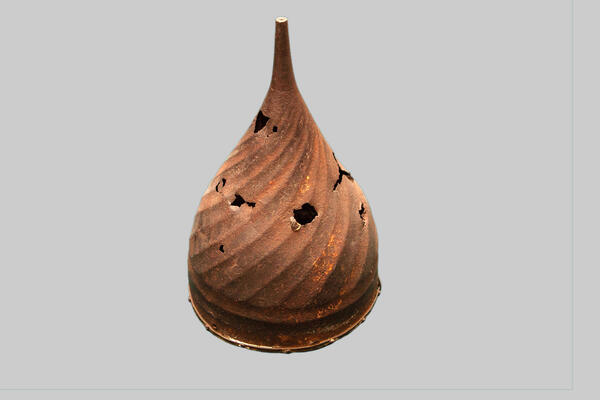
The Tobolsk Museum Reserve exhibits a rare example of a Russian helmet - the so-called “shalom” (headpiece). Unlike the spiked helmets, it has a voluminous crown with an elongated crest. The exhibit has an “embossed” crown – it is covered with twisted grooves. It has a narrow convex hoop on the lower edge and a long crest.
“Sheloms” (headpieces) were a popular type of battle warheads of the Russian local cavalry of the 16th century. There are rare mentions of them among the weapons of the Siberian service people of the 17th century. Historians suggest that commanders of military formations and commanding officers wore sheloms in Siberia. There are many illustrations by cartographer and artist Semyon Remezov on the pages of the Kungur chronicle, which tells about Yermak’s expedition. It is possible to relate some of the drawings of high cylindrical and sphero-conical helmets precisely with sheloms.
According to the preserved sources, service men in Siberia used helmets a little less often than body armour. Historical documents mention such types of warheads as spiked helmets, headpieces (‘sheloms’), iron caps, misyur caps (misyurki), brought beyond the Urals from European Russia. Some protective weapons were purchased independently and were held by the warriors as private property.
Additionally, the main volume of protective weapons was delivered to Siberia on the instructions of the Moscow authorities to the arsenal of cities and prisons as the ‘sovereign’s treasury’. For example, according to data of the year 1647, 50 headpieces and spiked helmets were kept in Tobolsk.
The Tobolsk Museum Reserve exhibits a rare example of a Russian helmet - the so-called “shalom” (headpiece). Unlike the spiked helmets, it has a voluminous crown with an elongated crest. The exhibit has an “embossed” crown – it is covered with twisted grooves. It has a narrow convex hoop on the lower edge and a long crest.
“Sheloms” (headpieces) were a popular type of battle warheads of the Russian local cavalry of the 16th century. There are rare mentions of them among the weapons of the Siberian service people of the 17th century. Historians suggest that commanders of military formations and commanding officers wore sheloms in Siberia. There are many illustrations by cartographer and artist Semyon Remezov on the pages of the Kungur chronicle, which tells about Yermak’s expedition. It is possible to relate some of the drawings of high cylindrical and sphero-conical helmets precisely with sheloms.
#14
Date: 15th-16th century
Place: Ancient Rus
Technique: forging, riveting, silver-plating
Dimensions: 34×21,5×21,5 cm
Collection: Weaponry
Copyright: Tyumen Province State Autonomous Cultural Institution ‘Tyumen Museum and Educational Association’, Structural Division ‘Tobolsk Historical and Architectural Museum Reserve’
Goskatalog Number: 5901423
Place: Ancient Rus
Technique: forging, riveting, silver-plating
Dimensions: 34×21,5×21,5 cm
Collection: Weaponry
Copyright: Tyumen Province State Autonomous Cultural Institution ‘Tyumen Museum and Educational Association’, Structural Division ‘Tobolsk Historical and Architectural Museum Reserve’
Goskatalog Number: 5901423
#15
Chain mail
#17
#19
Service people in Siberia extensively used protective weapons. During the whole of the 17th century, cossacks and streltsy, who practically did not use armour during the hostilities in the ‘west’, being behind the Urals, tried to hastily acquire shells and helmets. They felt vulnerable in battles against militant aborigines. The West Siberian peoples fought with bows and arrows with iron and bone warheads and used long-bladed weapons in horse attacks. So the iron ring shells were an irreplaceable defense.
Unlike European Russia, in Siberia, only military elite, but also ordinary fighters wore the defensive weapons.
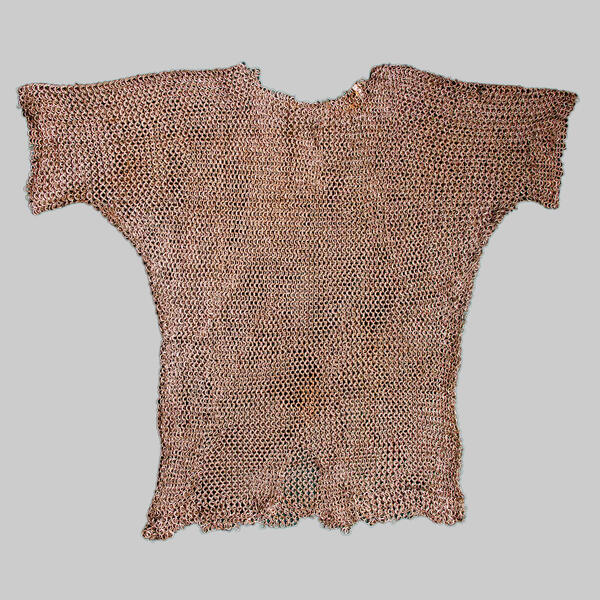
Protective shells had two varieties, ringed, which were bonded from the rings, and plate-armour, in which the protective plates were either bonded to each other or put onto a leather or fabric base. In Siberia, the most common type of ringed shell was the chain mail. This is what the Tobolsk Museum Reserve displays.
The armour is cut out in the form of a shirt with short sleeves. It has a chest incision and underground, plus four incisions at the bottom. Researchers suggest that this was to make the shell elastic. It was also easier to wear armour with these incisions – if there was no incision, the warrior would probably not have been able to fit into them because the hem was too tight.
The shell is made of two types of rounded and flattened rings: riveted and welded rings. The craftsman used a single weaving — he inserted four adjacent into each ring. To produce one chain mail, the blacksmith pulled out a metal wire about 600 metres long. Then he sliced it into three-centimeter pieces and twisted them into rings. He welded half of them and flattened the edges of the rest of them and punctured holes in them. There were about 20,000 rings on one chain mail. It could weigh up to 17 kilograms. A chain mail was made wherever there was a high level of blacksmithing and enough iron.
Russian service people wore similar shells in the 16th and 17th centuries. Historians believe that it was made by Russian armourers, either Tatar or Central Asian craftsmen.
Unlike European Russia, in Siberia, only military elite, but also ordinary fighters wore the defensive weapons.
Protective shells had two varieties, ringed, which were bonded from the rings, and plate-armour, in which the protective plates were either bonded to each other or put onto a leather or fabric base. In Siberia, the most common type of ringed shell was the chain mail. This is what the Tobolsk Museum Reserve displays.
The armour is cut out in the form of a shirt with short sleeves. It has a chest incision and underground, plus four incisions at the bottom. Researchers suggest that this was to make the shell elastic. It was also easier to wear armour with these incisions – if there was no incision, the warrior would probably not have been able to fit into them because the hem was too tight.
The shell is made of two types of rounded and flattened rings: riveted and welded rings. The craftsman used a single weaving — he inserted four adjacent into each ring. To produce one chain mail, the blacksmith pulled out a metal wire about 600 metres long. Then he sliced it into three-centimeter pieces and twisted them into rings. He welded half of them and flattened the edges of the rest of them and punctured holes in them. There were about 20,000 rings on one chain mail. It could weigh up to 17 kilograms. A chain mail was made wherever there was a high level of blacksmithing and enough iron.
Russian service people wore similar shells in the 16th and 17th centuries. Historians believe that it was made by Russian armourers, either Tatar or Central Asian craftsmen.
#20
Date: 16th century
Technique: forging, riveting
Place: Russia
Dimensions: 100×64 cm
Collection: Weaponry
Copyright: Tyumen Province State Autonomous Cultural Institution ‘Tyumen Museum and Educational Association’, Structural Division ‘Tobolsk Historical and Architectural Museum Reserve’
Goskatalog Number: 5901481
Technique: forging, riveting
Place: Russia
Dimensions: 100×64 cm
Collection: Weaponry
Copyright: Tyumen Province State Autonomous Cultural Institution ‘Tyumen Museum and Educational Association’, Structural Division ‘Tobolsk Historical and Architectural Museum Reserve’
Goskatalog Number: 5901481
#16
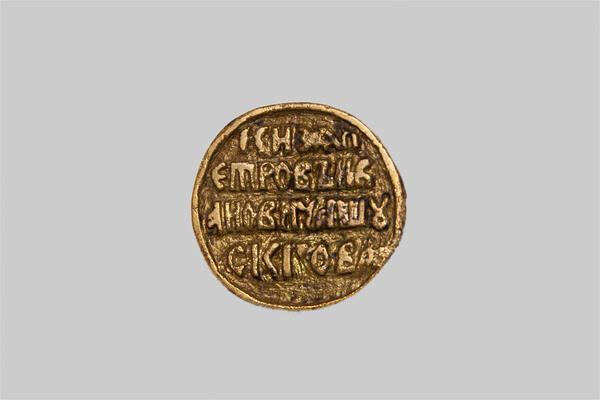
Sign (mark) from Yermak’s chain mail
#18
#21
For the first time, the sign from the chain mail was presented in the catalogue of finds from the Isker settlement. Vasily Pignatti, the compiler of the catalogue, drew attention to the inscription ‘Held by Lord Pyotr Ivanovich Shuysky’ and asked a question: ‘Do the words above mean that the kinsman or things (weapons) belong to the druzhina of Lord Pyotr Ivanovich Shuysky, who died in 1564 and led the Russian squads in the fight against the Kazan Tatars? ’.
Lord Pyotr Ivanovich Shuysky was a prominent military official and statesman of Moscow Russia in the 1540s and the first half of the 1560s. His last position was the Viceroy of Polotsk in 1563. In the battle of Chashniki near Orsha on January 26, 1564, Russian troops under the command of Pyotr Shuysky were defeated by the Lithuanian army of Hetman Nikolay Radzivill Ryzhy. When retreating from the battlefield, the Russian commander-in-chief was killed.
A similar target sign is kept in the Armoury Chamber, it was delivered there in the 17th century from Western Siberia. In the second quarter of the 17th century service men from Berezovsk ‘recaptured’ the chain mail from the Priobsky Samoyeds (Nenets), and ‘there were gold target signs on that shell on the chest, and the sovereign”s name was carved on one of them, and an eagle on the other’. On closer examination, it was found that the target plates were not gold, but copper: ‘a double-headed eagle is carved on one of them, and the signature of Lord Pyotr Ivanovich Shuysky on the other’. When the chain mail was delivered to Moscow, it was found that only one copper plate with gilt remained on it, which could be used to determine that the item belonged to Shuysky.
Finding a similar sign on Isker, perhaps from the same shell, allowed the famous historian Sergey Bakhrushin to express the assumption with some reservations that the chain mail of Pyotr Shuysky once belonged to ataman Yermak, and he lost a plate from it during his stay in the Siberian capital. It is known that in the 1980s of the 16th century, after the victory over the troops of Khan Kuchum in the battle of the Chuvash Cape, Yermak’s squad occupied the settlement of Isker without a fight, where they lived for several years later. According to an employee of the Moscow Kremlin Armoury Nikolay Gordeev, “the Tobolsk target must have once been on Yermak”s second shell”, he received it as a gift from Tsar Ivan IV the Terrible as a reward for the Siberian expedition.
Lord Pyotr Ivanovich Shuysky was a prominent military official and statesman of Moscow Russia in the 1540s and the first half of the 1560s. His last position was the Viceroy of Polotsk in 1563. In the battle of Chashniki near Orsha on January 26, 1564, Russian troops under the command of Pyotr Shuysky were defeated by the Lithuanian army of Hetman Nikolay Radzivill Ryzhy. When retreating from the battlefield, the Russian commander-in-chief was killed.
A similar target sign is kept in the Armoury Chamber, it was delivered there in the 17th century from Western Siberia. In the second quarter of the 17th century service men from Berezovsk ‘recaptured’ the chain mail from the Priobsky Samoyeds (Nenets), and ‘there were gold target signs on that shell on the chest, and the sovereign”s name was carved on one of them, and an eagle on the other’. On closer examination, it was found that the target plates were not gold, but copper: ‘a double-headed eagle is carved on one of them, and the signature of Lord Pyotr Ivanovich Shuysky on the other’. When the chain mail was delivered to Moscow, it was found that only one copper plate with gilt remained on it, which could be used to determine that the item belonged to Shuysky.
Finding a similar sign on Isker, perhaps from the same shell, allowed the famous historian Sergey Bakhrushin to express the assumption with some reservations that the chain mail of Pyotr Shuysky once belonged to ataman Yermak, and he lost a plate from it during his stay in the Siberian capital. It is known that in the 1980s of the 16th century, after the victory over the troops of Khan Kuchum in the battle of the Chuvash Cape, Yermak’s squad occupied the settlement of Isker without a fight, where they lived for several years later. According to an employee of the Moscow Kremlin Armoury Nikolay Gordeev, “the Tobolsk target must have once been on Yermak”s second shell”, he received it as a gift from Tsar Ivan IV the Terrible as a reward for the Siberian expedition.
#22
Date: 16th century
Technique: embossed
Place: Russia
Dimensions: 2,7×2,7 cm
Collection: awarding medals, signs
Copyright: Tyumen Province State Autonomous Cultural Institution “Tyumen Museum and Educational Association”, Structural Division “Tobolsk Historical and Architectural Museum Reserve”
Goskatalog Number: 4117588
Technique: embossed
Place: Russia
Dimensions: 2,7×2,7 cm
Collection: awarding medals, signs
Copyright: Tyumen Province State Autonomous Cultural Institution “Tyumen Museum and Educational Association”, Structural Division “Tobolsk Historical and Architectural Museum Reserve”
Goskatalog Number: 4117588
read morehide
00:00
00:00
1x
Berdiche, helmets, chain mail, sign
Collection
0
 Point your smartphone camera to open in the app
Open in app
Share