#1
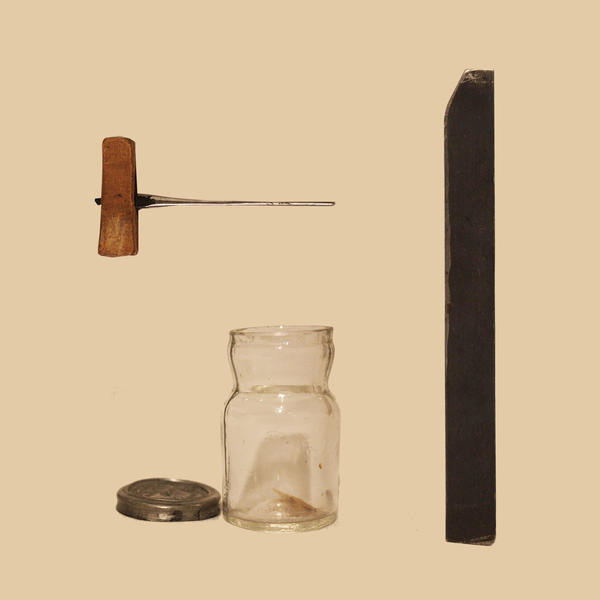
Steel Gimlet, Paper cutter, A glass jar
#2
#3
Scarce everyday things that became museum memorabilia cherish the memory of the most difficult period of N.G. Chernyshevsky’s exile. The writer spent 1871 through 1883 in Vilyuisk, a “ghost of a city” where he was missing articles of daily necessity. His list of such articles included a gimlet required for binding manuscript sheets. Chernyshevsky had to make with his own hands the tool in the shape of a steel awl with a wooden handle.
During his exile in Vilyuisk, N.G. Chernyshevsky did a lot of translations from foreign languages, “learned… plane trigonometry”, wrote his poem A Hymn to the Virgin of Heaven and scientific treatises. According to the writer himself, he wrote around 14 novels, amongst which there are Stories from the White Hall, Stories by A.M. Levitsky, etc. However, all those works have not survived to this day: they were either confiscated during searches of his cell by gendarmery, or were destroyed by Chernyshevsky himself. He realized that it was prohibited to publish any of his works in the Russian Empire.
In late 1873, the Irkutsk Governor General was anonymously advised that an escape was being prepared for Chernyshevsky. Gendarme Colonel Kupenkov was sent to Vilyuisk to search the home of the exiled. The gendarmes failed to find any evidence of the planned escape. Kupenkov wrote in his report: “Chernyshevsky, who has lost too much weight and whose face has yellowed, is queer, odd and unsociable, … he spends his time in reading and writing, and destroys his works”. To conclude, the Colonel added that the escape was impossible due to severe climatic conditions and unpopulated environment.
The writer did not only burn his manuscripts. He also destroyed them in another way: he tore them to pieces and threw them in the river Vilyui. “I write and tear: there is no point in preserving the manuscripts: I keep in my memory all that I have once written”, wrote he to Alexander Pypin in 1877.
Out of the vast number of Chernyshevsky’s manuscripts of those years, only one short novel survived: The Glows of Radiance, extracts of which were confiscated by a Yakutsk prosecutor. The novel starts with reminiscences of his native Saratov: ‘Let my greeting fly to my native land’.
In the summer of 1874, Chernyshevsky was offered to petition for mercy. The writer declined the offer.
During his exile in Vilyuisk, N.G. Chernyshevsky did a lot of translations from foreign languages, “learned… plane trigonometry”, wrote his poem A Hymn to the Virgin of Heaven and scientific treatises. According to the writer himself, he wrote around 14 novels, amongst which there are Stories from the White Hall, Stories by A.M. Levitsky, etc. However, all those works have not survived to this day: they were either confiscated during searches of his cell by gendarmery, or were destroyed by Chernyshevsky himself. He realized that it was prohibited to publish any of his works in the Russian Empire.
In late 1873, the Irkutsk Governor General was anonymously advised that an escape was being prepared for Chernyshevsky. Gendarme Colonel Kupenkov was sent to Vilyuisk to search the home of the exiled. The gendarmes failed to find any evidence of the planned escape. Kupenkov wrote in his report: “Chernyshevsky, who has lost too much weight and whose face has yellowed, is queer, odd and unsociable, … he spends his time in reading and writing, and destroys his works”. To conclude, the Colonel added that the escape was impossible due to severe climatic conditions and unpopulated environment.
The writer did not only burn his manuscripts. He also destroyed them in another way: he tore them to pieces and threw them in the river Vilyui. “I write and tear: there is no point in preserving the manuscripts: I keep in my memory all that I have once written”, wrote he to Alexander Pypin in 1877.
Out of the vast number of Chernyshevsky’s manuscripts of those years, only one short novel survived: The Glows of Radiance, extracts of which were confiscated by a Yakutsk prosecutor. The novel starts with reminiscences of his native Saratov: ‘Let my greeting fly to my native land’.
In the summer of 1874, Chernyshevsky was offered to petition for mercy. The writer declined the offer.
#4
Author: Nikolay Gavrilovich Chernyshevsky
Date: 1870s
Technique: handicraft, wood, metal
Dimensions: 13×7.75 сm
Collection: Artefacts
Copyright: Municipal institution of culture The Memorial Estate of N.G. Chernyshevsky
Date: 1870s
Technique: handicraft, wood, metal
Dimensions: 13×7.75 сm
Collection: Artefacts
Copyright: Municipal institution of culture The Memorial Estate of N.G. Chernyshevsky
Goskatalog Number: 18304205
#5
Iron paper cutter, made by Nikolay Gavrilovich Chernyshevsky in Vilyuisk
#6
In the 19th century, the paper cutter was an indispensable part of everyday life of any reader, even more so, of a man of letters. Books printed at that time consisted of folded packs of paper. To read them, one had to cut the packs into separate sheets with a special knife. Sheets were cut in the course of reading, and a knife used for that purpose often was an item of decorative art.
However, in the Vilyuisk prison where Chernyshevsky was incarcerated from 1871 through 1883, a paper knife, as well as other useful household items, was nowhere to be found. The writer had to make it himself of a commonplace iron bar. Such a paper cutter is of interest as an item that testifies to Chernyshevsky’s occupation in his Yakutia exile. A brilliant mind of his time, an armchair scientist, after seven years of penal servitude was incarcerated for 12 years in Vilyuisk, a town located on a hillock bog that had no more that 36 houses, 5 Yakut nomad tents and a wooden church. The population did not exceed five hundred.
Also, it was beyond belief to find any books there. His cousin Alexander Pypin came to help the keen book-lover. It is exactly from Pypin that Chernyshevsky received packs of books and stacks of magazines. Those were the books by Pypin himself: Social Movement in Russia of Alexander I, Belinsky: His Life and Correspondence, as well as The Last Songs by Nekrasov, Russian History in the Lives of its Major Personalities by Kostomarov, works by Dobrolubov, The Descent of Man by Darwin, Capital by Karl Marx, the Encyclopedia by Brockhaus. Among the magazines, there were “Vestnik Evropy” (The Herald of Europe), “Otechestvennye Zapiski” (Homeland Transactions), “Russky Vestnik” (Russian Herald), “Russky Arkhiv” (Russian Archive), “Voenno-Meditsinsky Zhurnal” (Military Medical Journal), “Znaniye” (Knowledge), etc. Of fiction, those were works by Spielhagen, Daudet, Collins, Bret Harte, Boccaccio, Schlosser, Mill.
The List of State Prisoners of the Vilyuisk District under Police Surveillance of 1882 in the line Occupation provided the following information on Nikolay Chernyshevsky: “Has no occupation except reading”.
However, in the Vilyuisk prison where Chernyshevsky was incarcerated from 1871 through 1883, a paper knife, as well as other useful household items, was nowhere to be found. The writer had to make it himself of a commonplace iron bar. Such a paper cutter is of interest as an item that testifies to Chernyshevsky’s occupation in his Yakutia exile. A brilliant mind of his time, an armchair scientist, after seven years of penal servitude was incarcerated for 12 years in Vilyuisk, a town located on a hillock bog that had no more that 36 houses, 5 Yakut nomad tents and a wooden church. The population did not exceed five hundred.
Also, it was beyond belief to find any books there. His cousin Alexander Pypin came to help the keen book-lover. It is exactly from Pypin that Chernyshevsky received packs of books and stacks of magazines. Those were the books by Pypin himself: Social Movement in Russia of Alexander I, Belinsky: His Life and Correspondence, as well as The Last Songs by Nekrasov, Russian History in the Lives of its Major Personalities by Kostomarov, works by Dobrolubov, The Descent of Man by Darwin, Capital by Karl Marx, the Encyclopedia by Brockhaus. Among the magazines, there were “Vestnik Evropy” (The Herald of Europe), “Otechestvennye Zapiski” (Homeland Transactions), “Russky Vestnik” (Russian Herald), “Russky Arkhiv” (Russian Archive), “Voenno-Meditsinsky Zhurnal” (Military Medical Journal), “Znaniye” (Knowledge), etc. Of fiction, those were works by Spielhagen, Daudet, Collins, Bret Harte, Boccaccio, Schlosser, Mill.
The List of State Prisoners of the Vilyuisk District under Police Surveillance of 1882 in the line Occupation provided the following information on Nikolay Chernyshevsky: “Has no occupation except reading”.
#7
Author: Nikolay Gavrilovich Chernyshevsky
Date: 1870s
Technique: iron
Dimensions: 18×2 сm
Collection: Labor items
Copyright: Municipal institution of culture The Memorial Estate of N.G. Chernyshevsky
Goskatalog Number: 18309388
Date: 1870s
Technique: iron
Dimensions: 18×2 сm
Collection: Labor items
Copyright: Municipal institution of culture The Memorial Estate of N.G. Chernyshevsky
Goskatalog Number: 18309388
#8
A cold cream glass jar with metal lid used by Nikolay Gavrilovich Chernyshevsky as an inkpot during the years of his Siberian exile.
#9
After 7 years of penal servitude in East Siberia, Nikolay Chernyshevsky was transferred from Alexandrovsky Manufactory to a prison of the Yakut town of Vilyuisk. The transit by a winter road took over a month and was very difficult.
Having been advised of Chernyshevsky’s transfer to cold Yakutia, Alexander Pypin sent him a jar of cold cream. He might have done that on the advice of his sister Eugenia, who was then attending lectures in a Medical Academy and knew what remedy would be suited for severe northern conditions. Also, Pypin is known to have sent Chernyshevsky a parcel of medicines on 14 May 1877.
Cold cream is a white ointment invented in England and made of a mix of almond oil, wax and spermaceti oil. Upon applying it on the skin, the skin receives maximum moisture as well as wind and frost protection. On the jar lid there is an inscription: “Laboratoire chimique de St.-Petersbourg”, which means “Chemical Laboratory of St. Petersburg”.
Nikolay Chernyshevsky did not throw away the jar after use: it might remind him of close female relations and female care. Moreover, the jar proved useful in the writer’s most scanty household. It began to serve him as an inkpot: he dipped his pen into it when writing a letter to his wife to persuade her from coming to stay with him: ‘What is Vilyuisk? This place is only called a town. In fact, it is not even a village, not even a hamlet: it is something so small and desert that there is no such other thing in Russia’.
Traveler Tomasz Augustynowicz who visited Vilyuisk in winter, left the following description of the town: ‘One cannot see a smallest sign of life, the streets are always desert, there is silence everywhere <…> Wherever you turn, you will face the silent taiga that surrounds the town from all sides like a high circular wall’.
It is exactly in such wilderness that Chernyshevsky, being 42 years old, was confined ‘by order of His Imperial Majesty’. The man in the prime of life, having colossal intellect, comprehensive knowledge and public esteem was deprived of any and all chances to express himself except in cautious letters to friends and relatives.
Having been advised of Chernyshevsky’s transfer to cold Yakutia, Alexander Pypin sent him a jar of cold cream. He might have done that on the advice of his sister Eugenia, who was then attending lectures in a Medical Academy and knew what remedy would be suited for severe northern conditions. Also, Pypin is known to have sent Chernyshevsky a parcel of medicines on 14 May 1877.
Cold cream is a white ointment invented in England and made of a mix of almond oil, wax and spermaceti oil. Upon applying it on the skin, the skin receives maximum moisture as well as wind and frost protection. On the jar lid there is an inscription: “Laboratoire chimique de St.-Petersbourg”, which means “Chemical Laboratory of St. Petersburg”.
Nikolay Chernyshevsky did not throw away the jar after use: it might remind him of close female relations and female care. Moreover, the jar proved useful in the writer’s most scanty household. It began to serve him as an inkpot: he dipped his pen into it when writing a letter to his wife to persuade her from coming to stay with him: ‘What is Vilyuisk? This place is only called a town. In fact, it is not even a village, not even a hamlet: it is something so small and desert that there is no such other thing in Russia’.
Traveler Tomasz Augustynowicz who visited Vilyuisk in winter, left the following description of the town: ‘One cannot see a smallest sign of life, the streets are always desert, there is silence everywhere <…> Wherever you turn, you will face the silent taiga that surrounds the town from all sides like a high circular wall’.
It is exactly in such wilderness that Chernyshevsky, being 42 years old, was confined ‘by order of His Imperial Majesty’. The man in the prime of life, having colossal intellect, comprehensive knowledge and public esteem was deprived of any and all chances to express himself except in cautious letters to friends and relatives.
#10
Author: manufacturing
Date: 1870s
Technique: glass, metal
Dimensions: 7×5 сm
Collection: Artefacts
Copyright: Municipal institution of culture The Memorial Estate of N.G. Chernyshevsky
Restorers: 18304204
Date: 1870s
Technique: glass, metal
Dimensions: 7×5 сm
Collection: Artefacts
Copyright: Municipal institution of culture The Memorial Estate of N.G. Chernyshevsky
Restorers: 18304204
read morehide
00:00
00:00
1x
Steel Gimlet, Paper cutter, A glass jar
Exhibition
0
 Point your smartphone camera to open in the app
Open in app
Share