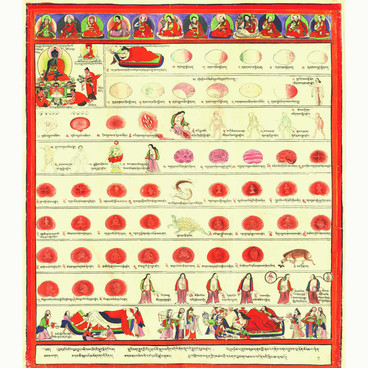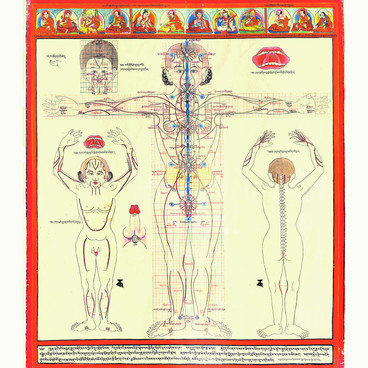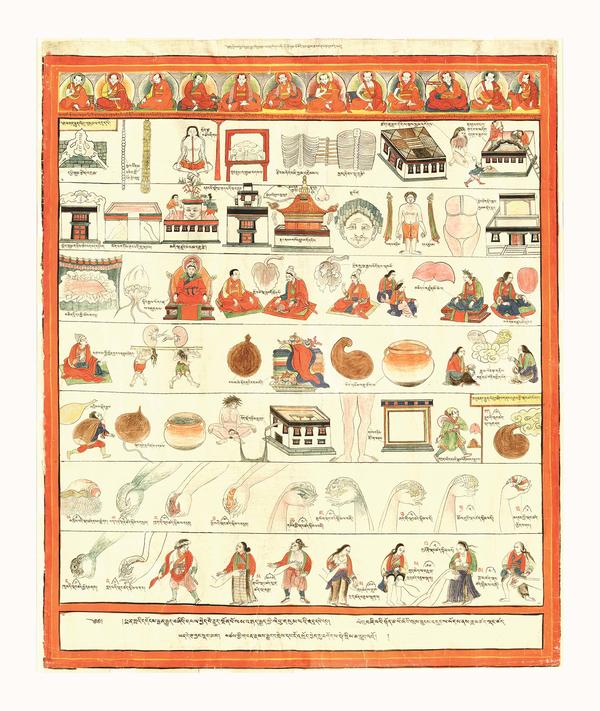
Illustrations for the 3rd and 4th chapters of the ‘Exegetical Tantra’.
The third chapter has a comparison of human body’s anatomy with the palace’s (temple’s) elements of construction and decoration. For instance, thighbones and hipbones are compared to the foundation, the ribs are compared with the roof timber, the skull is compared with the dome. The upper and the lower parts of the body are compared to the floors, the vessels and the strings are compared to the ceiling panels. Flesh and skin are the plastering and the coloring, hair is the roof tile, diaphragm is a curtain. Two human’s kidneys are like the king’s counselors on foreign policy or two knights holding the ceiling beam, two legs are two horse stalls at the palace’s gates. The body parts dangerous for destruction are compared to many king’s authorized representatives.
Comparing the inner organs with king’s palace’s hierarchy reflects their role in body activities. Heart is the king on the throne (first figure at the third line), the back lung parts are the ministers, the front lung parts are the king’s children, liver and milt are the elder and younger queens, the large and small intestines are the queens’ servants. Stomach, gall-bladder and urinary bladder are compared to the utensils for cooking food, the small bag with the spices and the bowl for water.
The 4th chapter of the “Exegetical Tantra” is about the measurements of the human body. The handful, fistful and the size of some inner organs are taken as measurement units for measuring the body parts. For example, the norm of wind and bile is equal to the urinary bladder’s size (last image at the third lower line) and the size of testicles. The quantity of blood is equal to seven handfuls, the brain is equal to one handful, the man’s flesh is equal to 5000 handfuls.
The four last female figures at the lower line show the levels of female body’s difference from the male’s one (breast, hips, maternal milk, menstrual blood)
The images at the upper cartouche depict the healers, followers of the famous Yuthokla’s school.
The third chapter has a comparison of human body’s anatomy with the palace’s (temple’s) elements of construction and decoration. For instance, thighbones and hipbones are compared to the foundation, the ribs are compared with the roof timber, the skull is compared with the dome. The upper and the lower parts of the body are compared to the floors, the vessels and the strings are compared to the ceiling panels. Flesh and skin are the plastering and the coloring, hair is the roof tile, diaphragm is a curtain. Two human’s kidneys are like the king’s counselors on foreign policy or two knights holding the ceiling beam, two legs are two horse stalls at the palace’s gates. The body parts dangerous for destruction are compared to many king’s authorized representatives.
Comparing the inner organs with king’s palace’s hierarchy reflects their role in body activities. Heart is the king on the throne (first figure at the third line), the back lung parts are the ministers, the front lung parts are the king’s children, liver and milt are the elder and younger queens, the large and small intestines are the queens’ servants. Stomach, gall-bladder and urinary bladder are compared to the utensils for cooking food, the small bag with the spices and the bowl for water.
The 4th chapter of the “Exegetical Tantra” is about the measurements of the human body. The handful, fistful and the size of some inner organs are taken as measurement units for measuring the body parts. For example, the norm of wind and bile is equal to the urinary bladder’s size (last image at the third lower line) and the size of testicles. The quantity of blood is equal to seven handfuls, the brain is equal to one handful, the man’s flesh is equal to 5000 handfuls.
The four last female figures at the lower line show the levels of female body’s difference from the male’s one (breast, hips, maternal milk, menstrual blood)
The images at the upper cartouche depict the healers, followers of the famous Yuthokla’s school.