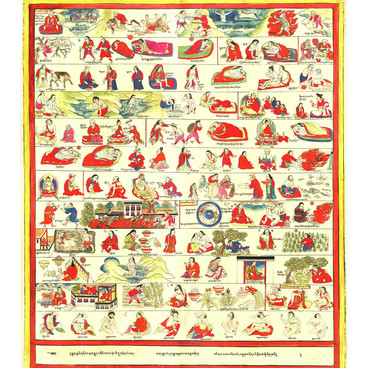
Illustrates the contents of the 16th chapter 16 of the ‘Exegetical Tantra’.
All food products are divided into five categories: cereals, meat, fat, green and mash. The first column of the table features nourishing cereal crops as well as the ones with the refreshing qualities. For instance, rice, being the grain which is light for stomach, helps in case of diarrhea and vomit. Millet is heavy for stomach and it helps for curing the wounds and broken bones. Further in the second and third columns the bean cultures are featured. They are light for stomach, have refreshing qualities and help to stop bleeding. White and black sesame seeds are heavy and warming which supports the sex activity and cures the pneuma’s diseases. All sorts of buckwheat are cooling and light, they help curing the blisters.
The columns from the second till the seventh contain the images of eight different sorts of meat. These are the wild animals digging the ground with their paws and beaks searching for food, big wild animals getting food with help of their strength and dexterity, predatory animals and birds, domestic animals living in the holes and damp places. For example, the meat of animals living in the dry places if refreshing, rough and easily digested, removing the heat of pheuma’s and phlegm’s diseases. The meat of the damp places’ inhabitants is oily, rough and warming. It is good for the ones with the diseases of stomach, kidneys, low back connected with the local decrease in temperature in these organs. The meat of the animals living both in dry and damp places have both listed qualities.
The eighth column has the images of four kinds of fat: butter and its sorts, oil, marrow and fat. Consuming different kinds of fat people improve their digestion, clean the stomach and bowel, improve the face tone, straighten the body power and the sense organs.
The last two columns have images of mashes and their qualities. For example, the boiled rice is recommended in case of exhaustion, attenuation and after cleaning the stomach. It should be eaten starting with the very liquid mash, gradually intensifying its density and finally eating the rice without any water in it at all.
All food products are divided into five categories: cereals, meat, fat, green and mash. The first column of the table features nourishing cereal crops as well as the ones with the refreshing qualities. For instance, rice, being the grain which is light for stomach, helps in case of diarrhea and vomit. Millet is heavy for stomach and it helps for curing the wounds and broken bones. Further in the second and third columns the bean cultures are featured. They are light for stomach, have refreshing qualities and help to stop bleeding. White and black sesame seeds are heavy and warming which supports the sex activity and cures the pneuma’s diseases. All sorts of buckwheat are cooling and light, they help curing the blisters.
The columns from the second till the seventh contain the images of eight different sorts of meat. These are the wild animals digging the ground with their paws and beaks searching for food, big wild animals getting food with help of their strength and dexterity, predatory animals and birds, domestic animals living in the holes and damp places. For example, the meat of animals living in the dry places if refreshing, rough and easily digested, removing the heat of pheuma’s and phlegm’s diseases. The meat of the damp places’ inhabitants is oily, rough and warming. It is good for the ones with the diseases of stomach, kidneys, low back connected with the local decrease in temperature in these organs. The meat of the animals living both in dry and damp places have both listed qualities.
The eighth column has the images of four kinds of fat: butter and its sorts, oil, marrow and fat. Consuming different kinds of fat people improve their digestion, clean the stomach and bowel, improve the face tone, straighten the body power and the sense organs.
The last two columns have images of mashes and their qualities. For example, the boiled rice is recommended in case of exhaustion, attenuation and after cleaning the stomach. It should be eaten starting with the very liquid mash, gradually intensifying its density and finally eating the rice without any water in it at all.