

#1
Pharmacy fee guide, Pharmaceutical Charter
#2
#3
#4
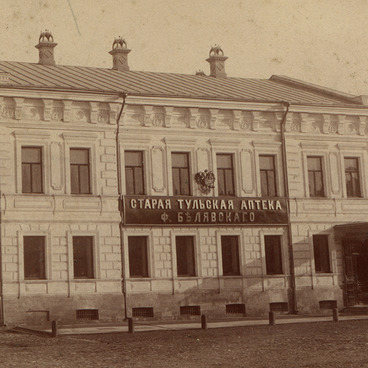
All pharmacies in The Russian Empire were controlled by the Medical Administration, which was part of the Department of Internal Affairs. Pharmacists wrote down every operation in a register, and there was a special document for each. All pharmacies had to keep a Formulary, a Book of sales of non-prescription drugs, a Book of poisons, and a Laboratory book, where all pharmaceuticals that were made for open sale were recorded. The pharmacy staff used special publications: a pharmacopoeia, which indicated the requirements for medicines, a list of practicing doctors, as well as a Pharmacy fee guide.
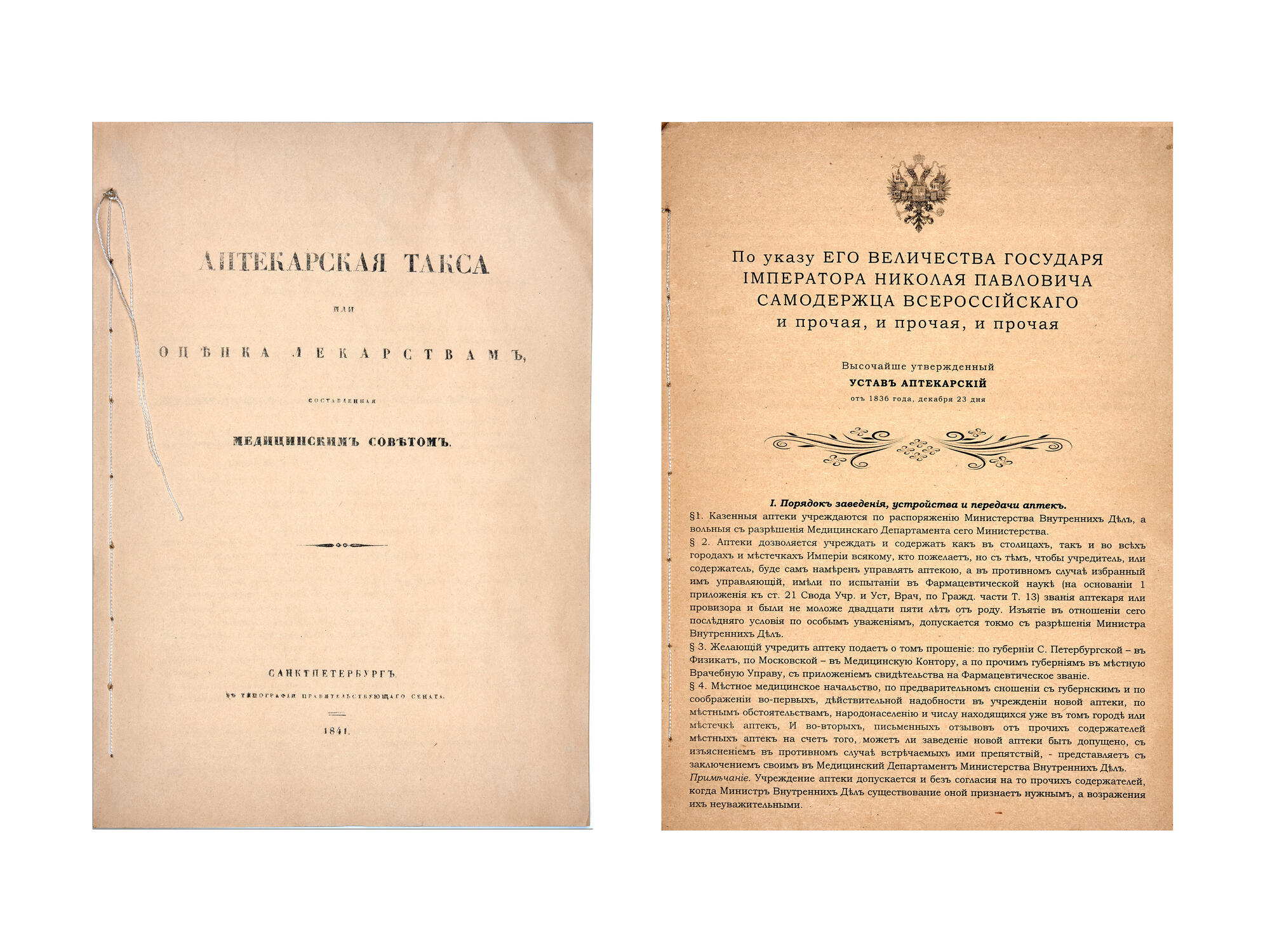
The Pharmacy fee guide was an official document that contained prices for medicines, containers, and the ‘manner of drug preparation’. The fee schedule was made up by the owners of large metropolitan pharmacies and was printed with the permission of the Medical Administration of the Russian Empire. The document passed the necessary certification, had the status of a legislative one, and was valid throughout the country.
The first Pharmacy fee guide in The Russian Empire was published on September 20, 1798, under the title ‘Prices of medicines, including: Pharmaceutical Charter. The Charter for midwives. The Charter on due pay for medical officers “. Compliance with the document was stipulated in the 12th paragraph of the Charter, which was valid until the beginning of the 20th century: “The pharmacist must charge the price for the dispensed medicines indicated in the published fee guide. When the price of a certain medicine rises or decreases in the future, then the State Medical Board will inform the public of the fact.”
The prices set in the document did not suit everyone. Anton Chekhov, who was also a practicing doctor, wrote in his humorous treatise “The Pharmacy fee guide, or Help me! I am being robbed!”: “The Pharmacy fee guide has a peculiarity: it recognizes the rules, but knows no exceptions. Its motto is " Сharge for everything without exception’. It charges for the preparation of the medicine, for mixing it, for stirring, saturating, dividing into fractions, for the wrapper, signature, label, seal, dishes, box, paper, binding thread, and so on.’
Despite the restrictions, the prices of pharmaceuticals in private pharmacies — and they made up the majority at that time — were 1.5–2 times higher than in district pharmacies of hospitals. The average prescription cost about 8 kopecks — one could buy a bottle of milk or half a kilo of wheat flour for this money.
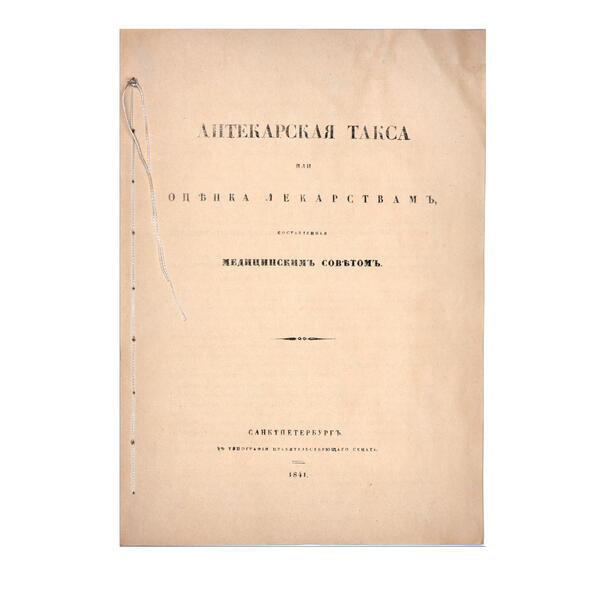
The exhibition presents a mock edition of ‘Pharmacy fee or medicine guide, compiled by the medical council’ in 1841.
The Pharmacy fee guide was an official document that contained prices for medicines, containers, and the ‘manner of drug preparation’. The fee schedule was made up by the owners of large metropolitan pharmacies and was printed with the permission of the Medical Administration of the Russian Empire. The document passed the necessary certification, had the status of a legislative one, and was valid throughout the country.
The first Pharmacy fee guide in The Russian Empire was published on September 20, 1798, under the title ‘Prices of medicines, including: Pharmaceutical Charter. The Charter for midwives. The Charter on due pay for medical officers “. Compliance with the document was stipulated in the 12th paragraph of the Charter, which was valid until the beginning of the 20th century: “The pharmacist must charge the price for the dispensed medicines indicated in the published fee guide. When the price of a certain medicine rises or decreases in the future, then the State Medical Board will inform the public of the fact.”
The prices set in the document did not suit everyone. Anton Chekhov, who was also a practicing doctor, wrote in his humorous treatise “The Pharmacy fee guide, or Help me! I am being robbed!”: “The Pharmacy fee guide has a peculiarity: it recognizes the rules, but knows no exceptions. Its motto is " Сharge for everything without exception’. It charges for the preparation of the medicine, for mixing it, for stirring, saturating, dividing into fractions, for the wrapper, signature, label, seal, dishes, box, paper, binding thread, and so on.’
Despite the restrictions, the prices of pharmaceuticals in private pharmacies — and they made up the majority at that time — were 1.5–2 times higher than in district pharmacies of hospitals. The average prescription cost about 8 kopecks — one could buy a bottle of milk or half a kilo of wheat flour for this money.
The exhibition presents a mock edition of ‘Pharmacy fee or medicine guide, compiled by the medical council’ in 1841.
#5
Full name: Pharmacy fee guide, or prices of medicines, compiled by the medical council
Date: 2014
Technique: moulage
Place: Tula
Copyright: Tula Historical and Architectural Museum
Dimensions: 25×18 cm
Date: 2014
Technique: moulage
Place: Tula
Copyright: Tula Historical and Architectural Museum
Dimensions: 25×18 cm
#6
Pharmaceutical Charter
#7
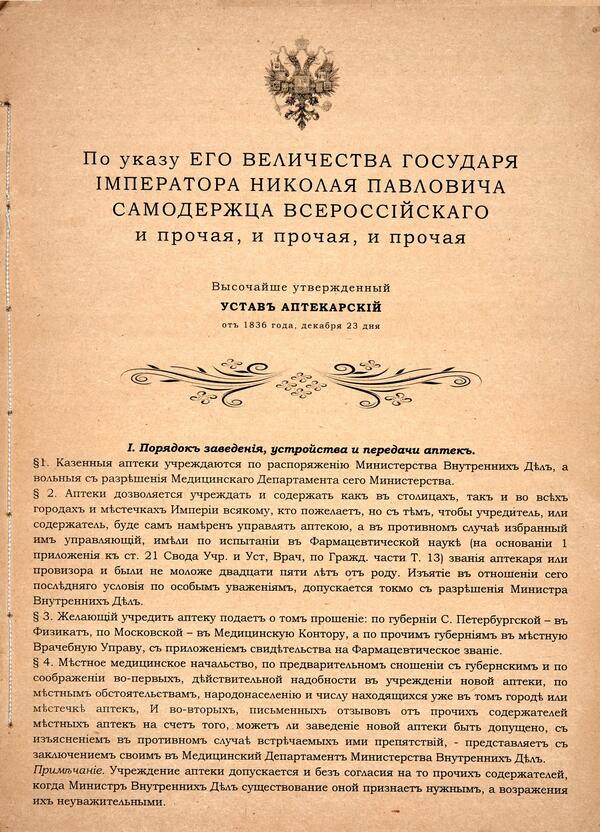
#8
The Pharmaceutical Charter was a law regulating the activities of pharmacies in the Russian Empire. It was first adopted in 1789, and it remained unchanged until 1857 when it entered the code of laws of the Russian Empire.
The systematization of medicines began in 1778. Then the Medical Board developed the State Pharmacopeia Rossica — a document that specified the requirements for medicines and a list of high-quality drugs. To a greater extent, this list included domestic remedies of plant origin. It also contained instructions for the preparation of the most complex medicines. In 1798, the pharmacopeia was reissued and finalized — new developments of domestic pharmacists were introduced.
The first Pharmaceutical Charter appeared in 1789 and contained 23 articles. The text was duplicated in Russian and German, given that since the end of the 16th century, the Pharmacy Order was controlled by immigrants from German lands. German doctors and pharmacists were invited to develop this business in Russia, and they referred to the German text of the charter. The Pharmaceutical Charter has become the main document regulating the activities of pharmacies. Its articles prescribed the rules for pharmacy management and the duties of its employees.
The charter stipulated that a pharmacist was to pass a test and to be given the pharmaceutical title by the State Medical Board. There were also requirements for the manner of his behavior: ‘Keepers and managers of pharmacies must be of an honest and upright demeanor.’ The pharmacist had the right to sell medicines only on a doctor’s prescription. The exceptions were ‘the lightest and safest medicines, such as almond oil, cinnamomic water, rosemary grass, rhubarb syrup and the like, ’ as well as drugs that were urgently needed during childbirth.
All medicines were made by a qualified pharmaceutical chemist — a pharmacist of the highest qualification. The pharmacy manager was responsible for their quality. For the purchase from the manufacturers of ‘such composite products that have to be prepared in a pharmacy laboratory’, a fine of 50 to 100 rubles could be imposed. Medicines were sold ‘at any time’, around the clock: a pharmacist was always on duty at night at the pharmacy.
In the charter of 1857, the requirements were tightened. For the sale of alcoholic beverages, pharmacists were subjected to serious punishment: ‘For the first time, a monetary penalty of 50 to 100 rubles, for the second time from 100 to 500 rubles, for the third time he permanently loses the right to manage the pharmacy.’ In such emergencies as poisoning, suffocation, bleeding, the pharmacist was obliged to provide emergency medical care, but at the same time, he was fully responsible for the consequences of treatment.
According to the Charter, the pharmacy was to have: a prescription room, a storage room, a laboratory, a coctorium, a dry basement, an ice cellar, a drying room for medicinal plants. The pharmacy ‘must be provided with a sufficient amount of fresh and proper quality medicines and materials, as well as necessary for the storage and distribution of medicines various dishes, pharmacy scales of various kinds, tools, and devices for composing medicines and for the production of pharmaceutical and chemical operations.’
The exhibition presents a moulage of the publication ‘Temporary prices of medicines with the pharmacy charter’ of 1811.
The systematization of medicines began in 1778. Then the Medical Board developed the State Pharmacopeia Rossica — a document that specified the requirements for medicines and a list of high-quality drugs. To a greater extent, this list included domestic remedies of plant origin. It also contained instructions for the preparation of the most complex medicines. In 1798, the pharmacopeia was reissued and finalized — new developments of domestic pharmacists were introduced.
The first Pharmaceutical Charter appeared in 1789 and contained 23 articles. The text was duplicated in Russian and German, given that since the end of the 16th century, the Pharmacy Order was controlled by immigrants from German lands. German doctors and pharmacists were invited to develop this business in Russia, and they referred to the German text of the charter. The Pharmaceutical Charter has become the main document regulating the activities of pharmacies. Its articles prescribed the rules for pharmacy management and the duties of its employees.
The charter stipulated that a pharmacist was to pass a test and to be given the pharmaceutical title by the State Medical Board. There were also requirements for the manner of his behavior: ‘Keepers and managers of pharmacies must be of an honest and upright demeanor.’ The pharmacist had the right to sell medicines only on a doctor’s prescription. The exceptions were ‘the lightest and safest medicines, such as almond oil, cinnamomic water, rosemary grass, rhubarb syrup and the like, ’ as well as drugs that were urgently needed during childbirth.
All medicines were made by a qualified pharmaceutical chemist — a pharmacist of the highest qualification. The pharmacy manager was responsible for their quality. For the purchase from the manufacturers of ‘such composite products that have to be prepared in a pharmacy laboratory’, a fine of 50 to 100 rubles could be imposed. Medicines were sold ‘at any time’, around the clock: a pharmacist was always on duty at night at the pharmacy.
In the charter of 1857, the requirements were tightened. For the sale of alcoholic beverages, pharmacists were subjected to serious punishment: ‘For the first time, a monetary penalty of 50 to 100 rubles, for the second time from 100 to 500 rubles, for the third time he permanently loses the right to manage the pharmacy.’ In such emergencies as poisoning, suffocation, bleeding, the pharmacist was obliged to provide emergency medical care, but at the same time, he was fully responsible for the consequences of treatment.
According to the Charter, the pharmacy was to have: a prescription room, a storage room, a laboratory, a coctorium, a dry basement, an ice cellar, a drying room for medicinal plants. The pharmacy ‘must be provided with a sufficient amount of fresh and proper quality medicines and materials, as well as necessary for the storage and distribution of medicines various dishes, pharmacy scales of various kinds, tools, and devices for composing medicines and for the production of pharmaceutical and chemical operations.’
The exhibition presents a moulage of the publication ‘Temporary prices of medicines with the pharmacy charter’ of 1811.
#9
Full name: Moulage of the publication “Temporary prices of medicines with the Pharmaceutical charter”
Date: 2014
Technique: combined
Place: Tula
Copyright: Tula Historical and Architectural Museum
Dimensions: 27×18 см
Date: 2014
Technique: combined
Place: Tula
Copyright: Tula Historical and Architectural Museum
Dimensions: 27×18 см
#10
Ministry of Culture of the Russian Federation
read morehide
00:00
00:00
1x
Pharmacy fee guide, Pharmaceutical Charter
Exhibition
0
 Point your smartphone camera to open in the app
Open in app
Share