Font
Color
Graphics
Изображение точки

To see AR mode in action:

1. Install ARTEFACT app for iOS or Android;

2. Find the exhibition «Culture and Way of Life of the Adyghes»

3. Push the «Augmented reality» button and point your phone's camera at the exhibit;

Скрыть точки интересаПоказать точки интереса
Показать в высоком качестве

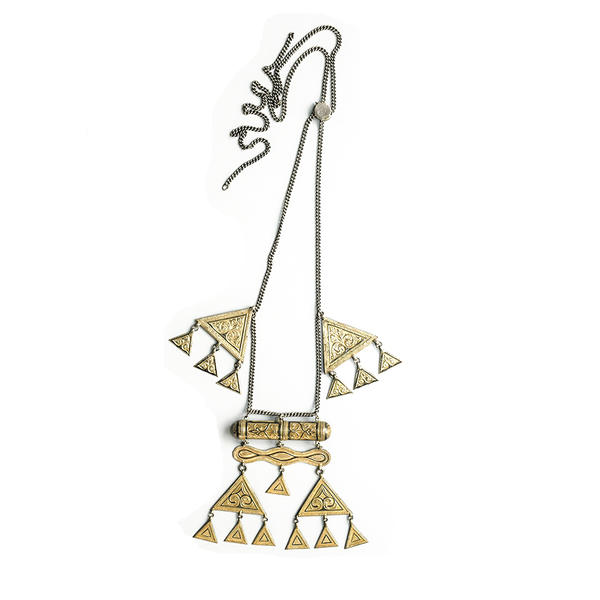
Amulet box for storing quotes from the Koran

Creation period
End of the 19th – beginning of the 20th century
Technique
Forging, minting, casting, blackening, engraving, granulation (silver, gilding).
11
Open in app
#1
Amulet box for storing quotes from the Koran
#4
Most Circassian pieces of jewellery were not only decorative but also had a sacral meaning. They served as talismans against any negative influences. Amulet boxes (in Adyghe ei, ‘dyuah thyl’yl’’) belonged to that type of talismans, and were usually worn by Adyghe women over their national clothes.

A traditional amulet box looked like a silver pendant on a chain. The box was decorated with ancient ornaments, usually vegetal or geometrical, and encrusted with stones: carnelians, turquoise, and lapis lazuli. The Adyghe believed that those minerals had various magical powers. Inside the box, a talisman was placed: an object related to ancient magic. That is how the amulet box became not only a fine piece of jewellery, but a real talisman that protected its owner from misfortunes and even from evil forces.

#5
When the Circassians turned to Islam, they started putting papers with quotes from the Koran into the amulet boxes. The amulet box there was made just for keeping quotes from the Muslim holy book. Experts suppose that this piece of jewellery was created between the end of the 19th and the beginning of the 20th century.
#7
The amulet box was worn as a pendant on a chain put around the neck. It could be hanging down straight, coming below the buckle of the silver belt, or over one shoulder, and then it hang below the waist. The shape of the pendant depended on how it had to be worn. Amulet boxes that hung higher were triangle-shaped, and those worn like present-day bags were rectangular. There were also pendants worn on the chest. They were usually made in the shape of a horizontal cylinder on which a triangular plate was soldered with various charms on it. 
 
Silver was the traditional material of amulet boxes. They were decorated in various techniques common among Adyghe jewellers: gilding, forging, casting, filigree, chiselling, and granulation. With the passage of time, amulet boxes lost their magical meaning and became a purely decorative element. They became smaller, and paper sheets with texts from the Koran did not fit into them anymore.
read morehide
00:00
00:00
1x

Amulet box for storing quotes from the Koran

Creation period
End of the 19th – beginning of the 20th century
Technique
Forging, minting, casting, blackening, engraving, granulation (silver, gilding).
11
Point your smartphone camera to open in the app
Share
VkontakteOdnoklassnikiTelegram
Share on my website
Copy linkCopied
Copy
Open in app
To see AR mode in action:
  1. Install ARTEFACT app for 
  2. iOS or Android;
  3. Find and download the «Paintings in Details» exhibition
  4. Push the «Augmented reality» button and point your phone's camera at the painting;
  5. Watch what happens on your phone screen whilst you flip through the pictures.
 
We use Cookies
Cookies on the Artefact Website. We use cookies to ensure that we give you the best experience on our website. If you continue without changing your settings, we'll assume that you are happy to receive all cookies on the Artefact website. However, if you would like to, you can change your cookie settings at any time.
Learn more about useHide
Content is available only in Russian

X

Нашли опечатку?...

%title%%type%