Font
Color
Graphics
Изображение точки

To see AR mode in action:

1. Install ARTEFACT app for iOS or Android;

2. Find the exhibition «Yamal: the Past and the Present»

3. Push the «Augmented reality» button and point your phone's camera at the exhibit;

Скрыть точки интересаПоказать точки интереса

Akan, Nguhuko, Handicraft bag

0
Open in app
#1
Akan, Nguhuko, Handicraft bag
#2
Akan
#3
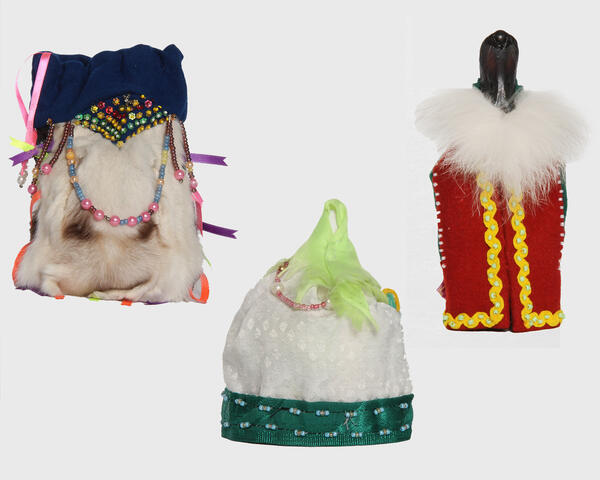
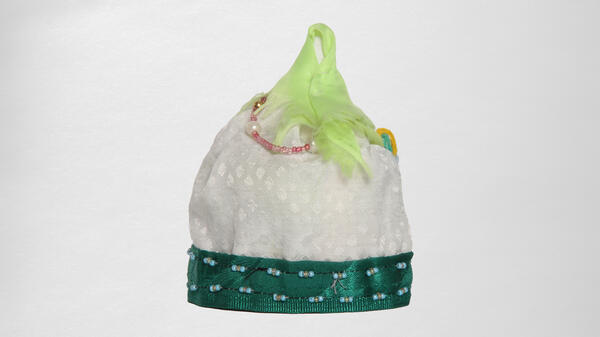
An Akan toy is a traditional Khanty doll. They were popular in the past, but even today, the Khanty, who live along the banks of the Ob River and its tributaries, make such dolls for their children from fabric, woolen cloth or fur.

An Akan toy was a symbolic human figurine and consisted of a head and a torso. Dolls could be male or female. If an Akan doll personified a girl or a woman, her head was sewn in a special way. About 10 multi-colored chintz strips were laid first one on top of the other. Then the head was placed on the fabric that had been folded. All this was wrapped from above in one fabric strip. The female Akan’s head was always covered with a shawl, and a dress embroidered with stripes, beads or ornaments was her body.

A male doll looked different. Its body consisted of a traditional malitsa shirt, embroidered with stripes or ornaments, and two legs made of fabric strips. Male dolls, unlike female ones, were not decorated with beads.

Akan toys were always regarded by Khanty boys and girls as real family members. If parents took their children to visit relatives, the little ones brought their Akan dolls with them. Just like people, the dolls gave gifts to their Akan relatives and received presents in return. Akan toys accompanied children who took them to summer villages and reindeer herders, they went fishing and celebrated holidays together.

The girl’s first doll was made by her mother or grandmother, sometimes by her older sister. As the girl became older, she learnt how to sew Akan toys herself, decorating them with the same pattern that the adults had on their clothes. These dolls were often given to relatives as a gift.

Each Khanty girl had a whole set of dolls and toy accessories. Various miniature household items were made for Akan dolls: little bags for handicraft materials, birch bark boxes, cribs and beds, wooden tableware, hammers and beaters and much more. The girls used these toys to learn about household chores.

Khanty dolls did not have facial features — they were always faceless. The Khanty believed that if a toy with eyes was left unattended or lost in the forest, an evil spirit would enter it, and it would turn into a harmful creature called “pеchak”. It was dangerous for children to play with Akan toys far from home or in the dark, where they could be hurt by an evil spirit. In Nenets mythology, it appeared in the form of “Parne” — a hairy witch with long nails.
#4
Полное наименование: National doll in dress and shawl. Akan
Дата создания: 2008
Техника: fabric, beads, handmade, weaving
Место создания: YaNAO (Yamalo-Nenets Autonomous District)
Размеры: 13.5×9 cm
Коллекция: Ethnography
Правообладатель изображений: MBIC “Muravlenko Ecological and Local History Museum”
№ Госкаталога: 14215181
#5
Ekaterina Katkileva
Nguhuko
#6
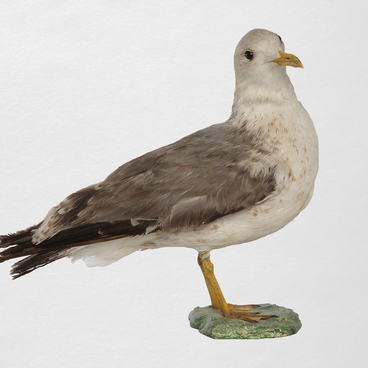
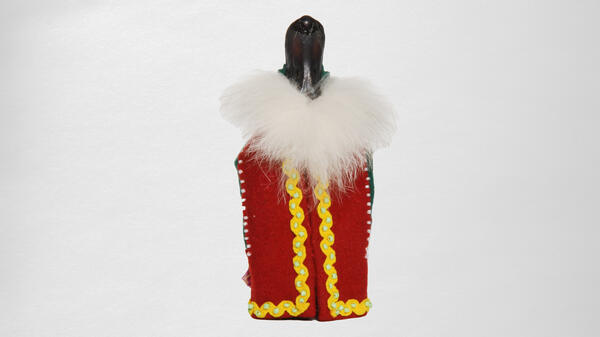
The Nguhuko doll was a traditional children’s toy of the Nenets. It was made on the basis of the beak of a waterfowl. For a male doll, a goose’s upper beak was used, for a female doll, a duck’s one, and for a child doll it was the beak of a small bird. Sometimes the beak was used with the remaining plumage from the forehead.

The use of body parts of waterfowl for toys had sacred significance, since these birds were associated with three elements at once: earth, water and air. The Nenets believed that in winter the birds went south to the spirits of their ancestors, and in the spring they returned back to the people. Therefore, they were strong enough to protect the child from misfortunes and evil spirits. At the same time, the Nenets did not depict a face on the Nguukhko. According to popular beliefs, the doll was not supposed to “see”, otherwise it could come to life and take the child’s soul.

The body of a doll about 15–20 centimeters high was created from a piece of fabric — broadcloth. It was wrapped in the form of a skirt around the base of the beak, hemmed and additionally tied to it with a ribbon made of fabric, which depicted a collar.

These dolls, as a rule, did not have limbs. Hands were sometimes designated by sleeves, and legs seemed to be hidden under the wide hem of a dress or fur coat.

Nguhukos were dressed and decorated with fur, beads, multi-colored ribbons from different fabrics. Usually an odd number of ribbons were used; sometimes they were covered with a triangular ornament. Nguhuko from the collection of the museum of the city of Muravlenko is sewn from fabric of two colors — green and red. The patches are separated by beaded embroidery.

In Nenets families, girls began to prepare early for the role of housewives. Making clothes for Nguhukos, under the guidance of their mother or older sister, from the age of five or six, they learned to sew, cut, and select jewelry. Outfits for the Nguhukos were created in the image and likeness of real national costumes.

Over time, the girls had whole doll families — with adults, children and old people. Small plagues, boats, sledges with toy deer and even household items were made for the Nguhukos: dishes made of fish vertebrae or birch bark, axes, fishing nets and so on.
#7
Полное наименование: Nenets doll with a duck nose. Nguhuko
Автор: Ekaterina Dmitrievna Katkileva
Дата создания: 2006
Техника: cloth, beads, deer hind, handicraft, sewing
Место создания: YaNAO (Yamalo-Nenets Autonomous District), Noyabrsk
Размеры: 15.5×7.5 cm
Коллекция: Ethnography
Правообладатель изображений: MBIC “Muravlenko Ecological and Local History Museum”
№ Госкаталога: 14215139
#8
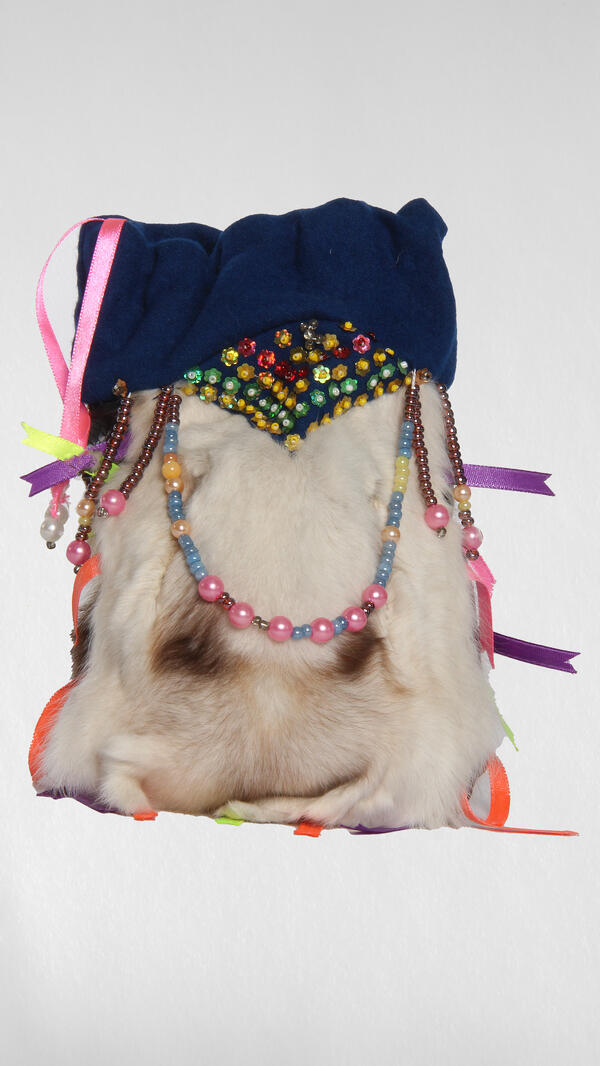
Handicraft bag
#9
In a fur bag, or in a fur sack, the inhabitants of the tundra stored and transported household belongings: clothes, tools, handicrafts, religious objects and much more.

Initially, fur bags were sewn from fox, arctic fox, beaver, squirrel, marten, sable, ermine skins. The peoples who roamed the coast used the skins of seals or nerpa for sacks. Parts of the product were connected to each other using animal tendon threads.

Sacks made from kamus — the hide from the lower part of a deer’s legs — as well as from the hide from the foreheads of deer, gradually became popular. This was due to the development of large-scale reindeer husbandry in the tundra.

There were three main types of Nenets bags: pad, tutsya (tucheyka) and padko.

Padko was the smallest bag. It was tied with a pair of leather strings. Cloth, tendon threads, buttons, small household items were stored in the padko.

The pad was a large and horizontally elongated bag. It was closed with the help of paired straps made of rovduga — tanned leather. Clothes, fur shoes for women and men, skins of fur animals were kept in the pad. Sometimes wood shavings, fur rags, bird feathers were put into it. Usually the bag served for a long time — up to 40-50 years.

The tutsya was a small vertical oval bag. From above, it was closed by pulling a leather strap threaded through the holes in upper part of the bag. Women used this bag to store sewing accessories: pieces of leather, tendon threads, and scissors. A woman always had a tutsya by her side, so the bag wore out very quickly. The museum collection exhibits just this type of a handicraft bag.

To make a tutsya, two pieces of deerskins removed from the head (forehead) of a deer were needed. They were sewn with a strip of fur or rovduga. It also formed the sides, bottom and mouth of the bag. The bottom corners of the bag were rounded.

In contrast to the pad, both the front and back walls of the tutsya were decorated. The front was light and the back was dark. The ornament was inserted the same on both sides, but made it contrasting. The most common pattern was geometric, which was sewn from pieces of white and dark fur. These could be “heads” — a line of triangles with the top turned downward, patterns composed of oblique crosses and meaning “deer antlers”, and others. Strips of colored cloth were often inserted into the seams. The mouth of the bag was not decorated.

The eye holes on the deer’s foreheads were sewn up with strips of fur and trimmed. The preferable colors were red, yellow, and green. Sometimes, triangles of fur with strips of cloth were inserted in the place of the eye sockets. Tassels were sewn along the edges of the bag as a talisman against blindness and deafness.
#10
Полное наименование: Handicraft bag
Дата создания: 2014
Техника: handmade, sewing, fur, cloth, beads
Место создания: YaNAO (Yamalo-Nenets Autonomous District)
Размеры: 15×21×10 cm
Коллекция: Ethnography
Правообладатель изображений: MBIC “Muravlenko Ecological and Local History Museum”
№ Госкаталога: 14221501
#11
read morehide
00:00
00:00
1x

Akan, Nguhuko, Handicraft bag

0
Point your smartphone camera to open in the app
Share
VkontakteOdnoklassnikiTelegram
Share on my website
Copy linkCopied
Copy
Open in app
To see AR mode in action:
  1. Install ARTEFACT app for 
  2. iOS or Android;
  3. Find and download the «Paintings in Details» exhibition
  4. Push the «Augmented reality» button and point your phone's camera at the painting;
  5. Watch what happens on your phone screen whilst you flip through the pictures.
 
We use Cookies
Cookies on the Artefact Website. We use cookies to ensure that we give you the best experience on our website. If you continue without changing your settings, we'll assume that you are happy to receive all cookies on the Artefact website. However, if you would like to, you can change your cookie settings at any time.
Learn more about useHide
Content is available only in Russian

X

Нашли опечатку?...

%title%%type%