Font
Color
Graphics
Изображение точки

To see AR mode in action:

1. Install ARTEFACT app for iOS or Android;

2. Find the exhibition «Ugra Heritage»

3. Push the «Augmented reality» button and point your phone's camera at the exhibit;

Скрыть точки интересаПоказать точки интереса
Показать в высоком качестве

Akan, braids, stripe, handbag

Exhibition
0
Open in app
#1
Akan, braids, stripe, handbag
#15
Akan doll
#3
Akan is a traditional doll of the Ob-Ugrians. The Ob-Ugrian people are called the Khanty and the Mansi, the indigenous population of the Khanty-Mansi Area.

Children of northern peoples played with different toys: boys mastered miniature bows and lassos, used old harnesses and pieces of fishing nets, and girls sewed akan dolls.

They made the toy from tightly rolled up pieces of cloth. For this purpose they used not only cloth — chintz or broadcloth, but also pieces of fur. These dolls had no faces. The Khanty believed that a doll with a face would acquire a soul and could harm a child. It was also believed that if a doll with eyes was left unattended, it could be possessed by an evil spirit.

The first dolls for a girl were made by her mother or grandmother, later, they taught her to sew the akan and clothes for it by herself. Khanty people believed that a girl might be evaluated on her skills in needlework. That’s why girls were taught to sew from an early age, and dolls helped them practice their skills. Adults made sure that akan was made only from scraps of new cloth. The remnants of worn clothes could not be used under any circumstances. It was believed that the material with human scent was a human’s shadow and if someone buried such a doll in the ground, they could send illness or even death to a person.

Often, girls created a whole set of dolls that represented their family. Male dolls were larger than female dolls. They also differed in the clothing, which was sewn like real clothes — with ornaments, headdresses, belts and hoods.

The Khanty people treated dolls with superstition. According to their beliefs, the destiny of the doll is the same as its owner’s destiny. Therefore, girls took care of their dolls, they became talismans and accompanied the women until old age.

The Nefteyugansk History and Art Museum Complex houses a large collection of the Khanty akan dolls, some of them are displayed at the exhibition “Ugra Heritage”. One of the dolls was purchased in 1991, in the art shop of the Regional Museum of Local History. In 2000, it was given to the fund of the museum.

The doll was made of cotton cloth according to ancient canons. The bottom of the dress was decorated with an ornament, which is found on the clothes of the eastern Khanty — it is called “pike”s teeth”.
#19
Полное наименование: Akan doll
Дата создания: the 1990s
Техника: hand sewing
Место создания: the Khanty-Mansi Autonomous Area
Размеры: 13.5×12 cm
Коллекция: History and Art Museum Complex
Правообладатель изображений: History and Art Museum Complex
#16
Faux braids
#22
In the old days, long hair was considered one of the signs of beauty, good health, and well-being among many peoples. Indigenous peoples of Western Siberia were no exception, so they did their best to lengthen the braids. In folklore, many deities, bogatyri (heroes from folk Russian legends), and their wives have braids. While bold people and hairless deities were considered weak and flawed. It is also possible to see the cult of long hair in material culture: even traditional dolls were made with braids to the waist, decorated with beads and pearls.

The Khanty believed that hair brought not only beauty but also spiritual power to a person. There were a lot of superstitions and rules related to hair. When giving a haircut, they made sure hair was not to be thrown in all directions, and then it was forbidden to scatter hair. It was believed that otherwise, the soul would wander looking for its hair.

Not only women but also men wore braids. In the early years of the Soviet regime, the Khanty’s braids were cut off forcefully since the authorities considered braids a thing of the past. However, when the Great Patriotic War was over, the tradition of wearing long hairstyles came back.

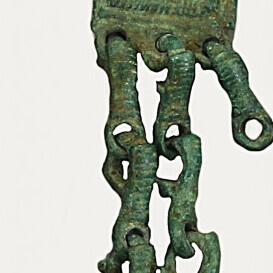
To visually lengthen their hair, women used faux braids. The basis of such an accessory was an oval plate that was covered with broadcloth and decorated with buttons and coins. Its frontal part was heavily ornamented with beads. Two straps made of broadcloth were attached to the occipital part on both sides. Broadcloth straps were wrapped around real hair so that real braids were covered with faux ones. There were not any specific rules for decorations, so everything was a matter of how wealthy and skilled a woman was.

The ethnographic collection of the Museum of the Ob River contains black broadcloth “put lantos” — this is a national name of such faux braids. They were made at the beginning of the 20th century. The braids are wrapped with intertwined woolen multicolored threads to which rings, a copper chain, castings, and buttons are fixed. Since olden times, it was believed that the ringing of metal could scare away evil spirits so metal items in faux braids were not only an accessory but also a woman’s amulet that should protect her from demons.
#21
Полное наименование: Faux braids
Дата создания: the early 20th century
Техника: hand sewing
Размеры: length — 66 cm
Место создания: the Nefteyugansk District
Коллекция: History and Art Museum Complex
Правообладатель изображений: History and Art Museum Complex
#17
Ornamental stripe
#20
The Khanty decorated fur coats, woolen clothes and traditional shoes with ornaments. Ornamental art developed in various ways among different groups of the Khanty. Among the Salym Khanty, after the development of Siberia, it was practically lost along with traditional clothing and way of life. The Yugan Khanty, however, preserve the art to this day. Their ornament is distinguished by a variety of plots, severity and clarity of the pattern design.

To create patterns, the Khanty women used different materials: birch bark, fur, rovduga (suede), broadcloth. They sewed with purchased metal needles, but before they used homemade ones — made from the leg bones of a reindeer or a squirrel, fish bone. When sewing, they put a thimble without a bottom on the index finger — a homemade bone thimble or a purchased metal one. The needles were stored in needle cases, which were made of cloth, fur, cotton fabrics.

Ornaments were often beaded. When and how this material appeared in Siberia, it has not yet been found out for sure. Researchers believe that merchants who came to buy furs could have brought it. Usually, they brought multi-colored opaque beads, sometimes hand-carved from shells. The Khanty purchased white, green, blue, and red beads. White was used as a background, and the rest of the colors were used to create a repeating pattern.

At the same time, an ornament could have several functions: decorative, protective and communicative. Some ornaments were made during a strictly defined time period, for an event. For example, a bear footprint on a mitten was embroidered for a hunter who had killed a bear.

The funds of the Nefteyugansk History and Art Museum Complex contain ornamental stripes made by women of the Yugan group of the Khanty. The exhibition “Ugra Heritage” displays two beaded ribbons. One of them depicts a “pike teeth” ornament in the form of a displaced crooked cross with radial branches. The yellow background and dark circles form another pattern — “heads” with a crooked cross in the center. Usually “pike teeth” are used as an additional finish to the main pattern. Outerwear was decorated with such ornamental stripes, sewn on with homemade tendon threads. The strip was made in 1990 in the Kayukovs yurts of the Nefteyugansk District.
#23
Полное наименование: Ornamental stripe
Автор: Tatiana Alexandrovna Kayukova
Дата создания: 1990
Техника: beading
Место создания: the Nefteyugansk District
Размеры: 141×3 cm
Коллекция: History and Art Museum Complex
Правообладатель изображений: History and Art Museum Complex
#18
Handbag for needlework
#25
Among the Ob-Ugrians, the beauty of a girl was judged by the quality and decoration of her clothes. From an early age, the girl was taught sewing and embroidery, and when growing up, she made outfits for herself. After marriage and the birth of children, the woman sewed for her whole family.

The first handicraft device was given to the girl at the age of six: her mother made a special box for her daughter from birch bark and fir bark. At first, dolls were kept in it, and after that, there were things necessary for sewing and embroidery: tendons, scissors, a thimble, a needle case with needles, and cloth shreds. For these purposes, there were also fur handbags called tuchans. A tuchan could be made not only from fur but also from leather or fabric. The handbag was decorated with embroidery and ornaments, which were supposed to protect the owner from evil spirits, and tassels with coins and beads were sewn on its sides. By the age of 13–15, the girl had several tuchans. The functions of a birch bark box for needlework and a fur bag are similar; however, going to a nomad camp or into the forest, a woman took a bag with her, because it is lighter and more convenient. In a tuchan, women kept not only sewing accessories but also her own amulets. Children’s umbilical cords were also put there.

The Museum of the Ob River houses a collection of traditional Khanty needlework bags. The exhibition “Ugra Heritage” displays the tuchan which was sewn in the 1980s in Punsi yurts located in the Nefteyugansk District. For its manufacture, two skins from the frontal part of the reindeer’s head were used. The skins were sewn with a pile outward, and an ornamented strip of rovduga — suede — was inserted between them. The rovduga stripe is decorated with a mosaic in the form of a horse’s head ornament. The eye holes are sewn up with a blue cloth and decorated with beads. Above the holes, the brow ridges are marked in the form of two ornamental stripes. Also on the tuchan there are two pairs of ears, embroidered with multi-colored beads.

Clasps were not made on the tuchan, instead, a drawstring was used, thanks to which the upper edge could be tightened. A tuchan was with the woman throughout her life, and even after the death of the owner, it was buried with her.
#24
Полное наименование: Handbag for needlework
Автор: Alevtina Kayukova
Дата создания: the 1980s
Техника: hand sewing
Место создания: the village of Kayukovo
Размеры: 30×20×3.5 см
Коллекция: History and Art Museum Complex
№ Госкаталога: 18836260
Правообладатель изображений: History and Art Museum Complex
#14
read morehide
00:00
00:00
1x

Akan, braids, stripe, handbag

Exhibition
0
Point your smartphone camera to open in the app
Share
VkontakteOdnoklassnikiTelegram
Share on my website
Copy linkCopied
Copy
Open in app
To see AR mode in action:
  1. Install ARTEFACT app for 
  2. iOS or Android;
  3. Find and download the «Paintings in Details» exhibition
  4. Push the «Augmented reality» button and point your phone's camera at the painting;
  5. Watch what happens on your phone screen whilst you flip through the pictures.
 
We use Cookies
Cookies on the Artefact Website. We use cookies to ensure that we give you the best experience on our website. If you continue without changing your settings, we'll assume that you are happy to receive all cookies on the Artefact website. However, if you would like to, you can change your cookie settings at any time.
Learn more about cookie useHide
Content is available only in Russian

X

Нашли опечатку?...

%title%%type%