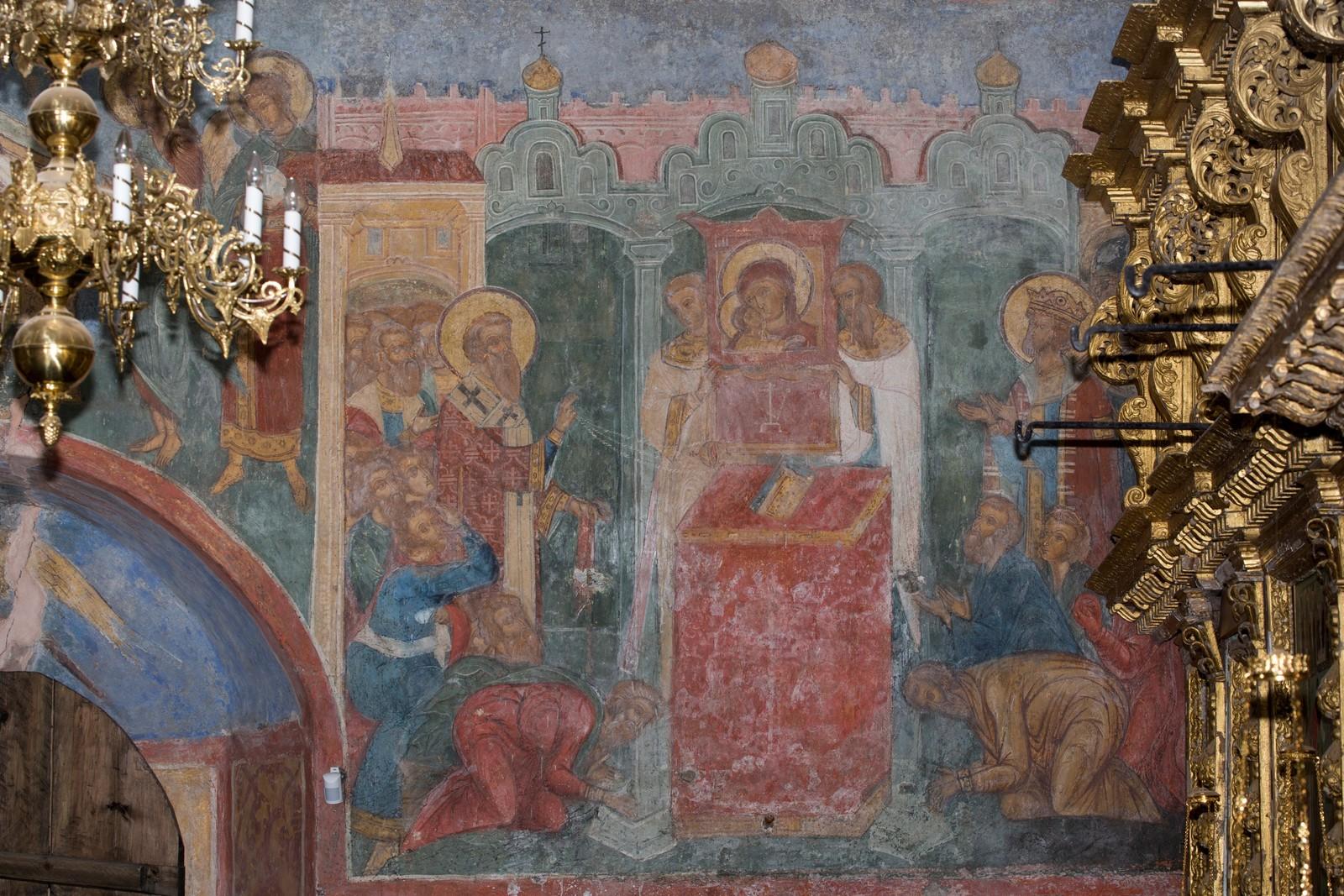



The fresco presents the composition of the Akathist of the Holy Virgin (Kontakion 13): ‘O all-praised Mother Who didst bear the Word, holiest of all the saints, accept now our offering, and deliver us from all misfortune, and rescue from the torment to come those that cry to Thee: Alleluia! “According to researchers, the scene depicts the worship of the icon of Our Lady of Korsun. In the 16th–17th centuries. “Korsun” were called the ancient Byzantine and Russian images of the Virgin, associated with the era of St. Prince Vladimir, who seized Korsun and was baptized in this city. According to legend, one of these icons in 988 was brought by Vladimir from Korsun to Kiev, then transferred to Novgorod, and later to Moscow, where she was located in the altar of the Kremlin’s Assumption Cathedral. On the fresco, among those praying to the image of the Virgin Mary, is Prince Vladimir and, probably, the first Kyiv Metropolitan Michael.
General information:
The Akathist Hymn is one of the most well-loved services of devotion in the Orthodox Church. The Akathist to the Holy Virgin is a praise hymn in Her honor, composed in Byzantium between the 5th and 7th centuries. In the Russian tradition of authorship is attributed to Venerable Roman the Melodist (6th century). The cycle of illustrations of Akathist is traditionally included in the decoration system of the Virgin temples and temples dedicated to other people and events. In ancient Russian monumental painting of the 16th–17th centuries, it is often adjacent to the cycle of the Protoevangelium of James.
Full name: Akathist to the Blessed Virgin Mary. Kontakion 13
Creation Time: 1641
Technique: Fresco, Tempera
Location: North Face