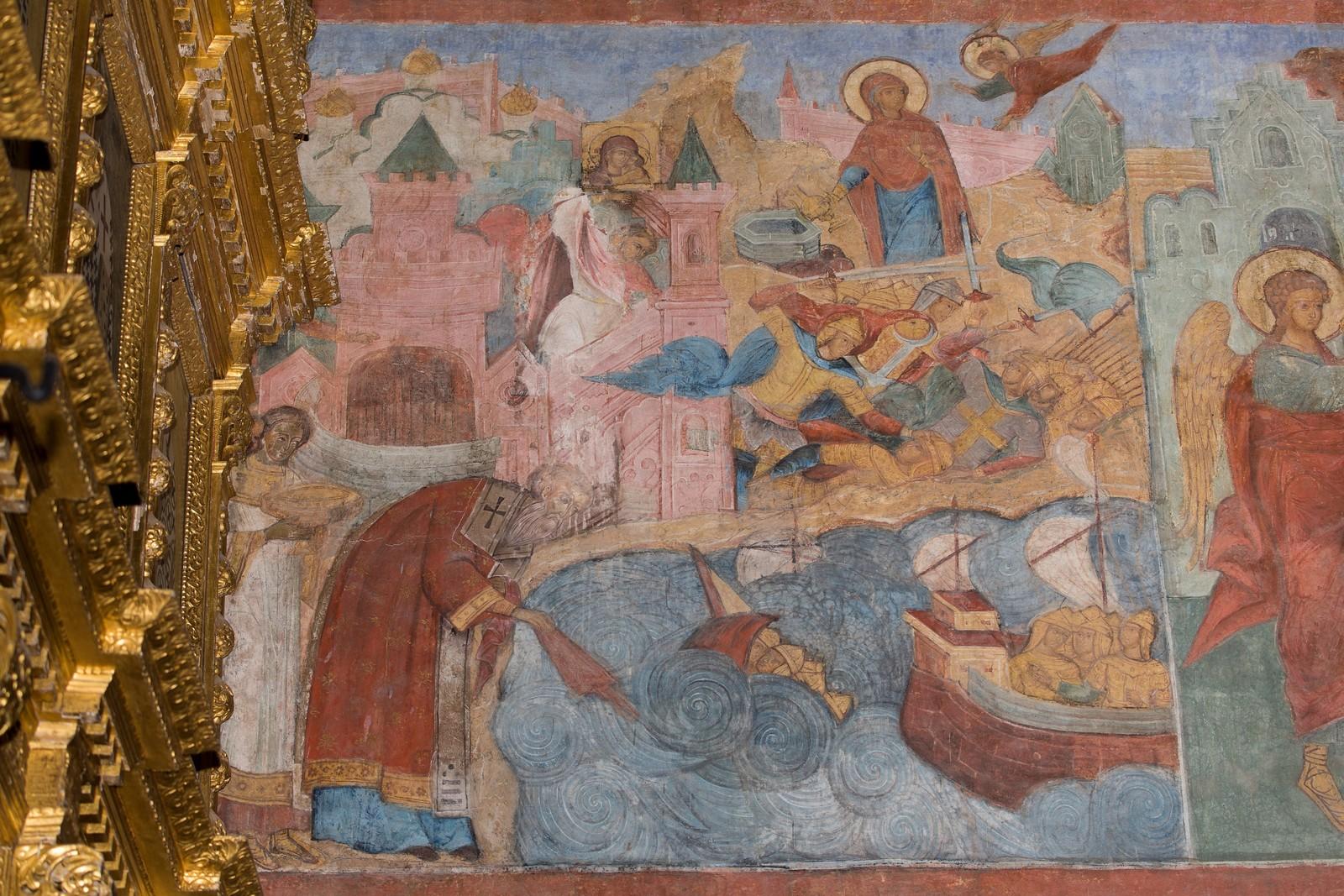



The central part of the composition is occupied by illustration of Akathist to the Holy Virgin Mary (kontakion 1): ‘To Thee, the Champion Leader, we Thy servants dedicate a feast of victory and of thanksgiving as ones rescued out of sufferings, O Theotokos: but as Thou art one with might which is invincible, from all dangers that can be do Thou deliver us, that we may cry to Thee: Rejoice, O Unwedded Bride! ’ According to the Russian fine arts tradition, finally established by the XVII century, the title song of Akathist is represented by two scenes of saving Constantinople by the intercession of the Virgin from the attack of enemies. The upper part of the composition depicts the plot of the liberation of the city from the Avars and the Slavs by the icon of the Mother of God (626), the lower part depicts the scene of the sinking of the fleet of Russian knights Askold and Dir with the help of the Riza of the Mother of God, lowered into the waters of the Bosphorus (860). The composition of the fresco is crowned with an illustration of 1 icon of Akathist (ikos 1): ‘An archangel was sent from Heaven to say to the Theotokos…’
General information
The Akathist Hymn is one of the most well-loved services of devotion in the Orthodox Church. The Akathist to the Holy Virgin is a praise hymn in Her honor, composed in Byzantium between the 5th and 7th centuries. In the Russian tradition of authorship is attributed to Venerable Roman the Melodist (6th century). The cycle of illustrations of Akathist is traditionally included in the decoration system of the Virgin temples and temples dedicated to other people and events. In ancient Russian monumental painting of the 16th–17th centuries, it is often adjacent to the cycle of the Protoevangelium of James.
The full name: The Akathist to the Blessed Virgin Mary. Kontakion 1, Ikos 1
Time of creation: 1641
Technique: Fresco, tempera.
Location: Southern wall


