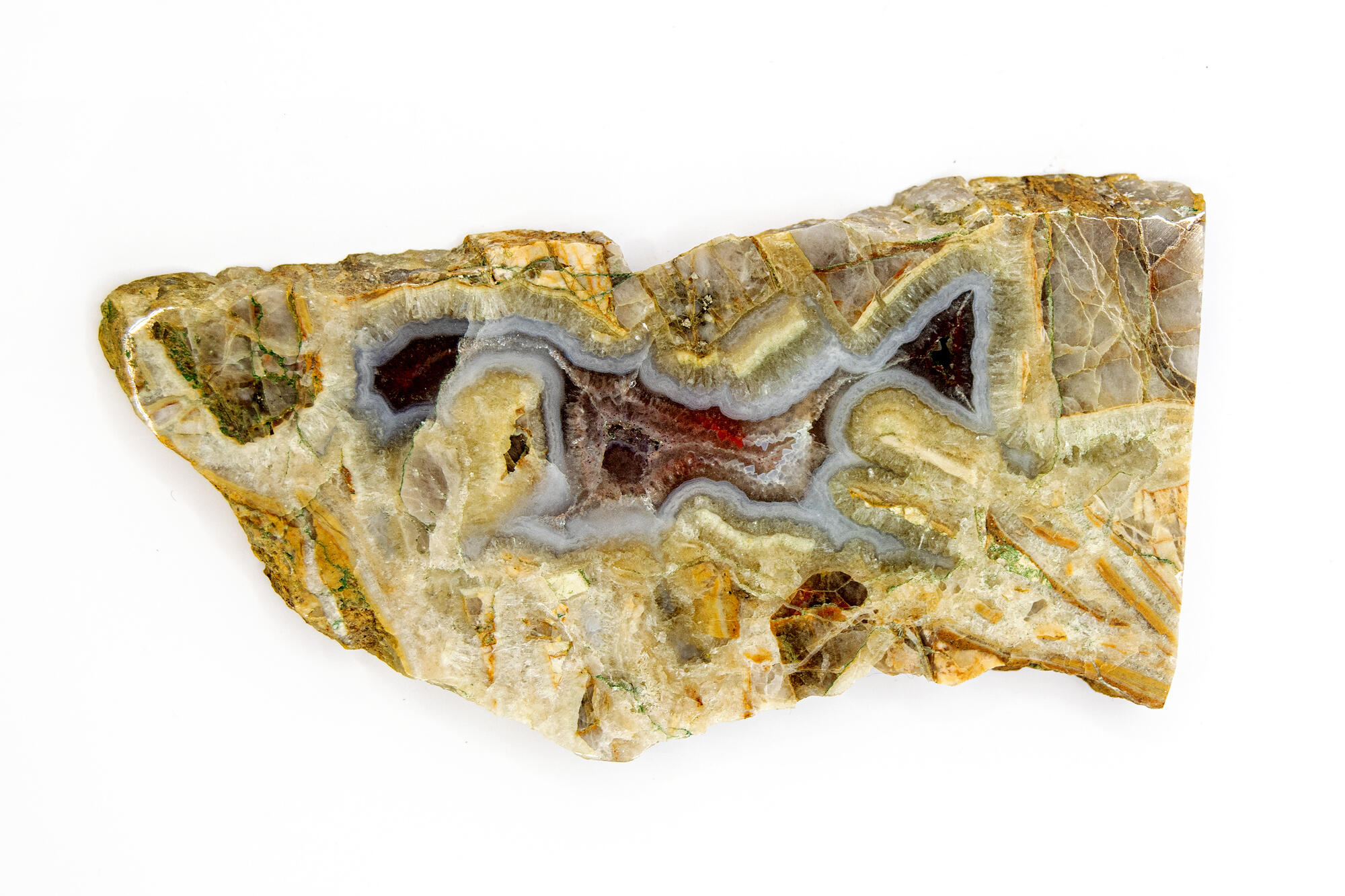


Agate is a mineral, a variety of cryptocrystalline quartz. It is a finely banded chalcedony with a stratified structure and colorful layers. Jewelers also include in this category the chalcedony without layers but with various inclusions that form a specific pattern, such as moss agate, star agate, and others. Most often, the pattern of agate resembles an eye. According to an ancient legend, it is the eye of a heavenly white eagle: after fighting against an evil wizard, it fell to Earth, and its eyes turned into two large agates. The origin of the mineral’s name is still debated. Some researchers suggest that it was produced on the shoreline of the ancient river Achates in Italy. Others believe that the name comes from the Greek word “ἀγαθός” which means “kind”, “happy”, and “good”.
In Yamalo-Nenets Autonomous Okrug, there is an agate deposit called Yagodnoye, which is known all over Russia. The deposit is unique in its origin and is the only agate deposit above the Arctic Circle. Kharbey agate is decorative in structure and is used as a jewelry material and collectible mineral. Agate from this deposit is extremely rare, and not every museum can boast having such a precious artifact. Yagodnoye is currently part of the Kharbey Geological Natural Monument.
Depending on the tectonic
fractures of the rock, Yamal agate has a complex lentoid shape. It is found in
the bedding rock of the Kharbey River. The structure of the ancient Kharbey
metamorphosed block, containing clusters of ornamental chalcedony, was first
described by the famous polar geologist Oskar Backlund in his 1911 book “Rocks
of the Polar Urals”. The Polar Urals agates were further extensively studied by
Valery Grigoriev, a senior researcher of geology at the Ural State Mining
University in Yekaterinburg. He created a large collection of agates which was
partially donated to the Labytnangi Museum of Local History. This exhibit was
collected in the early 21st century, sawed, polished, and handed
over to the museum in 2016.