Font
Color
Graphics
Изображение точки

To see AR mode in action:

1. Install ARTEFACT app for iOS or Android;

2. Find the exhibition «I.A. Bunin museum exhibit»

3. Push the «Augmented reality» button and point your phone's camera at the exhibit;

Скрыть точки интересаПоказать точки интереса
Показать в высоком качестве

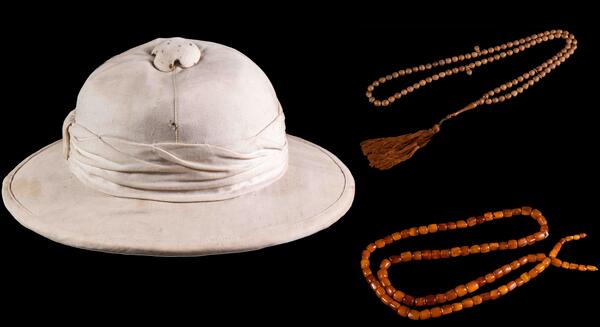
Pith helmet, amber and cypress wood beads

0
Open in app
#1
Pith helmet, amber and cypress wood beads
#15
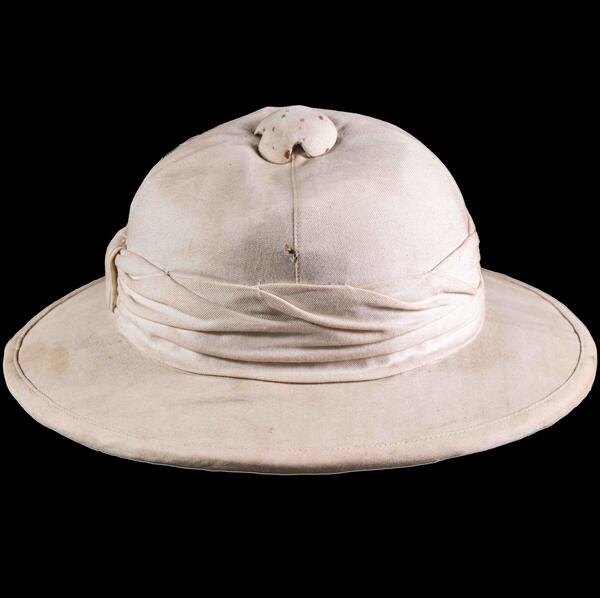
Pith helmet
#2
A pith helmet is a lightweight hat or hard hat which protects the head from the sun rays. Traditionally, they are made from cork or plant fibre and covered with cloth.

The first pattern of such headgear appeared in the 19th century: a unified model of a pith helmet was developed in the 1840s in England for the colonial troops which served in tropical countries. Helmets of this model (Home Service Helmet) remain an element of the formal uniform of the English police even in our time.

Over time, pith helmets became popular civilian headgear. Most often, they were used by travellers during trips to hot countries. Such hats were called ‘panamas’.

The exhibit of the museum presents the famous pith helmet of Ivan Bunin, which he wears in many pictures. This travel hat is made of lightweight and durable cork tree and lined with cotton fabric.

The helmet was one of Bunin’s favourite headgears. The writer bought it in 1907 during a trip to the countries of the East, where he went with his future wife Vera Muromtseva.

This trip marked the beginning of Muromtseva and Bunin’s life together, which lasted 47 years. They met in 1906, and for six months they kept their relationship in secret: relatives and friends of Muromtseva did not approve her pursuit. However, in March 1907, Vera Nikolaevna finally decided to speak frankly with her father and confessed to him: ‘You know, I decided to make a trip to the Holy Land with Bunin’. Nikolai Muromtsev did not comment on his daughter’s desire to spend her life with Bunin – he got up silently, walked up to the sofa, over which a geographical map was put, and began to explain to his daughter where Palestine was.

Ivan Bunin often recalled this trip:
#10
“This is what comforts me when I recall those luminous ancient countries where my feet once stepped, those blessed days when at noon there was the sun of my life, when, at the height of my strength and hopes, hand in hand with the one whom God had chosen to be my companion till death do us apart, I made my first long journey, a marriage journey, which was also a pilgrimage to the Holy Land of our Lord Jesus Christ”.
Bunin I.A.
#17
Full name: Ivan Alekseevich Bunin’s pith helmet
Date: 19-th century
Place: Palestine
Dimensions: Height - 15 см; brims - 35×29 cm
Collection: Museum of I.A. Bunin
Copyright: Budgetary Cultural Institution of the Oryol Region ‘Oryol United State Literary Museum of I.S. Turgenev’
Goskatalog Number: 20514300
#12
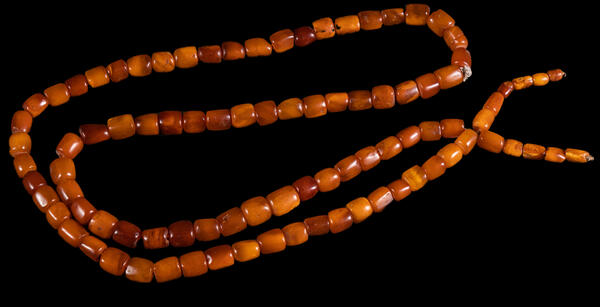
Amber beads
#7
Ivan Bunin brought the amber beads presented in the museum’s exhibit from a trip to the countries of the East, where he went with Vera Muromtseva, his future wife, in the spring of 1907. In the philosophical essay-story “The Rose of Jericho” the classic recalled this trip: “This is what comforts me when I recall those luminous ancient countries where my feet once stepped, those blessed days when at noon there was the sun of my life, when, at the height of my strength and hopes, hand in hand with the one whom God had chosen to be my companion till death do us apart, I made my first long journey, a marriage journey, which was also a pilgrimage to the Holy Land of our Lord Jesus Christ”.

On April 10, Bunin and Muromtseva left Moscow for Odessa, from where they arrived by steamer to Constantinople. Further, their path lay to Africa, to Egypt. Ivan Alekseevich and Vera Nikolaevna visited Jaffa, Ancient Judea and arrived in Jerusalem along the Saron Valley. After, the Bunins made a trip to Hebron and Bethlehem, visited Jericho, the Dead Sea. Upon returning to Jerusalem, they travelled north through Jaffa: to Lebanon and Syria – to the cities of Beirut, Baalbek, Damascus, Gennisaret, Tiberias and Tabgha.

Vera Muromtseva described this journey in her book “Conversations with Memory”. She left especially detailed memories of Jerusalem and Bethlehem: “On the eastern slope of the hill, the densely crowded houses turned yellow: Bethlehem! It is a small town surrounded by cultivated fields, with the Church of the Nativity of Christ towering over it, in front of which we stopped. The church is two-story, also kind of joyful. A star, the place where the manger located, – is on the floor in the lower church”. Muromtseva also recalled how she and Bunin bought the beads: “On the marble parvis, right on the stones, all kinds of beads, crosses, holy pictures, pearl, cypress and others are laid out for sale. Our pilgrims leave the Temple – it is touching to see them here, far from their homeland, in an atmosphere alien to them, earnestly and reverently crossing themselves and bowing down to earth. Many of people have tears of joy in their eyes from the executed oath – to worship the Holy Sepulcher”.

These amber beads appeared in the museum funds in 1977. The museum purchased them from the niece of the writer’s cousin Natalia Budatinskaia for 80 rubles.
#18
Full name: Amber beads
Date: 19-th century
Place: Palestine
Dimensions: Hight - 58 cm
Copyright: Budgetary Cultural Institution of the Oryol Region ‘Oryol United State Literary Museum of I.S. Turgenev’
Collection: Museum of I.A. Bunin
Goskatalog Number: 20514296
#13
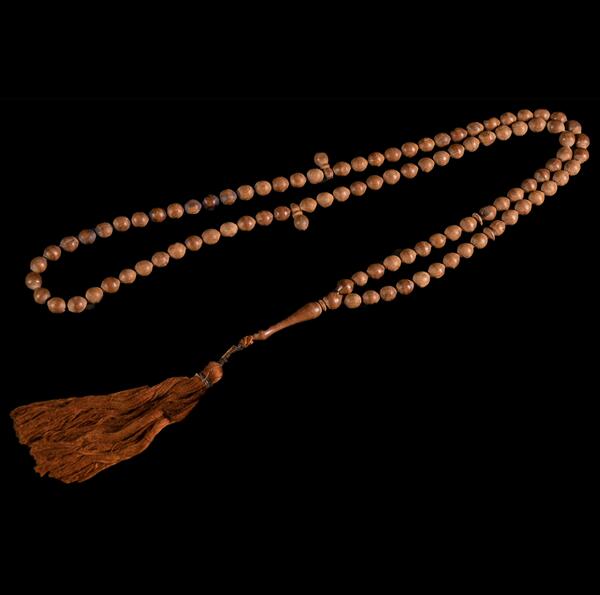
Cypress wood beads
#9
The exhibit presents elegant cypress beads of Ivan Bunin. They consist of small balls, closely spaced to each other, and several flat discs. The beads are completed with a brush of brown threads.

Bunin brought these beads from a trip to the countries of the East, where he went with his future wife Vera Muromtseva in 1907.

Bunin and Muromtseva left Odessa and went through Constantinople to Egypt. From there they went to Jaffa, visited ancient Judea, Jerusalem. They made a trip to Hebron and Bethlehem, visited Jericho and the Dead Sea. Upon returning to Jerusalem, they went by sea through Jaffa to the north, to Lebanon and Syria, where they stayed in Beirut, Baalbek, Damascus, Gennisaret, Tiberias and Tabgha.

Vera Muromtseva preserved detailed memories of the trip of 1907 in her book ‘Conversations with Memory’. She paid special attention to the description of Jerusalem and Bethlehem.

‘We enter the courtyard paved with stone slabs, walk slowly, with some caution, and look eagerly at the heavy façade of the Temple. I feel with chagrin that it is impossible to go around the Temple – everything around is closely built up with some kind of high stone buildings.

All kinds of beads, crosses, holy pictures, pearl, cypress and others are laid out for sale on the marble porch, right on the stones. Our pilgrims leave the Temple – it is touching to see them here, far from their homeland, in an atmosphere alien to them, earnestly and reverently crossing themselves and bowing down to earth. Many of them have tears of joy in their eyes from the executed oath - to worship the Holy Sepulcher…

Calvary is the second floor of the church. Here we stand for quite a long time in gloomy silence, in a kind of eerie stupor… The Orthodox worship is taking place below, in the underground church. But we are still impressed by Calvary, and pomp and splendour of the divine worship leave us cold…

The road goes uphill; we drive past the Tomb of the Virgin Mary, past the Garden of Gethsemane – we decide to see around it on the way back, – then we go up the slope of the Mount of Olives. All around are the same glaucous-grey blocks, with nests of bright red poppies…

The Mount of Olives, as I have already mentioned, is crowned with an Orthodox church, very Russian, and it does not fit with the gloomy desolation of Judea at all; besides, as if on purpose, its domes are painted with a deep blue…

The densely crowded houses turned yellow on the eastern side of the hill: Bethlehem!

It is a small town surrounded by cultivated fields, with the church of the Nativity towering over it, in front of which we stopped. The church is double-stored, also looks as joyful. A star, the place where the manger located, – is on the floor in the lower church.

We stood for a long time on the white staircase of the church under a vaulted stone canopy. The sun rose high and joyfully flooded this happy of the happiest cities, and the spacious valley, hilly to the east, closed by the Moab mountains, the homeland of Ruth…’
#19
Full name: Cypress wood beads
Date: 19-th century
Place: Palestine
Dimensions: Hight - 58 cm
Collection: Museum of I.A. Bunin
Copyright: Budgetary Cultural Institution of the Oryol Region ‘Oryol United State Literary Museum of I.S. Turgenev’
read morehide
00:00
00:00
1x

Pith helmet, amber and cypress wood beads

0
Point your smartphone camera to open in the app
Share
VkontakteOdnoklassnikiTelegram
Share on my website
Copy linkCopied
Copy
Open in app
To see AR mode in action:
  1. Install ARTEFACT app for 
  2. iOS or Android;
  3. Find and download the «Paintings in Details» exhibition
  4. Push the «Augmented reality» button and point your phone's camera at the painting;
  5. Watch what happens on your phone screen whilst you flip through the pictures.
 
We use Cookies
Cookies on the Artefact Website. We use cookies to ensure that we give you the best experience on our website. If you continue without changing your settings, we'll assume that you are happy to receive all cookies on the Artefact website. However, if you would like to, you can change your cookie settings at any time.
Learn more about useHide
Content is available only in Russian

X

Нашли опечатку?...

%title%%type%