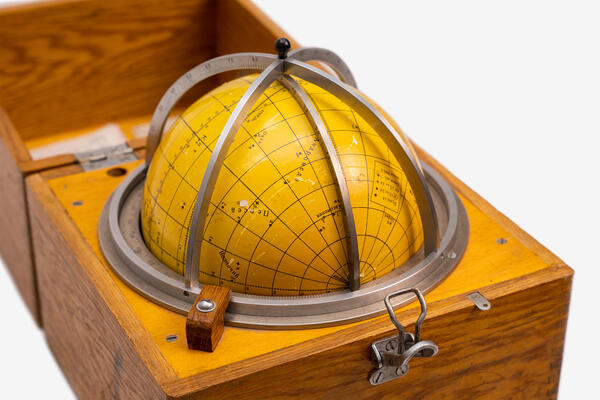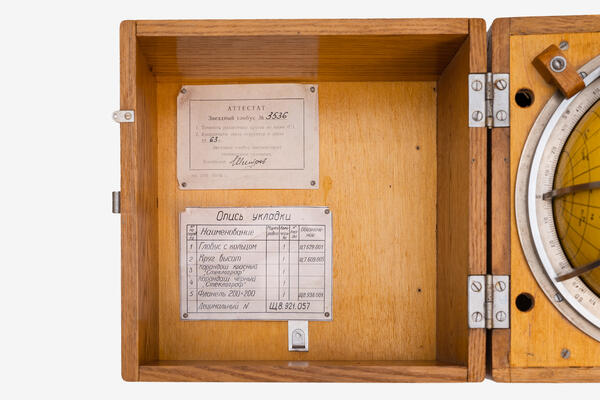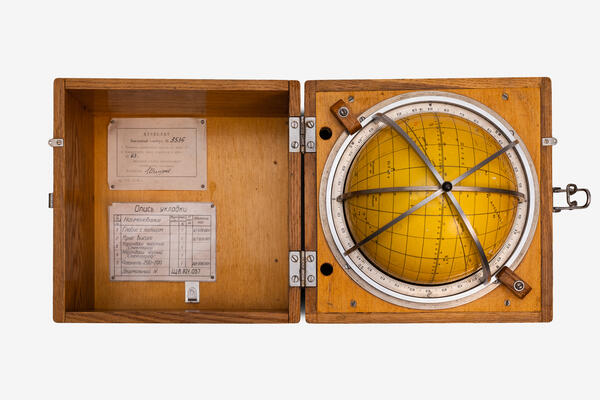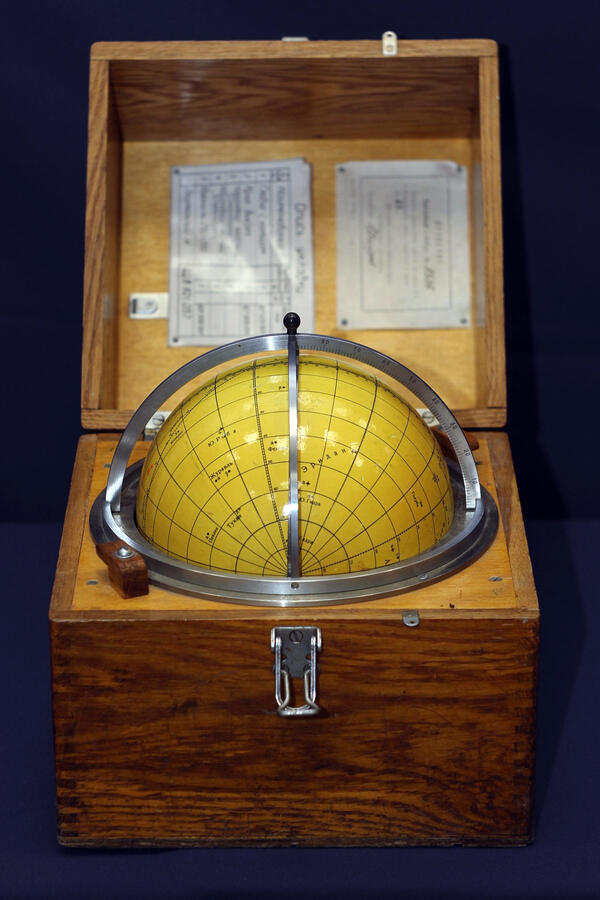
The celestial globe is a device designed to address the challenges of nautical astronomy and to study the starry night sky and movement of celestial bodies. This globe is a representation of the celestial sphere, which allows users to determine the names of stars, coordinates of celestial objects, and other relevant information at a given time. With a celestial globe, one can identify specific stars and celestial bodies, determine their coordinates (h, A, t), and select those that are most convenient and beneficial for determining ship location using astronomical methods. Additionally, such a globe can be used to determine azimuth, approximate times of sunrise and sunset for each celestial body, and more.
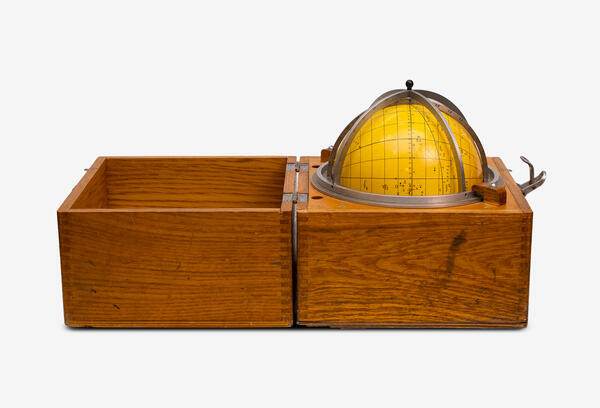
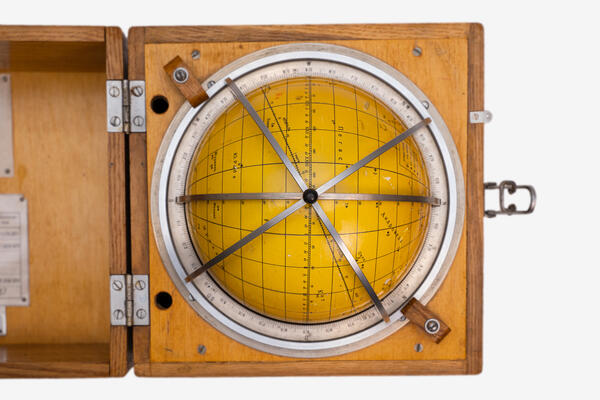
The equator, the ecliptic plane, the declination circles, the celestial parallels, and the main constellations and stars are all plotted on the globe. The celestial equatorial circle is subdivided into degrees. A metal ring representing the meridian of the observer’s location is attached to the sphere. Inside the ring, the celestial globe rotates around an axis that is perpendicular to the celestial equator. The globe, along with the ring, is housed in a wooden case, at the bottom of which is a flat metal ring that serves as a true horizon. This ring is graduated and marked with the letters N, S, Ost, and W (North, South, East and West).
If a celestial globe is placed in a box, one half of its surface will be above the horizontal plane, and the other half will be below it. The metal ring, acting as the meridian for the observer, will be perpendicular to the true horizon of the globe, running along the north (N) and south (S) points. A circular crosspiece representing the vertical is placed over the globe. A vertical is a great circle of the celestial sphere that passes through the zenith and a specific point on the globe. The verticals are graduated, and a sliding pointer can be moved along one of these lines. The accuracy of measurements made with a celestial globe depends on the calibration of the circles (within 1–2 degrees).
The star globe displays the positions of stars in a mirrored image compared to their actual positions in the sky. This is because the observer looks at the globe from the outside, but sees the celestial sphere from the “inside”.
The first mentions of globes date back to the 4th and 3rd centuries BC. The oldest surviving example is believed to be the “Earth Apple”, created by the German cartographer and navigator Martin Behaim. This globe, which was made between 1493 and 1494, was commissioned by the Nuremberg city council. The first, or one of the earliest, globes to arrive in Russia was brought by Dutch ambassadors as a gift for Tsar Alexis of Russia. It was crafted by master Wilhelm Janssen Bleu. Subsequently, it became part of the collection of the State Historical Museum.