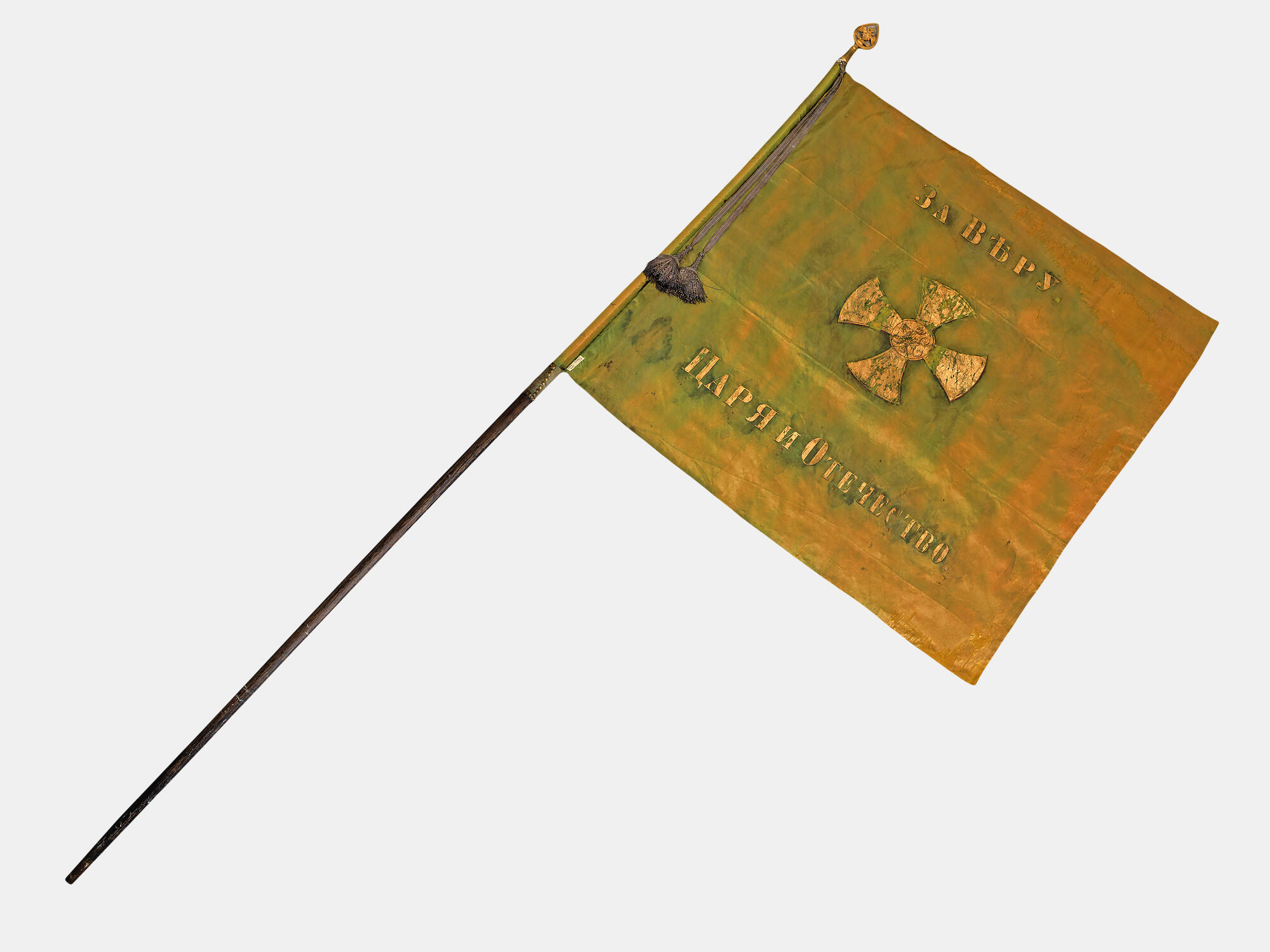


The exhibition presents a double-sided banner made of green silk fabric. Each side consists of three parts, which are interconnected by a seam. On each side there is an identical image — a militia cross with the monogram of Nicholas I. Above and below is the inscription “For Faith, Tsar and Fatherland”. The inscription and the cross are made in gold using distemper painting
On March 30, 1856, the Crimean War ended. It was an unsuccessful campaign for the Russian state, but it also showed the selfless courage and heroism of the Russian people. In the history of Russia, people’s militias were formed during the Time of Troubles and the invasion of Napoleon Bonaparte. The heroic militia of 1941 have not been forgotten. However, few people have heard about another such force — about 350,000 Russian peasants who defended the borders of the Fatherland during the difficult Crimean War.
In March 1854, England and France, at that time the strongest colonial powers on the planet, declared war on the Russian Empire. The armies of Paris and London became allies of the Ottoman Empire, which, six months prior, had already engaged in a military conflict with Russia.
On January 29 (February 10, New Style), 1855, the tsar’s manifesto “On Calling Forth the State Militia” was published.
Militia members had to leave their place of residence and move from the inner provinces to the front lines, as well as to the sections of the Russian border and the coast that were under attack. Hence, the new militia was called “mobile”. The tsar entrusted the organization of the militia and the gathering of contributions for it to the local assemblies of the nobility.
Usually, each uyezd (county) formed one druzhina (unit) — according to the rules, it was supposed to have 19 noble commanders and 1069 ratniks (ordinary militia soldiers). By the summer of 1855, 198 militia units were formed in the central provinces of Russia, with a total of 203,000 soldiers. The units were designated by numbers and place of formation; each unit received its own banner — a green silk piece of fabric with a golden cross and an inscription “For Faith, Tsar and Fatherland.”
It is established that on May 23, 1855, in total,
the Kostroma militia included 11,003 soldiers of lower ranks from the
townspeople and peasants and 199 officers from the nobility. The head of the
Kostroma militia, at the request of the nobility, was approved by the actual
state councilor Fyodor Ivanovich Vaskov. He was a participant in the Patriotic
War of 1812, fought as a lieutenant near Smolensk and in the Battle of
Borodino, was wounded, and later took part in the foreign campaign of the
Russian army in 1813–1814.


