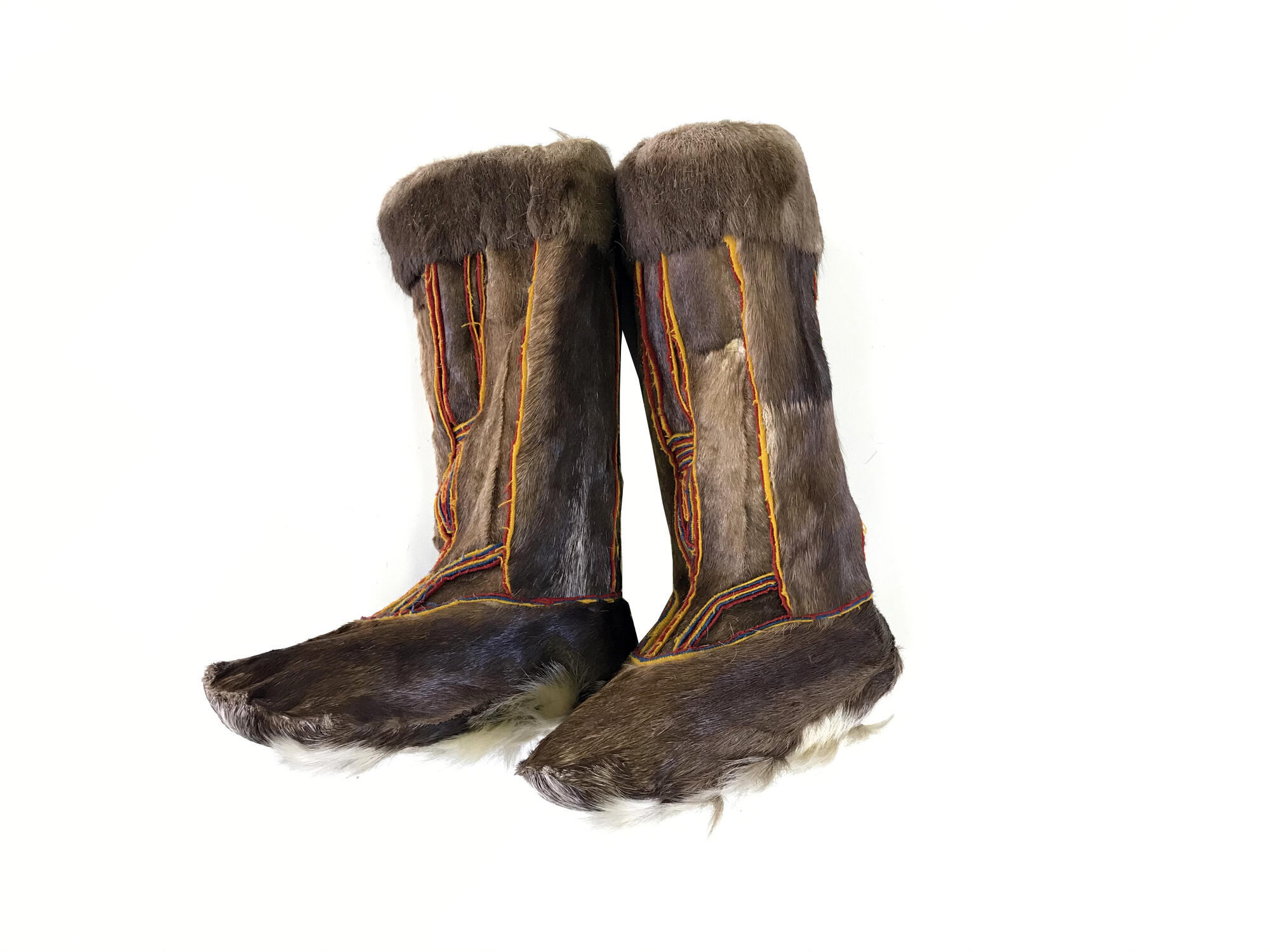


Knee-high fur boots are called “kisy” in the Khanty language. It is a type of traditional winter footwear of the indigenous peoples of the North. Such boots with a thick sole are sewn from “kamuses” — the skin taken from the legs of the deer.
The kisy from the collection were sewn by Maina Rusmilenko, who comes from the Vanzevat village of the Beloyarsky district of Ugra, in 2008. To make these boots, the craftswoman used deer fur, cloth, and tendon threads.
In the old days, the Khanty women sewed clothes and shoes mostly in winter. The material was prepared, processed, and selected by color well in advance. Dark and light contrasting fur was used for the kisy. The skins were folded with the pile inward, and the details of future shoes were cut out with a sharp knife. After the pattern was ready, the fur was sewn from the inside out and then everted. Then, a sole was made of the so-called “brushes” — the skin between the deer’s hooves — and sewn to the boots. This fur was very coarse, so the snow did not stick to these boots and the non-slip soles came handy.
Kamuses were selected so that contrasting pieces of fur formed an ornament. Women’s kisy differed from men’s in the cut and design of the front part. Sometimes they were made with a small heel. In women’s boots, the lower part of the side fabric strips is made in such a way that it is convenient to decorate them with ornamented applications.
Winter boots were decorated quite modestly, unless they were part of a festive costume. The main decoration was a colored fabric trim. It was used to make the seams. Sometimes the front part of the kisy was decorated with a colored cloth or an ornament performed in the fur mosaic technique.
These were winter boots, but, for example, the northern Khanty wore fur kisy even in summer. These warm and comfortable boots were indispensable during a long walk or moving from one place to another. The kisy protected the feet from cold and moisture, even when the temperature dropped below 50 degrees Celsius. When the boots were changed for lighter leather shoes, for example, “nirs” (traditional women’s footwear), they were put away for storage in special bags or hung on poles. Thus, the shoes were protected from rodents and other pests.
The kisy from the collection were sewn by Maina Rusmilenko, who comes from the Vanzevat village of the Beloyarsky district of Ugra, in 2008. To make these boots, the craftswoman used deer fur, cloth, and tendon threads.
In the old days, the Khanty women sewed clothes and shoes mostly in winter. The material was prepared, processed, and selected by color well in advance. Dark and light contrasting fur was used for the kisy. The skins were folded with the pile inward, and the details of future shoes were cut out with a sharp knife. After the pattern was ready, the fur was sewn from the inside out and then everted. Then, a sole was made of the so-called “brushes” — the skin between the deer’s hooves — and sewn to the boots. This fur was very coarse, so the snow did not stick to these boots and the non-slip soles came handy.
Kamuses were selected so that contrasting pieces of fur formed an ornament. Women’s kisy differed from men’s in the cut and design of the front part. Sometimes they were made with a small heel. In women’s boots, the lower part of the side fabric strips is made in such a way that it is convenient to decorate them with ornamented applications.
Winter boots were decorated quite modestly, unless they were part of a festive costume. The main decoration was a colored fabric trim. It was used to make the seams. Sometimes the front part of the kisy was decorated with a colored cloth or an ornament performed in the fur mosaic technique.
These were winter boots, but, for example, the northern Khanty wore fur kisy even in summer. These warm and comfortable boots were indispensable during a long walk or moving from one place to another. The kisy protected the feet from cold and moisture, even when the temperature dropped below 50 degrees Celsius. When the boots were changed for lighter leather shoes, for example, “nirs” (traditional women’s footwear), they were put away for storage in special bags or hung on poles. Thus, the shoes were protected from rodents and other pests.