The first klaxon horns for sound signals appeared in the 19th century. The horse-drawn vehicles had an attached horn, blown by the coachman. Over time, for convenience, a rubber bulb was attached to it, to pump air by hand.


Car Klaxon Horn, The book: Life of Jesus
Creation period
1st third of the 20th century
Exhibition
0
Open in app#1
Car Klaxon Horn
#2
#3
In the second half of the 19th century, cars had to move slowly: a man walked in front of them, waving a flag by day or holding a lantern by night. However, this was a very impractical way of warning passers-by about the danger of getting run over; so they started attaching klaxon horns to cars.
#4
The first klaxon horns were rather quiet: the sound they made was drowned out by the roar of the car engine. In addition, pedestrians confused such horns with bicycle bells and were not always quick enough to give way to cars.
#5
In 1899, Russian engineer Boris Lutskoy developed an electric klaxon horn, attached it to a car of his own design and demonstrated it at the Berlin exhibition. But at that time, electrical machinery was at an early stage of development, it was regarded with suspicion, and the idea was not implemented.
The classic electric car horn was designed by inventors Rhys Miller and Thomas Edison. The horn that they created and patented in the 1910s was an electric device with gear rotation. The number of cars in the US grew, and new klaxon horns came in handy.
#6
The word klaxon means to howl or to make noise in Greek. The device was associated with the company Klaxon Signals Ltd., which started working on the production and distribution of horns in 1908, based on the idea of Reese Miller and Thomas Edison. These were improved mechanical devices that consisted of a spring plate with a rivet lock in the center. The plate touched the gear of the device, and it made a specific sound. To amplify the signal, a special horn was attached to the device.
#7
Even though electric klaxons were convenient, they took some time to supplant the horns with bulbs. For some time they existed in parallel: the electric claxon looking like a horn with wires was mounted on the vehicle body, while the rubber bulb horn was placed near the windshield.
#8
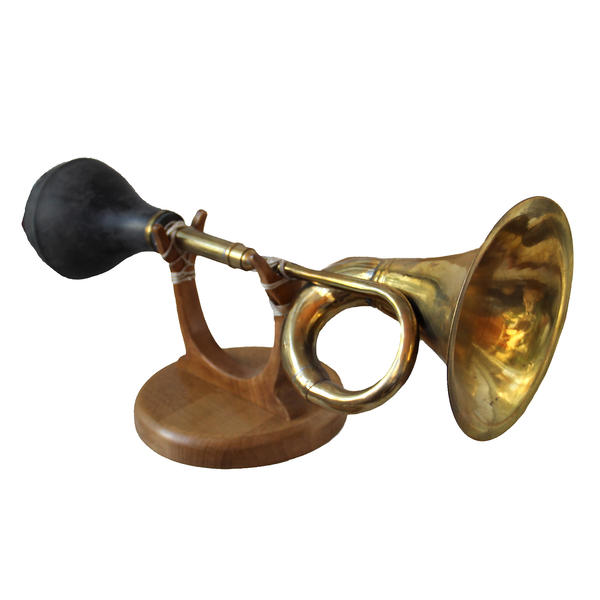
The klaxon horn shown in the museum horn was made in the first third of the 20th century and works like a bicycle horn. The flow of air from a hand-pumped bulb creates sound vibrations in the pipe. The horn has a large horn that amplifies the sound, making it sharp and loud.
#9

#10
The book: Life of Jesus
#11
David Friedrich Strauss was born in 1808 to the family of a merchant but received religious upbringing. Therefore he excelled at the knowing of texts from the Holy Bible. He resisted his own rational thinking for a long time and tried to take all theological tenets on faith. But he came to know the works of such philosophers as Schleiermacher and Hegel and they finally changed his attitude to religion. Strauss wrote:
#12
‘He who dislikes the modern church and theology for the fact that they consider the Christian religion a supernatural revelation, its founder − the Godman and his life a continuous chain of miracles, he can most likely reach his goal by historical research’.
#13
In 1831, he quit the position of a vicar to attend the lectures of Hegel and Schleiermacher. It was their face-to-face meeting with the philosophers that gave him the idea of writing the Life of Jesus – his most important scientific and religious work – and he made the first outline of the work. It was published in 1835 and greatly impressed both religious scholars and the broad general public.
#14
In his work David Strauss proved that the Gospel was devoid of historical credibility and came up with the hypothesis that most of its texts had originated from popular myths about the death of Christ and the events that followed. Such myth-making, in his opinion, was not deliberate. People just related legends and traditions to one another and, as a result, the stories acquired new details. In the end, actual Jesus Christ, a historical person, was showered with made-up traits and turned into a literary character. David Strauss considered God the source of natural laws, and such perception negated divine miracles.
#15
The academic community and the public had a heated discussion. With the book published, the school of Hegel, whose philosophical works were the source of Strauss’ admiration and aspiration, was split into two conflicting camps — the left and right Hegelians.
#16
Impacted by the published book, Strauss’ teacher, Ferdinand Christian Baur, set up the Tübinger Schule, which relied on the theses laid down in the Life of Jesus. Strauss himself paid the price for his free thinking by being transferred from the cultural centre of Germany to the south-western suburb and demoted from the position of a tutor in the theological institution in Tübinger to the position of a junior school teacher in a lyceum. From 1836, he finally quit his job to take up free literary activity: he wrote scholarly papers, revised his early essays, wrote the biographies of prominent contemporaries and composed poems.
#17
The appearance of the first part of the book Life of Jesus in the museum is connected with the history of the building. The volume was discovered in the attic of the Clodt mansion during the first renovation in 1994-1995. The paper was translated into Russian in 1907, and now the book is deemed an antiquarian rarity.
read morehide
00:00
00:00
1x
Car Klaxon Horn, The book: Life of Jesus
Creation period
1st third of the 20th century
Exhibition
0
 Point your smartphone camera to open in the app
Open in app
Share