Font
Color
Graphics
Изображение точки

To see AR mode in action:

1. Install ARTEFACT app for iOS or Android;

2. Find the exhibition «The Ethnography of the Adyghe People»

3. Push the «Augmented reality» button and point your phone's camera at the exhibit;

Скрыть точки интересаПоказать точки интереса
Показать в высоком качестве

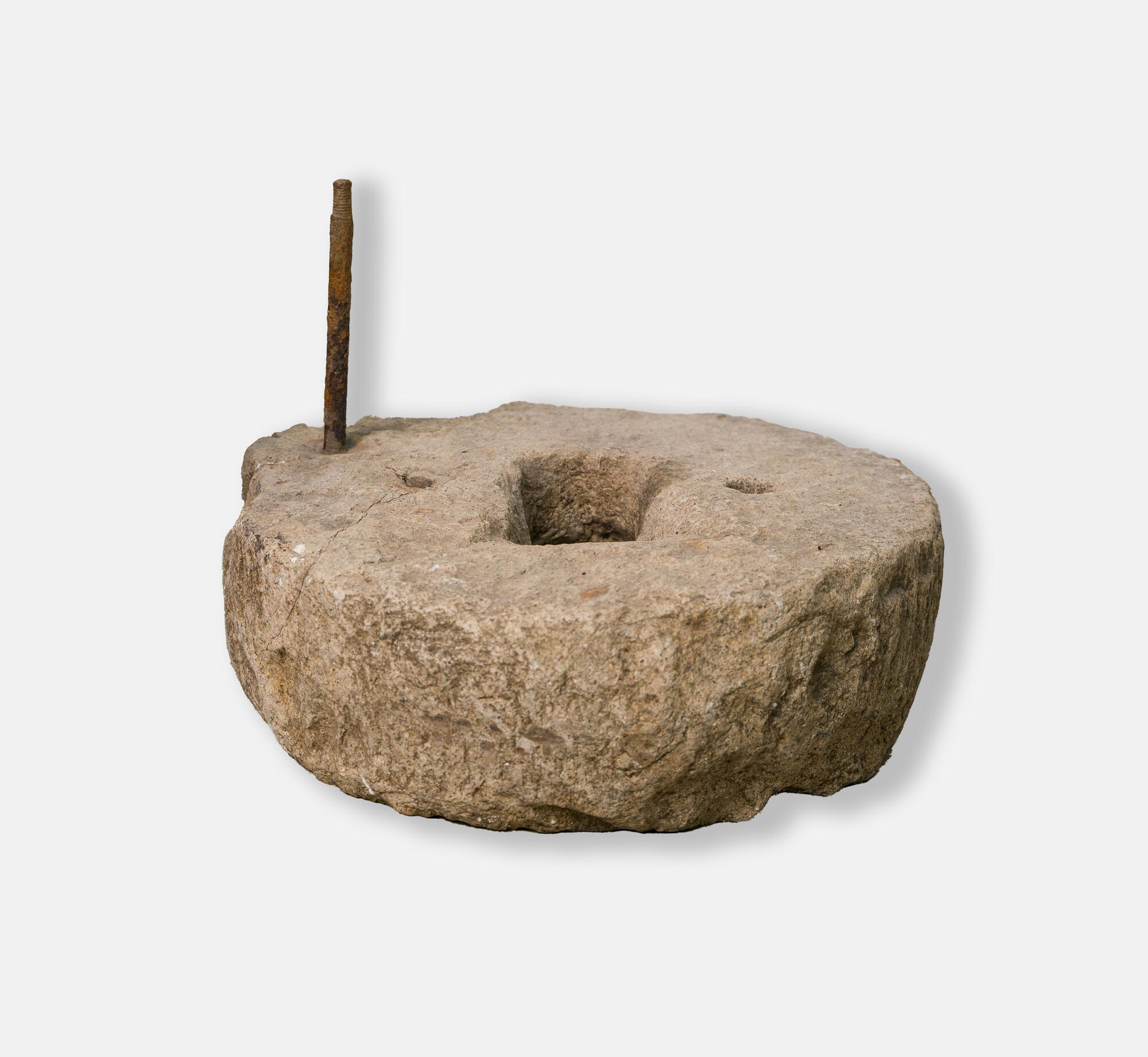
Millstone

Creation period
the 1930s
Place of сreation
the USSR
Dimensions
diameter — 39 cm, the thickest part of the disk — 8 cm, the diameter of the opening in the middle (eye) — 8 cm
Technique
natural rock
0
Open in app
#2

A millstone is set into motion by turning a wooden rod. Grains are ground when they fall between opposite furrows of the two stone disks, both of which need to be properly tuned. Poorly balanced millstones produce poor-quality flour.

A special kind of fine-grained sandstone was considered ideal for making millstones for its firmness and durability.

In the old days, almost every household had this simple, but essential device. In villages, there was a special group of craftspeople who manufactured millstones. During its use, the millstone became worn out, as its surfaces became smooth and inefficient. Therefore, under high workloads, stone disks had to be redressed.

For grain processing, the Adyghe people used several devices. Wooden mortars were used to separate grains from the husk. Once everything was separated, grains were sent to mills or ground manually using hand mills.

The body of a hand mill was made of wood and the millstones could be either wooden (for coarse flour) or made of stone (for finer flour). Traditional millstones were around 70 centimeters in diameter so as to not be too bulky and remain suitable for use at home. At the same time, their design made it possible to grind any kind of cereals and grains without making much effort.

The natural scientist Karl Koch said:

#3
The Circassians [Adygs] do not have barns, and they keep grains in so-called mows [a large stack of hay, straw or non-threshed wheat kept outside]. ˂…˃ Since the Circassians rarely bake bread, flour mills are used just as rarely and are rather primitive. As a rule, millet is ground in a mortar. If they want to peel it, they use two blocks of solid wood. To make flour, they use a kind of millstone and turn it with their hands. Only occasionally does one see small simple mills with horizontal wheels.
#5
View in the State Catalogue
read morehide
00:00
00:00
1x

Millstone

Creation period
the 1930s
Place of сreation
the USSR
Dimensions
diameter — 39 cm, the thickest part of the disk — 8 cm, the diameter of the opening in the middle (eye) — 8 cm
Technique
natural rock
0
Point your smartphone camera to open in the app
Share
VkontakteOdnoklassnikiTelegram
Share on my website
Copy linkCopied
Copy
Open in app
To see AR mode in action:
  1. Install ARTEFACT app for 
  2. iOS or Android;
  3. Find and download the «Paintings in Details» exhibition
  4. Push the «Augmented reality» button and point your phone's camera at the painting;
  5. Watch what happens on your phone screen whilst you flip through the pictures.
 
We use Cookies
Cookies on the Artefact Website. We use cookies to ensure that we give you the best experience on our website. If you continue without changing your settings, we'll assume that you are happy to receive all cookies on the Artefact website. However, if you would like to, you can change your cookie settings at any time.
Learn more about useHide
Content is available only in Russian

X

Нашли опечатку?...

%title%%type%