

#1
Victory medals
#2
#3
#4
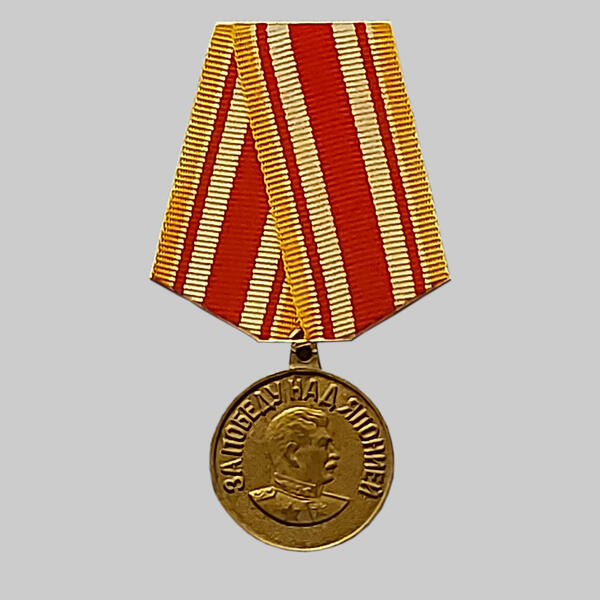
A decree of the Presidium of the Supreme Soviet of the USSR dated September 30, 1945 established the medal ‘For the Victory over Japan’ to the award the participants of the Soviet-Japanese War in August-September 1945, during which a million strong Kwantung Army was completely defeated. According to Soviet data, its losses amounted to 84 thousand people, taken prisoner about 600 thousand. In this war 12 thousand Soviet soldiers died. Soviet troops occupied ManchUria, the Kuril Islands and South Sakhalin.
The main combat on the continent lasted 12 days, until 20 August. However, sporadic fighting continued until 10 September, which was the day of the complete surrender of the Kwantung Army. Soviet troops remained in north-eastern China until May 1946. The fighting on the islands ended completely on 5 September 1945. The official end of the war between the USSR and Japan took place on 12 December 1956, the day of the entry into force of the 1956 Moscow Declaration. The peace treaty between Japan and Russia (the successor to the Soviet Union) has not yet been signed.
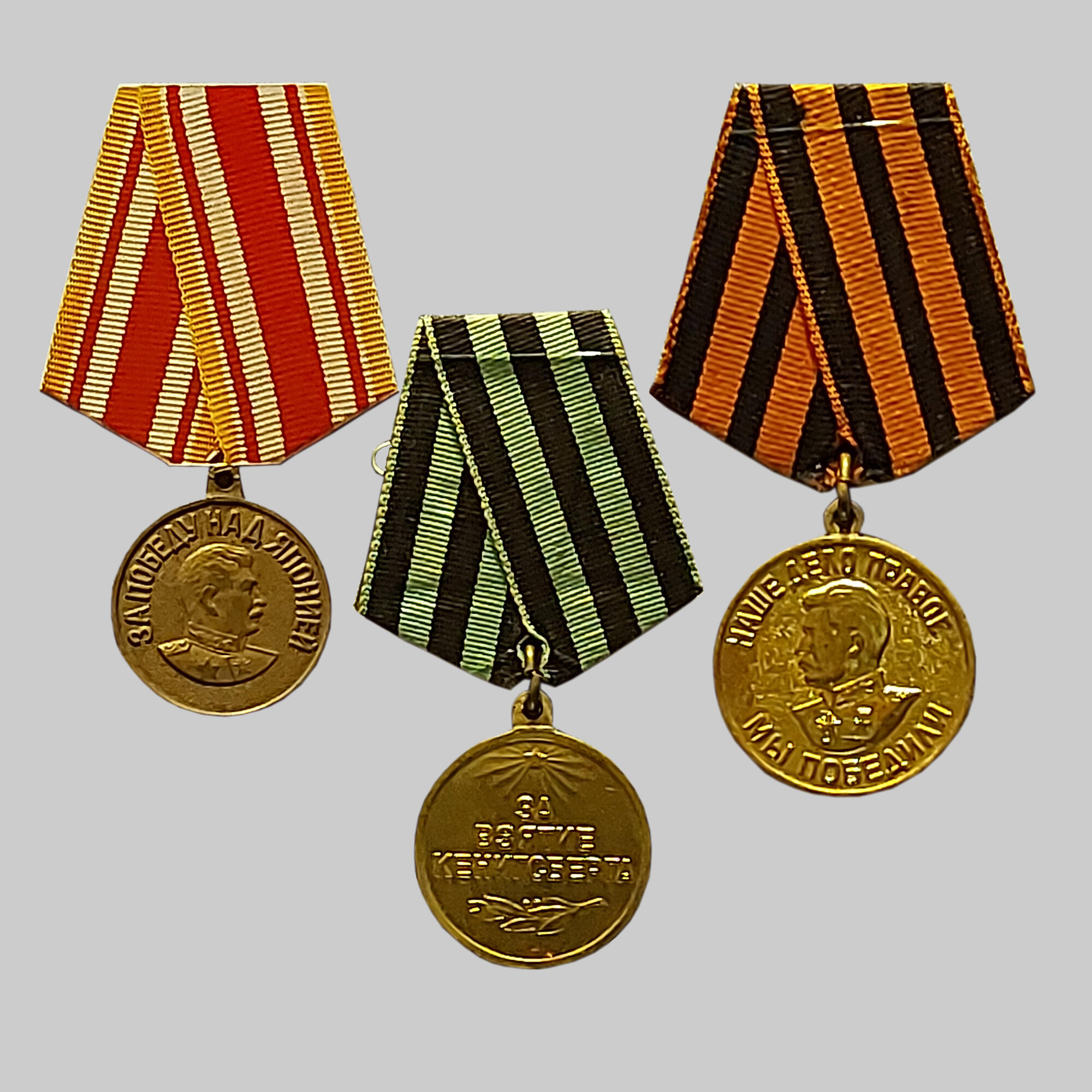
Four draft medals were presented to be established. The project by artist M.Lukina was chosen. The medal ‘For Victory over Japan’ in the form of a correct circle with a diameter of 32 mm was made of brass. On the front of the medal is a profiled chest-high image of the Generalissimo of the Soviet Union, Joseph Stalin, with the commander’s face turned to the right. At the top of the medal you can read the inscription “For victory over Japan”. All the inscriptions and images on the medals are convex.
The medal “For the Victory over Japan” was awarded to all soldiers and other persons who served in the ranks of the Red Army, Navy and People’s Commissariat for Internal Affairs (NKVD) troops. They were required to take direct part in combat operations against the Japanese forces as part of the 1st Far East, 2nd Far East and Zabaikal Fronts, the Pacific Fleet and the Amur River Flotilla.
Medal ‘For the Victory over Japan’ was worn on the left side of the chest and if there were other medals of the USSR it was placed after the medal jubilee medal ‘Forty Years of Victory in the Great Patriotic War 1941-1945’. Those who were awarded the medal ‘For the Victory over Japan’, were subsequently awarded jubilee medals in memory of the victory in the Great Patriotic War of 1941-1945. The total number of winners of the medal ‘For Victory over Japan’ is more than 1 million 800 thousand people. Despite the fact that the status of the medal provided for a one-time award, there have been cases of re-awards.
The main combat on the continent lasted 12 days, until 20 August. However, sporadic fighting continued until 10 September, which was the day of the complete surrender of the Kwantung Army. Soviet troops remained in north-eastern China until May 1946. The fighting on the islands ended completely on 5 September 1945. The official end of the war between the USSR and Japan took place on 12 December 1956, the day of the entry into force of the 1956 Moscow Declaration. The peace treaty between Japan and Russia (the successor to the Soviet Union) has not yet been signed.
Four draft medals were presented to be established. The project by artist M.Lukina was chosen. The medal ‘For Victory over Japan’ in the form of a correct circle with a diameter of 32 mm was made of brass. On the front of the medal is a profiled chest-high image of the Generalissimo of the Soviet Union, Joseph Stalin, with the commander’s face turned to the right. At the top of the medal you can read the inscription “For victory over Japan”. All the inscriptions and images on the medals are convex.
The medal “For the Victory over Japan” was awarded to all soldiers and other persons who served in the ranks of the Red Army, Navy and People’s Commissariat for Internal Affairs (NKVD) troops. They were required to take direct part in combat operations against the Japanese forces as part of the 1st Far East, 2nd Far East and Zabaikal Fronts, the Pacific Fleet and the Amur River Flotilla.
Medal ‘For the Victory over Japan’ was worn on the left side of the chest and if there were other medals of the USSR it was placed after the medal jubilee medal ‘Forty Years of Victory in the Great Patriotic War 1941-1945’. Those who were awarded the medal ‘For the Victory over Japan’, were subsequently awarded jubilee medals in memory of the victory in the Great Patriotic War of 1941-1945. The total number of winners of the medal ‘For Victory over Japan’ is more than 1 million 800 thousand people. Despite the fact that the status of the medal provided for a one-time award, there have been cases of re-awards.
#5
Date: Second half of the 1940s
Place: USSR
Technique: minting, bronze
Dimensions: 3.7×3.1 cm
Copyright: Belozersky regional Museum of local lore
Goskatalog Number: 11634433
Place: USSR
Technique: minting, bronze
Dimensions: 3.7×3.1 cm
Copyright: Belozersky regional Museum of local lore
Goskatalog Number: 11634433
#6
For the Capture of Königsberg
#7
#8
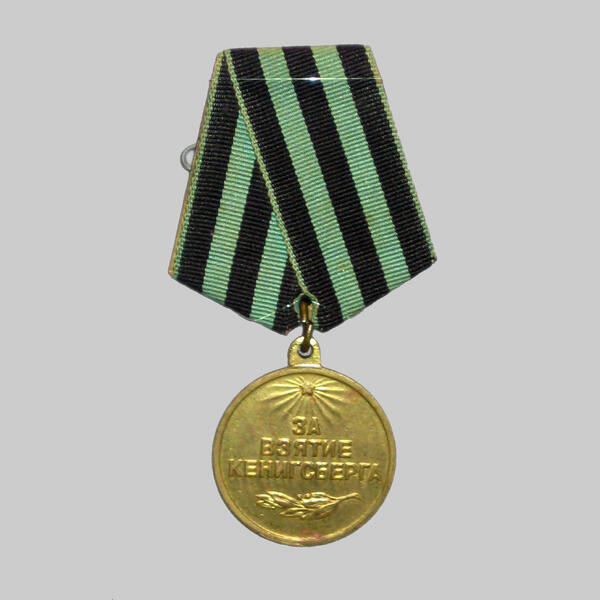
Medal ‘For the Capture of Königsberg’ was established by the Decree of the Presidium of the Supreme Soviet of the USSR of 9 June 1945. The medal ‘For the Capture of Königsberg’ was awarded to soldiers of the Red Army, the Navy and People’s Commissariat for Internal Affairs (NKVD) troops - direct participants in the heroic assault and capture of the fortress city of Königsberg in the period 23 January - 10 April 1945, as well as the organizers and persons in charge of combat operations in the capture of this city.
“For the capture of Königsberg” is the only medal of the USSR established as a reward for the capture of the fortress city, not in connection with the capture or liberation of the capital. The assault of Königsberg took place from 6 to 9 April, 1945. As a result of the operation, the main forces of the East Prussian group of Germans were defeated. Only the Zemland group remained, which was liquidated on 25 April. According to Soviet data, 93,853 enemy soldiers were taken prisoner, about 42,000 were killed, more than 2,000 guns captured, among them 1,652 mortars and 128 aircraft. According to Soviet data, from 1 to 10 April 1945, 3,700 soldiers and officers of the 3rd BelorUssian Front were killed during the assault on Königsberg, which was engaged in active combat.
The capture of Königsberg was celebrated by the highest-category salute. 324 guns carried out 24 artillery salvos in Moscow. Soon after the medal “For the Capture of Königsberg” was established, and 98 military units received the name “Königsbergsky”.
The medal “For the Capture of Königsberg” is worn on the left side of the chest and if there are other medals of the USSR it is placed after the medal “For the Capture of Budapest”. The medal “For the Capture of Königsberg” was awarded to more than 700 thousand people.
The medal has the shape of a correct circle with a diameter of 32 mm and is made of brass. On the front side of the medal in the center one can read the inscription “For the capture of Königsberg”. Above the inscription is a five-pointed star with divergent rays, and below it is a laurel branch. The front side of the medal is bordered by a flank, and on the back of the medal the date of the capture of Königsberg is carved: “April 10, 1945”, above the date there is also a five-pointed star. All the inscriptions and images on the medals are convex.
“For the capture of Königsberg” is the only medal of the USSR established as a reward for the capture of the fortress city, not in connection with the capture or liberation of the capital. The assault of Königsberg took place from 6 to 9 April, 1945. As a result of the operation, the main forces of the East Prussian group of Germans were defeated. Only the Zemland group remained, which was liquidated on 25 April. According to Soviet data, 93,853 enemy soldiers were taken prisoner, about 42,000 were killed, more than 2,000 guns captured, among them 1,652 mortars and 128 aircraft. According to Soviet data, from 1 to 10 April 1945, 3,700 soldiers and officers of the 3rd BelorUssian Front were killed during the assault on Königsberg, which was engaged in active combat.
The capture of Königsberg was celebrated by the highest-category salute. 324 guns carried out 24 artillery salvos in Moscow. Soon after the medal “For the Capture of Königsberg” was established, and 98 military units received the name “Königsbergsky”.
The medal “For the Capture of Königsberg” is worn on the left side of the chest and if there are other medals of the USSR it is placed after the medal “For the Capture of Budapest”. The medal “For the Capture of Königsberg” was awarded to more than 700 thousand people.
The medal has the shape of a correct circle with a diameter of 32 mm and is made of brass. On the front side of the medal in the center one can read the inscription “For the capture of Königsberg”. Above the inscription is a five-pointed star with divergent rays, and below it is a laurel branch. The front side of the medal is bordered by a flank, and on the back of the medal the date of the capture of Königsberg is carved: “April 10, 1945”, above the date there is also a five-pointed star. All the inscriptions and images on the medals are convex.
#9
Date: Second half of 1940s
Place: USSR
Technique: minting, bronze
Dimensions: 8,6×4,6 cm
Copyright: Belozersky regional Museum of local lore
Place: USSR
Technique: minting, bronze
Dimensions: 8,6×4,6 cm
Copyright: Belozersky regional Museum of local lore
#10
For the Victory over Germany
#11
#12
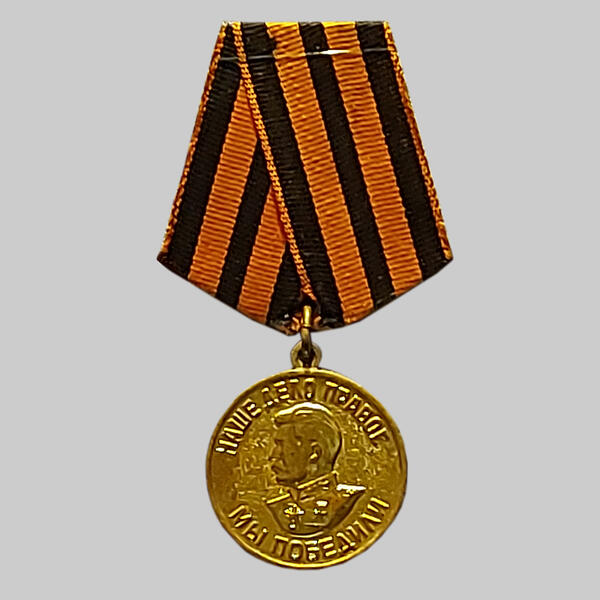
Medal ‘For the Victory over Germany in the great Patriotic War 1941-1945’ was established by the decree of the Presidium of the Supreme Soviet of the USSR dated May 9, 1945. The medal ‘For the Victory over Germany’ was awarded to all soldiers and staff members who served in the Red Army, the Navy and the People’s Commissariat for Internal Affairs (NKVD), fought on the fronts of the Patriotic War or ensured victory by their work in military districts. The award was also given to members of the armed forces who were out of service for health reasons, as well as to those who were transferred by the authorities to another service in the rear.
Medal “For the Victory over Germany in the great Patriotic War 1941-1945 is worn on the left side of the chest and if there are other medals of the USSR is located after the medal “For the Defense of the Soviet Arctic”. The people to whom this medal was awarded subsequently received the jubilee medals established in honor of the anniversaries of the Victory.
Medal “For the Victory over Germany in the great Patriotic War 1941-1945” was made out of brass. It has the shape of a correct circle with a diameter of 32 mm. With the aid of an ear and a ring, it was connected to a pentagonal pad wrapped around a silk moire ribbon. The ribbon consisted of five alternating stripes, three black and two orange. The edges of the ribbon are bordered by narrow orange stripes.
There is an inscription in the upper part of the medal on the circumference: “Our case is just”, in the lower part on the circumference the inscription “We have won”. The phrase “Our case is just” was taken from the VYAcheslav MOlotov’s speech on the radio in 1941. The Deputy Chairman of the Council of People’s Commissars of the USSR said: “Our case is just, the enemy will be defeated, victory will be ours”. The phrase “Our case is just – we have won” can also be read on the medal “For Valiant Labour in the Great Patriotic War 1941–1945”. And these words were also used on various post-war certificates and diplomas.
There are inscriptions on the back of the medal: on the circumference - “For victory over Germany”, in the center - “in the Great Patriotic War 1941-1945”.
Medal “For Victory over Germany in the Great Patriotic War 1941-1945” has become one of the largest: more than 14 million people have won the award.
Medal “For the Victory over Germany in the great Patriotic War 1941-1945 is worn on the left side of the chest and if there are other medals of the USSR is located after the medal “For the Defense of the Soviet Arctic”. The people to whom this medal was awarded subsequently received the jubilee medals established in honor of the anniversaries of the Victory.
Medal “For the Victory over Germany in the great Patriotic War 1941-1945” was made out of brass. It has the shape of a correct circle with a diameter of 32 mm. With the aid of an ear and a ring, it was connected to a pentagonal pad wrapped around a silk moire ribbon. The ribbon consisted of five alternating stripes, three black and two orange. The edges of the ribbon are bordered by narrow orange stripes.
There is an inscription in the upper part of the medal on the circumference: “Our case is just”, in the lower part on the circumference the inscription “We have won”. The phrase “Our case is just” was taken from the VYAcheslav MOlotov’s speech on the radio in 1941. The Deputy Chairman of the Council of People’s Commissars of the USSR said: “Our case is just, the enemy will be defeated, victory will be ours”. The phrase “Our case is just – we have won” can also be read on the medal “For Valiant Labour in the Great Patriotic War 1941–1945”. And these words were also used on various post-war certificates and diplomas.
There are inscriptions on the back of the medal: on the circumference - “For victory over Germany”, in the center - “in the Great Patriotic War 1941-1945”.
Medal “For Victory over Germany in the Great Patriotic War 1941-1945” has become one of the largest: more than 14 million people have won the award.
#13
Date: 1945-1950
Place: USSR
Technique: minting, brass
Dimensions: 8.6×4.6×0.6 cm
Copyright: Belozersky regional Museum of local lore
Goskatalog Number: 11634490
Place: USSR
Technique: minting, brass
Dimensions: 8.6×4.6×0.6 cm
Copyright: Belozersky regional Museum of local lore
Goskatalog Number: 11634490
read morehide
00:00
00:00
1x
2
 Point your smartphone camera to open in the app
Open in app
Share