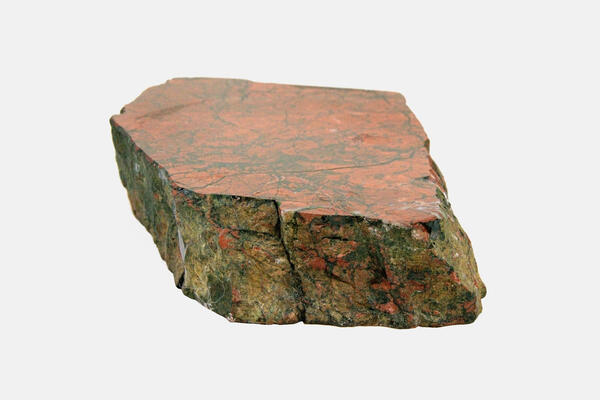
Several dozen deposits of jasper and jasperoids are located in the Polar Urals in the Yamalo-Nenets Autonomous Okrug. The jasper of the Nyrdvomenshor occurrence is found both in bedding surfaces and in debris. Jasper extracted from this area ranges in color from cherry red to dark red. The presented sample was brought from the occurrence by members of the Polar-Ural Mining and Geological Expedition in the late 20th century. The sample is sawn and polished.
The formation of jasper began many millions of years ago. At that time, there was a warm sea and active volcanoes in the Urals. Volcanic ash mixed with colored silt. The composition of jasper includes iron and manganese oxides — brown, red and even black, — green chloride salts, blue silicates and all kinds of other minerals. Gradually, the sea dried up and the rocks hardened, becoming dense and compressed. Thus, a new diverse mineral was born. In texture and color, it cannot be compared with any other stone, as it is very variegated and has many varieties.
Jasper was called “yaspis” in Rus. The word comes from the Greek iaspis, which literally means “motley”. In Europe, jasper was called “meat agate”, “tiger stone” and “German lapis”. It has been used for thousands of years, since the Neolithic period. At that time, people appreciated the stone for its hardness: they used jasper to make tools, arrowheads and spears, and to create jewelry and amulets.
The strength of jasper allows it to be used as a technical raw material in various fields. Jewelers and stone carvers appreciate it for its beauty and for the fact that it lends itself well to processing. The large Kolyvan vase made of jasper adorns the Hermitage. “Jasper Emperor” is the largest Buddha statue, a landmark of China, listed in the Guinness Book. Under Catherine the Great, entire factories were built in Russia to produce items from this rock. Jasper is used in interior décor. Altai and Ural jasper were used to decorate the Agate Rooms of the Catherine Palace in Tsarskoe Selo. The Empress adored it, spending a lot of money on geological expeditions looking for new deposits of gems. Some of them are still open.