Font
Color
Graphics
Изображение точки

To see AR mode in action:

1. Install ARTEFACT app for iOS or Android;

2. Find the exhibition «The Voronezh Region in the Great Patriotic War»

3. Push the «Augmented reality» button and point your phone's camera at the exhibit;

Скрыть точки интересаПоказать точки интереса
Показать в высоком качестве

Tokarev rifle, F-1 grenade, Equine gas mask

1
Open in app
#1
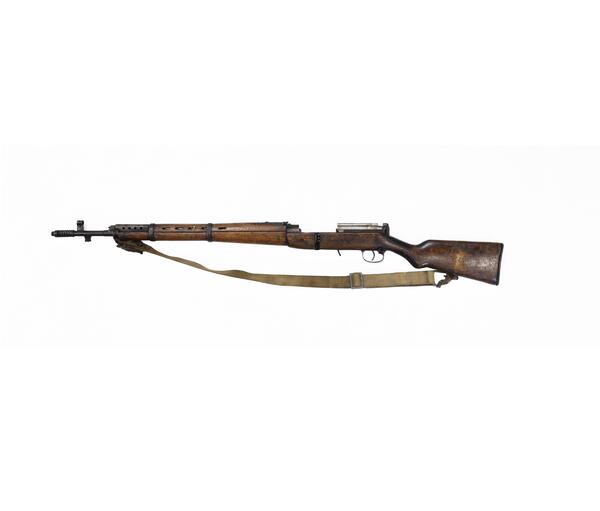
Tokarev self-loading rifle
#2
The displayed rifle was developed by Fedor Vasilievich Tokarev. At that time the military command and the highest political leadership of the country sought to introduce a self-loading automatic rifle in the Red Army instead of the AVS-36 automatic rifle, which would allow to rationalize the use of cartridges and ensure better accuracy. A competition was held in the spring and autumn of 1938. During field tests, the Tokarev rifle was recognized as the best and adopted by the Red Army under the designation “7.62 mm self-loading rifle of the Tokarev system, model of 1938 — SVT-38”.

As with the AVS-36, the SVT-38 was a gas-operated rifle: its system of operation was based on harnessing the energy, resulting from the gas from the cartridge being fired, through a port in the barrel. This high-pressure gas provided motion for the entire cycle of operation. The SVT-38 was a tilting bolt action. The rifle was designed to fire one shot per single pull of the trigger. At the same time, the trigger mechanism was a separate removable unit, which greatly facilitated the assembly and cleaning of these weapons.

To increase accuracy, the SVT-38 rifle had a trigger-type firing mechanism. The use of a muzzle brake also increased the accuracy. The rifle was fed by a detachable box magazine, designed for 10 cartridges arranged in a staggered order. The magazine could be refilled without removing it from the clip inserted into the open-top receiver.

Mass production of SVT-38 rifles started in the second half of 1939 at the Tula Arms Factory, and since the beginning of 1940 — at the Izhevsk Arms Factory. The first batches of rifles were sent to the Red Army units involved in the First Soviet-Finnish War of 1939–1940. In the extreme conditions of this Winter War, when the fighting was taking place in a rugged wooded area with a snow cover of 1.5–2 m in height and at an air temperature of about -40 degrees Celsius, many disadvantages of the rifle were revealed: those included bulkiness, heavy weight, inconvenience of gas regulation, and sensitivity to dirt and low temperatures. To eliminate these shortcomings, the rifle was upgraded, and on June 1, 1940, the SVT-40, its modified version, entered production.
#3
Name: Tokarev self-loading rifle
Author: Fedor Tokarev
Date of creation: 1938
Place of creation: the USSR
Dimensions: 122,6×11,5×4 cm
#4
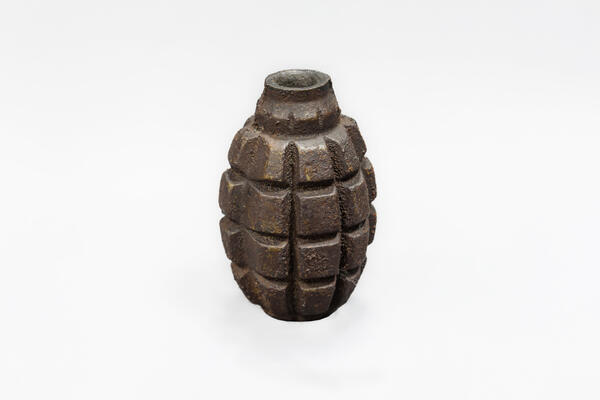
F-1 hand grenade
#6
The F-1 fragmentation grenade is a time-delay hand grenade designed to engage enemy manpower mainly in defensive combat. When the grenade explodes, the fragments produce a large injury radius of up to 200 meters, so it can be thrown only from a sheltered position, an armored personnel carrier or a tank.

The grenade was developed in 1939 by the engineer Fyodor Khrameyev based on the design of a French fragmentation grenade. The F-1’s design is relatively simple. It consists of a body, an explosive charge and a fuse. The cast-iron body of the grenade contains an explosive charge and a fuse and has longitudinal and transverse grooves, along which the grenade explodes into fragments. In the upper part of the body there is a threaded hole for screwing in the fuse. When storing, transporting and carrying the grenade, a plastic plug is screwed into this hole. The inner cavity of the body is filled with an explosive charge. The grenade uses the UZRG fuse, which detonates the explosive material and the grenade explodes into fragments.

The F-1 grenade always explodes when it falls on a hard surface, as well as in mud, snow and water. A plethora of fragments forms during the explosion, and they disperse in different directions. The fragments of the F-1 grenade are powerful enough to destroy enemy manpower within a radius of up to 200 meters. Due to its reliability, slick design and great characteristics, the F-1 grenade was very popular among Red Army soldiers. Every infantryman tried to carry five to ten grenades, saving them mainly for assault operations and to repel enemy attacks.

The combat grenade was painted green (from khaki to dark green). The training grenade was black with two white (vertical and horizontal) stripes. In addition, it had a hole in the bottom. In the training fuse, the safety pin’s pull ring and the lower part of the lever were scarlet.

The F-1 grenades were packed in wooden boxes with 20 grenades in each, the fuse hole was closed with a plastic plug. The box weighed 20 kg. The fuses were stored in cans, so the boxes also contained a can opener. The purpose of packing the fuses in a sealed container was to ensure maximum safety while they were in storage, and to prevent corrosion and oxidation of the components of the explosive mixture.

During the war years, about 137,924,000 fragmentation grenades were produced.
#5
Name: F-1 hand grenade
Date of creation: 1939
Place of creation: the USSR
Dimensions: 9×6×4 cm
#7
Equine gas mask
#9
Despite the fact that the Second World War was called “the war of motors”, horses still played a major role in it. Both in the Red Army and in the Wehrmacht, horses were used for transportation, especially in artillery. Without complaining and arguing, teams of six horses pulled guns to change the positions of batteries all through the war.

The cavalry engaged the Nazis from the first minutes of the war. In the Western Military District, together with border guards, two squadrons of the 6th Chongar Cavalry Division, sent to help the 87th Border Guards, faced the enemy who had begun the offensive on June 19. Afterwards, all units of this division joined the battle and approached the border an hour before the start of hostilities — at 3 a.m. on June 22, 1941.

Activities of partisan detachments and formations would have been impossible without horses. The head of the partisan movement in Ukraine, twice Hero of the Soviet Union Sydir Artemovych Kovpak, wrote:
#10
A partisan who fought on foot was limited in his actions and was thus tied to the territory of his detachment’s base… Over the winter of 1942, guerilla soldiers on horseback turned into a formidable force capable of delivering powerful blows to the enemy.
Sydir Kovpak
#11
In addition to pulling guns and ammunition, horses were needed to feed the soldiers: they delivered the wagons with food and field kitchens. Interestingly, it was for these (and some other) purposes that even a rifle regiment was supposed to have three hundred and fifty horses according to the regulations. And how many wounded owe their lives to these humble laborers! After all, most of the infirmaries and medical and sanitary battalions were also “horse-drawn”.

Cavalry formations participated in all major operations of the Red Army in 1943. Starting in the summer of 1943, the cavalry operated in conjunction with tank and mechanized units, which became the main means of conducting the offensive. Cavalry-mechanized groups that included both cavalry and mechanized units were used in some operations.

It is believed that during the Great Patriotic War, more than one million horses were killed on the battlefields. The names of these humble workers of the front are practically unknown.
#8
Name: Equine gas mask
Place of creation: the USSR
Dimensions: 13×30×24 cm
#12
read morehide
00:00
00:00
1x

Tokarev rifle, F-1 grenade, Equine gas mask

1
Point your smartphone camera to open in the app
Share
VkontakteOdnoklassnikiTelegram
Share on my website
Copy linkCopied
Copy
Open in app
To see AR mode in action:
  1. Install ARTEFACT app for 
  2. iOS or Android;
  3. Find and download the «Paintings in Details» exhibition
  4. Push the «Augmented reality» button and point your phone's camera at the painting;
  5. Watch what happens on your phone screen whilst you flip through the pictures.
 
We use Cookies
Cookies on the Artefact Website. We use cookies to ensure that we give you the best experience on our website. If you continue without changing your settings, we'll assume that you are happy to receive all cookies on the Artefact website. However, if you would like to, you can change your cookie settings at any time.
Learn more about useHide
Content is available only in Russian

X

Нашли опечатку?...

%title%%type%