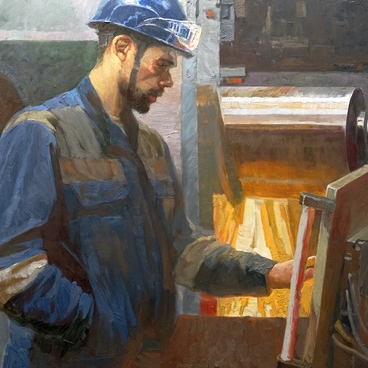
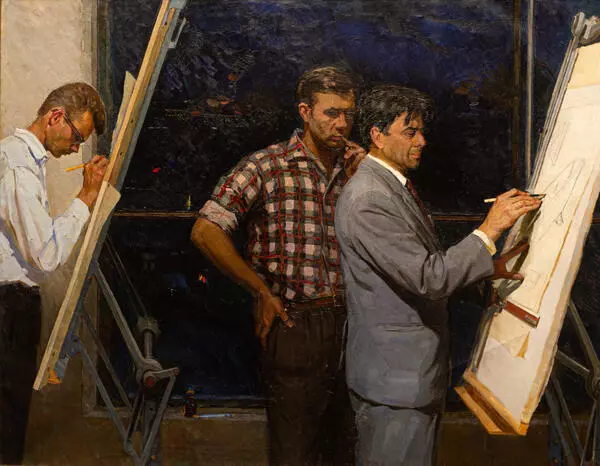
The Ural artist Nina Kostina (1934–2021) is best known for her powerful depictions of industrial subjects, but in the 1970s, a profound shift occurred in her artistic vision — she turned to landscape painting. The village of Volyny became a sanctuary of creative inspiration in her life, earning for itself the affectionate title of “the Ural Boldino”. Just as Pushkin found his muse amid the forests and rivers of Boldino, Kostina discovered her deepest artistic voice in Volyny — a quiet, lyrical haven where nature stirred her deepest artistic sensibilities. It was here that many of her most tender, atmospheric landscapes were born, infused with an exquisite sensitivity to the rhythms and moods of the natural world.
In her landscapes, Kostina developed a distinctive pictorial approach: she renders the central motif of the composition with meticulous detail, drawing the viewer’s gaze firmly toward it, while allowing peripheral elements to dissolve into soft, atmospheric blur. Her true “heroes” are not merely trees, rivers, or hills — but light and air. With masterful control over fluid paints, she achieves the ethereal luminosity of watercolor, capturing fleeting moments of nature with poetic subtlety.
A recurring and deeply personal theme in Kostina’s oeuvre is the arrival of spring. In her painting “Spring on the Chusovaya”, the awakening of nature unfolds with quiet majesty: the earth is still bare of green; the first silver catkins tremble on birch branches; and rocky cliffs vanish into a delicate bluish haze. The Chusovaya River — one of the most scenic waterways of the Urals — flows through the territories of Chelyabinsk, Sverdlovsk, and Perm regions. Since ancient times, its banks have been inhabited; archaeologists have uncovered Neolithic and Bronze Age settlements along its course. They became part of Russian history in the 16th century.
It was from the Chusovaya’s shores that the Cossack ataman Yermak Timofeyevich launched his legendary campaign. Later, the river served as a key transport route for the “iron caravans” — barges laden with Ural iron ore — which were annually floated downstream to Perm until the advent of the railway in the late 19th century. Today, the Chusovaya is celebrated as a premier destination for eco-tourism and artistic pilgrimage. Its towering cliffs and ever-changing light continue to inspire artists — and Nina Kostina was among its most devoted interpreters.
Born in Sverdlovsk (now Yekaterinburg), Kostina graduated from the Sverdlovsk Art College and later earned her degree from the Surikov Moscow State Academic Art Institute. From 1969, she taught at the Ural State University of Architecture and Art, where she rose to head the Department of Painting, and later the Department of Monumental and Decorative Art. In 1992, she was awarded the title of Honored Artist of the Russian Federation. Nina Kostina’s works reside in major Russian museums, as well as in private collections across the United States, France, India, China, and Japan.