In the 18th century, the decoration of fans became incredibly rich and varied. It was believed that an upper-class lady’s outfit would not be complete without a fan. In 1884, Evgeny Karnovich wrote in his book “Court Lace”: “She hastily opened the fan, which at that time the ladies constantly held in their hands or on the table next to them at a party and at home, in winter and in summer…” Women used their fans to demonstrate their beautiful hands or graceful gestures, and to relay secret messages.
In the second half of the 19th century, there was a reduction in the price of previously inaccessible objects of decorative and applied art. Fans began to be decorated with mechanical bone carving, lithographic printing, and machine lace. Expensive materials were replaced with cheaper ones. Fans became available to everyone: it finally left the salons and entered the everyday life of almost every fashionable city dweller.
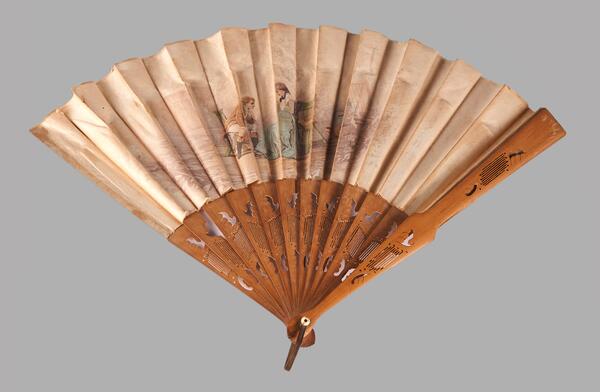
This fan was purchased in a Moscow antique shop and entered the Novorossiysk Museum-Reserve in 1986. The fan belongs to the pleated type — it consists of a mount and a leaf. The leaf is made of two layers of fabric, with the upper parts of wooden sticks inside. The set consisted of 14 sticks (the lower guard was lost), it was made of wood and decorated with an openwork carved design. At the base of the sticks is a pivot, which connects the fan, with a metal loop that was used to attach a tassel or a chain. The light pastel-colored leaf is one-sided.
The obverse shows a scene in the garden: a young man, wearing 18th- or early 19th-century clothes, sits on a folding chair and tells a story in a very enthusiastic way, trying to capture the attention of a modest girl who is engaged in needlework. Perhaps this is a scene from a play or a novel: the garden in the background is rendered in such a general way that it looks like a setting. Similar subjects and images can be found on the screens of pleated fans in museums and private collections. As a rule, such fans are dated to the 1890s, when imitating historical styles was in vogue and silk fan screens often featured gallant scenes.
In the second half of the 19th century, there was a reduction in the price of previously inaccessible objects of decorative and applied art. Fans began to be decorated with mechanical bone carving, lithographic printing, and machine lace. Expensive materials were replaced with cheaper ones. Fans became available to everyone: it finally left the salons and entered the everyday life of almost every fashionable city dweller.
This fan was purchased in a Moscow antique shop and entered the Novorossiysk Museum-Reserve in 1986. The fan belongs to the pleated type — it consists of a mount and a leaf. The leaf is made of two layers of fabric, with the upper parts of wooden sticks inside. The set consisted of 14 sticks (the lower guard was lost), it was made of wood and decorated with an openwork carved design. At the base of the sticks is a pivot, which connects the fan, with a metal loop that was used to attach a tassel or a chain. The light pastel-colored leaf is one-sided.
The obverse shows a scene in the garden: a young man, wearing 18th- or early 19th-century clothes, sits on a folding chair and tells a story in a very enthusiastic way, trying to capture the attention of a modest girl who is engaged in needlework. Perhaps this is a scene from a play or a novel: the garden in the background is rendered in such a general way that it looks like a setting. Similar subjects and images can be found on the screens of pleated fans in museums and private collections. As a rule, such fans are dated to the 1890s, when imitating historical styles was in vogue and silk fan screens often featured gallant scenes.