#1

Soap Dish and Pliant fan
#3
#4
#2
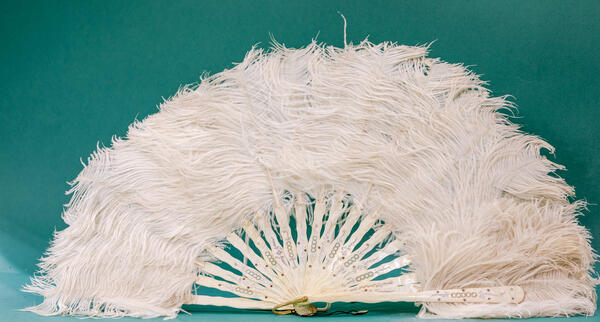
The folding Pliant fan was consigned to the Mytishchi History and Art Museum by Natalia Pavlova, a resident of the city of Mytishchi. She inherited it from her grandmother, Olga Pavlova. In the ancient nations of India and China, fans like these were status symbols of royalty. The exhibit with noble roots now on display was manufactured in Russia in the 19th century. It is made from ivory with metal inserts imitating gold and silver. The ivory used in this item is much sturdier than regular materials, like wood or nacre. The fan is decorated with ostrich feathers, with other elements crafted from paper and metal. Engraving and carving were used to create this fan.
The folding fan comprises several segments: eighteen ivory plates. The end plates are thicker than the rest—those are called ‘guards.’ The floral and geometric pattern runs across the ivory plates, and at one end the plates are conjoined with a special metal rivet—a pin with a ring. Guards and plates are the skeletal base of the item, the solid part of the fan.
The other part of the exhibit—the one with the ostrich feathers—is called the screen of the fan. There are several different manufacturing options for fan screens. Solid screens, seen in some fans, are comprised of the wide plates themselves. Soft screens are made from paper or fabric. Fans with folding screens made from feathers have a special designation: ‘Pliant.’ Originally, the word comes from French.
Even though the fans have lost their significance in the 19th century, this elegant accessory was still favored by women everywhere. In the 19th century, ostrich feathers became widely used for screens instead of more traditional materials. This led to a sharp decline in ostrich population. Some caricatures of the second half of the 19th century depict fashion-forward ladies chasing the scared ostrich birds. Plots captured on the screens changed, too. Pastoral scenes and images of gallantry were replaced by scenes from history. Birds, animals, and antique motifs were often seen on the fan screens—especially when the Empire style was all the rage—as well as a popular stylized floral and geometrical pattern. The fan, of course, remained a tool of ladies' coquetry.
The folding fan comprises several segments: eighteen ivory plates. The end plates are thicker than the rest—those are called ‘guards.’ The floral and geometric pattern runs across the ivory plates, and at one end the plates are conjoined with a special metal rivet—a pin with a ring. Guards and plates are the skeletal base of the item, the solid part of the fan.
The other part of the exhibit—the one with the ostrich feathers—is called the screen of the fan. There are several different manufacturing options for fan screens. Solid screens, seen in some fans, are comprised of the wide plates themselves. Soft screens are made from paper or fabric. Fans with folding screens made from feathers have a special designation: ‘Pliant.’ Originally, the word comes from French.
Even though the fans have lost their significance in the 19th century, this elegant accessory was still favored by women everywhere. In the 19th century, ostrich feathers became widely used for screens instead of more traditional materials. This led to a sharp decline in ostrich population. Some caricatures of the second half of the 19th century depict fashion-forward ladies chasing the scared ostrich birds. Plots captured on the screens changed, too. Pastoral scenes and images of gallantry were replaced by scenes from history. Birds, animals, and antique motifs were often seen on the fan screens—especially when the Empire style was all the rage—as well as a popular stylized floral and geometrical pattern. The fan, of course, remained a tool of ladies' coquetry.
#5
Date: 19th century
Technique: ivory, ostrich feathers, metal, paper, carving, and engraving
Place: Russia
Dimensions: 33 cm
Collection: Fabrics, Leather, Ivory
Technique: ivory, ostrich feathers, metal, paper, carving, and engraving
Place: Russia
Dimensions: 33 cm
Collection: Fabrics, Leather, Ivory
Copyright: Municipal Budget Cultural Institution ‘Mytishchi History and Art Museum’
Restorers: L.V. Getman
Restorers: L.V. Getman
#6
Soap Dish
#7

#8
The soap dish was manufactured at the Moscow factory M.S. Kuznetsov’s Partnership for Production of Porcelain, Dutchware, and Maiolica Items in the late 19th century. It was one of the largest porcelain and Dutchware enterprises in the Russian Empire of the late 19th–early 20th centuries and operated until 1917.
The partnership was established in 1887 by the Russian industrialist and businessman from the Kuznetsov family, Matvey Kuznetsov. The Kuznetsov family had long-lasting ties to porcelain manufacturing: in the early 19th century the dynasty opened a porcelain factory near Gzhel. The items made by the Partnership were highly praised for their quality. The factory actively used new technology, for example, steam machines. Products were decorated with stencil patterns and decals—a method for stamping an image from paper onto ceramic.
The factory aimed at making their products more accessible for people with any budget. Farmers could afford cheap and inconspicuous dishes, while townspeople bought mid-priced sets with showier patterns, much like the ones available to the nobility. Workers at the factory used a special method of manufacturing which was guarded as a company secret. For a year they kept clay in a cellar where it became more plastic due to atmospheric pressure.
The soap dish here is made from porcelain decorated with patterns, and the glazing gives it a glossy look. The manufacturer worked especially hard on the picture of the coat-of-arms of the Russian Empire as a symbol of their high status and respect, and the inscription saying “Soap and Cream Malakoderm. Brocard and Co Partnership.” The French perfumer Henri Brocard established a perfume manufacture in Moscow. He made a name for himself as a manufacturer of economic soap for common folk.
The elegant shape of the soap box in our exposition resembles a lily. The classic white and the signature form a single color scheme of the product. It has some features of the modern minimalistic style typical for the late 19th, early 20th centuries.
The partnership was established in 1887 by the Russian industrialist and businessman from the Kuznetsov family, Matvey Kuznetsov. The Kuznetsov family had long-lasting ties to porcelain manufacturing: in the early 19th century the dynasty opened a porcelain factory near Gzhel. The items made by the Partnership were highly praised for their quality. The factory actively used new technology, for example, steam machines. Products were decorated with stencil patterns and decals—a method for stamping an image from paper onto ceramic.
The factory aimed at making their products more accessible for people with any budget. Farmers could afford cheap and inconspicuous dishes, while townspeople bought mid-priced sets with showier patterns, much like the ones available to the nobility. Workers at the factory used a special method of manufacturing which was guarded as a company secret. For a year they kept clay in a cellar where it became more plastic due to atmospheric pressure.
The soap dish here is made from porcelain decorated with patterns, and the glazing gives it a glossy look. The manufacturer worked especially hard on the picture of the coat-of-arms of the Russian Empire as a symbol of their high status and respect, and the inscription saying “Soap and Cream Malakoderm. Brocard and Co Partnership.” The French perfumer Henri Brocard established a perfume manufacture in Moscow. He made a name for himself as a manufacturer of economic soap for common folk.
The elegant shape of the soap box in our exposition resembles a lily. The classic white and the signature form a single color scheme of the product. It has some features of the modern minimalistic style typical for the late 19th, early 20th centuries.
#9
Date: late 19th century
Technique: pottery, glaze, painting
Technique: pottery, glaze, painting
Place: Russia
Dimensions: h: 7,5 cm; d: 13,5 cm
Collection: Glass, Ceramics, Porcelain
Collection: Glass, Ceramics, Porcelain
Copyright: Municipal Budget Cultural Institution “Mytishchi History and Art Museum”
Goskatalog Number: 19705074
Goskatalog Number: 19705074
#10
Municipal Budget Cultural Institution “Mytishchi History and Art Museum”
read morehide
00:00
00:00
1x
2
 Point your smartphone camera to open in the app
Open in app
Share