#1
In the memory of the Russo-Japanese war, In the memory of the Russo-Turkish war
#5
#4
#3
Medal ‘In the memory of the Russo-Japanese war’ is the medal of the Russian Empire for awarding military personnel who participated in the Russo-Japanese War, as well as for awarding medical personnel and priests in service, civilian persons who distinguished themselves in military actions. It was established on 21 January 1906 by the decree of Emperor Nicholas II. The medal had three main variants made of different metals: silver, bronze, and dark bronze (copper). Medals from different metals were awarded to different categories of award recipients.
The silver version was intended to reward the defenders of the Kwantung Peninsula (Guangdong) and Port Arthur (now Lushun). The award was given to all persons involved in the military events, including the people of Port Arthur who were involved in its defense. A light bronze medal was awarded to all soldiers and sailors, regardless of rank or position, including volunteers who had been in at least one battle against the enemy on land or at sea. The medals of dark bronze (copper) were awarded to the military, who did not take a direct part in the battles, but were in service in the active armies and until the day of ratification of the peace treaty in the Far East and along the Trans-Siberian Railway and the Samaro-Zlatoust Railway, but only in those areas that were under martial law. Military, sailors, border guards, militiamen, priests, doctors were awarded the medal in the same way as other variants of the medal, if they were on duty in the military or medical establishment.
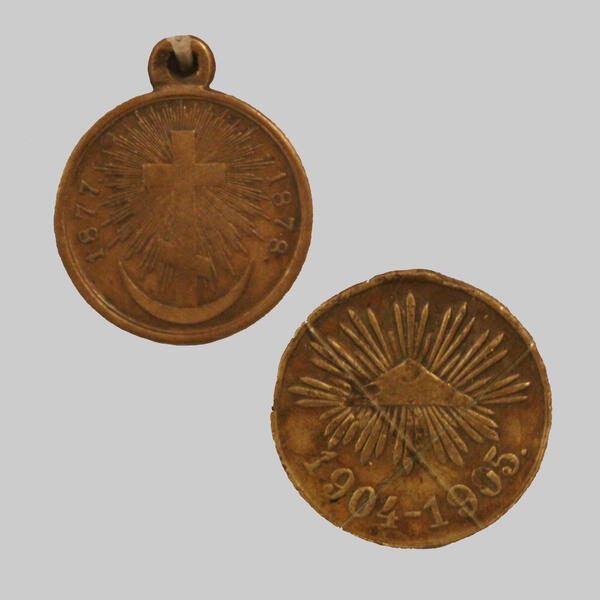
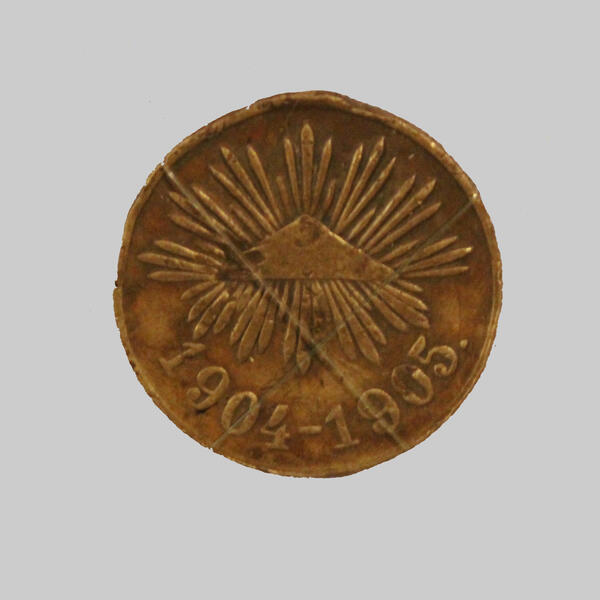
The diameter of the medal from the collection of the Belozersk Regional Museum of Local Lore is 28 millimeters. On the front of the medal the All-seeing Eye is depicted, surrounded by rays. In the lower part, along the edge, the inscription says ‘1904-1905’. On the back side the horizontal inscription in Slavic type in five lines: ‘May god lift you up at the right time’. There were many variants of the medal, due to the fact that the medal was allowed to be produced by private workshops. The main circulation was made at the Saint Petersburg mint. On the 1st of March, 1906, the wounded or shell-shocked in the Russo-Japanese War, were given the right to wear medals on a ribbon with an additional bow of the same colour by the decree of Nicholas II.
The silver version was intended to reward the defenders of the Kwantung Peninsula (Guangdong) and Port Arthur (now Lushun). The award was given to all persons involved in the military events, including the people of Port Arthur who were involved in its defense. A light bronze medal was awarded to all soldiers and sailors, regardless of rank or position, including volunteers who had been in at least one battle against the enemy on land or at sea. The medals of dark bronze (copper) were awarded to the military, who did not take a direct part in the battles, but were in service in the active armies and until the day of ratification of the peace treaty in the Far East and along the Trans-Siberian Railway and the Samaro-Zlatoust Railway, but only in those areas that were under martial law. Military, sailors, border guards, militiamen, priests, doctors were awarded the medal in the same way as other variants of the medal, if they were on duty in the military or medical establishment.
The diameter of the medal from the collection of the Belozersk Regional Museum of Local Lore is 28 millimeters. On the front of the medal the All-seeing Eye is depicted, surrounded by rays. In the lower part, along the edge, the inscription says ‘1904-1905’. On the back side the horizontal inscription in Slavic type in five lines: ‘May god lift you up at the right time’. There were many variants of the medal, due to the fact that the medal was allowed to be produced by private workshops. The main circulation was made at the Saint Petersburg mint. On the 1st of March, 1906, the wounded or shell-shocked in the Russo-Japanese War, were given the right to wear medals on a ribbon with an additional bow of the same colour by the decree of Nicholas II.
#6
Date: 1906
Place: Russian empire
Technique: minting
Dimensions 2,7×2,7 cm
Goskatalog Number: 9113050
Place: Russian empire
Technique: minting
Dimensions 2,7×2,7 cm
Goskatalog Number: 9113050
#9
In the memory of the Russo-Turkish war
#11

#10
Medal ‘In the memory of the Russo-Turkish war 1877—1878’ is the State award of the Russian Empire to award those involved in this armed conflict.
The medal was established by the decree of Emperor Alexander II on April 17 (29), 1878 and had three different variants - silver, light and dark bronze. The design of the medals was approved by Emperor Alexander II himself.
The Silver Medal was awarded to all persons who took part in the defence of the Shipkin Passasge or who were temporarily on duty there; all persons who defended Bayezet during the blockade. Since 1881, silver medals have also been awarded to the participants of the Siege of Kars, with earlier light bronze medals to be replaced.
The Light Bronze Medal was awarded to all ranks who fought at least one of the battles against the enemy during the war from 1877 to 1878, including during the suppression of the uprisings in the North Caucasus and during the fighting against the Circassian troops in Abkhazia. The award was also given to Bulgarian militiamen, priests, doctors, paramedics, sisters of mercy who were in the army and put their lives in danger.
The Dark Bronze Medal was awarded to all military ranks, Bulgarian militiamen, volunteers, sailors, and medical personnel who did not participate in the battle, but were present in the Ottoman Empire and Russia, where martial law was in effect.
The medals were cast in the form of the correct circle with a diameter of 27 millimetres. The design of the face side is close to that of the medal ‘For the Turkish War’ of 1830. On the front side of the medal in the center were depictions of an Orthodox cross surrounded by light. It lies above the defeated crescent moon, with which the cross formed a single composition. Along the side, the dates can be distinguished: ‘1877.’ and ‘1878.’ On the back of the medal there is an inscription in four lines: ‘Not unto us, O Lord, not unto us, but unto thy Name give glory’. The inscription on the bottom and on the sides is framed by two laurel branches bound by a ribbon.
From 1878 to 1883, 83,374 silver, 635,921 light bronze, 335,424 dark bronze medals were minted at the Saint Petersburg Mint. The medals could also be produced by private workshops. Because of this the medals from different masters differed from the state ones not only by the image, but also by the construction. It was allowed to issue tail-coat versions of the medals, which could be worn not only on a military uniform but also on a coat-tail. Since 1911, by the decree of Nicholas II, the wounded and shell-shocked in combat could wear these medals on a ribbon with a bow.
The medal was established by the decree of Emperor Alexander II on April 17 (29), 1878 and had three different variants - silver, light and dark bronze. The design of the medals was approved by Emperor Alexander II himself.
The Silver Medal was awarded to all persons who took part in the defence of the Shipkin Passasge or who were temporarily on duty there; all persons who defended Bayezet during the blockade. Since 1881, silver medals have also been awarded to the participants of the Siege of Kars, with earlier light bronze medals to be replaced.
The Light Bronze Medal was awarded to all ranks who fought at least one of the battles against the enemy during the war from 1877 to 1878, including during the suppression of the uprisings in the North Caucasus and during the fighting against the Circassian troops in Abkhazia. The award was also given to Bulgarian militiamen, priests, doctors, paramedics, sisters of mercy who were in the army and put their lives in danger.
The Dark Bronze Medal was awarded to all military ranks, Bulgarian militiamen, volunteers, sailors, and medical personnel who did not participate in the battle, but were present in the Ottoman Empire and Russia, where martial law was in effect.
The medals were cast in the form of the correct circle with a diameter of 27 millimetres. The design of the face side is close to that of the medal ‘For the Turkish War’ of 1830. On the front side of the medal in the center were depictions of an Orthodox cross surrounded by light. It lies above the defeated crescent moon, with which the cross formed a single composition. Along the side, the dates can be distinguished: ‘1877.’ and ‘1878.’ On the back of the medal there is an inscription in four lines: ‘Not unto us, O Lord, not unto us, but unto thy Name give glory’. The inscription on the bottom and on the sides is framed by two laurel branches bound by a ribbon.
From 1878 to 1883, 83,374 silver, 635,921 light bronze, 335,424 dark bronze medals were minted at the Saint Petersburg Mint. The medals could also be produced by private workshops. Because of this the medals from different masters differed from the state ones not only by the image, but also by the construction. It was allowed to issue tail-coat versions of the medals, which could be worn not only on a military uniform but also on a coat-tail. Since 1911, by the decree of Nicholas II, the wounded and shell-shocked in combat could wear these medals on a ribbon with a bow.
#12
Date: 1878
Place: Russian Empire
Technique: minting
Dimensions: 2,5×2,5 cm
Goskatalog Number: 9113061
Place: Russian Empire
Technique: minting
Dimensions: 2,5×2,5 cm
Goskatalog Number: 9113061
read morehide
00:00
00:00
1x
Japanese war, Turkish war
Exhibition
1
 Point your smartphone camera to open in the app
Open in app
Share