Yakut painter Afanasy Osipov was born on February 28, 1928. In his youth, he went to Moscow to study at the Moscow Secondary Art school at the V.I. Surikov Institute, and then entered the institute. Osipov participated in all-union and foreign art exhibitions, became a People’s Artist of the USSR, an academician of the Russian Academy of Arts, and was awarded the I. Repin State Prize of the RSFSR.
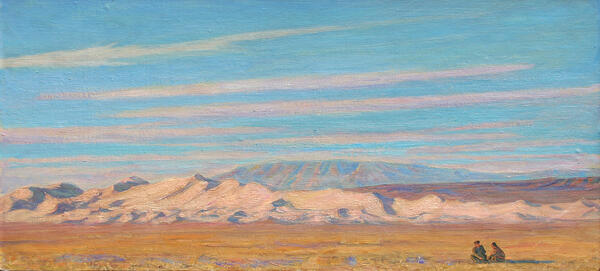
Afanasy Osipov first came to Mongolia in autumn of 1977 as part of a Soviet delegation that arrived for the Days of Soviet-Mongolian Friendship. The following autumn, he made a creative trip to the famous Gobi Desert in Southern Mongolia. A year later, a traveling exhibition of Osipov was held in Ulaanbaatar. It was formed in Moscow in 1978. Then it came to Leningrad, Prague and Bratislava, after which it continued its route through Mongolia. In those days, Osipov made a short trip to the Gobi in the Altai Aimag. In a subsequent visit, the artist traveled to the Arkhangai Aimag, thus deeper comprehending of the favorite images of the country.
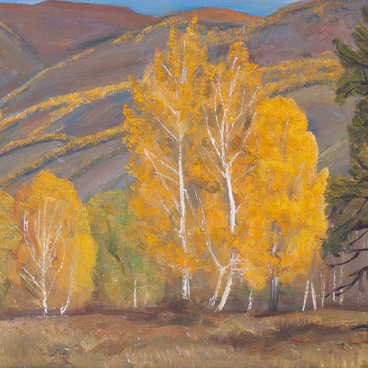
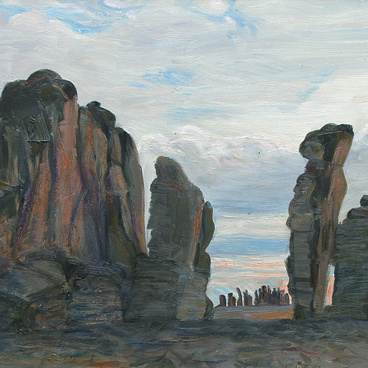
Works dedicated to Mongolia, Kyrgyzstan, Buryatia, Altai, and Nepal make up a whole cycle in the artist’s creative work. In 1986, there was a Mongolian series associated with a trip to the Arkhangai Aimag. A generalization of this series was the triptych ‘Arkhangai Arats’ created in 1986. This work was highly appreciated at the academic exhibition in Moscow and transferred to the collection of the State Tretyakov Gallery. The artist made an author’s copy for the National Art Museum of the Republic of Sakha (Yakutia). While working a lot from nature previously, the artist created a triptych in Yakutsk. Portrait “Brigadier Galbato”, “In the Arkhangai Ail”, and other etudes of Mongolian cycle served as working material for a painter.
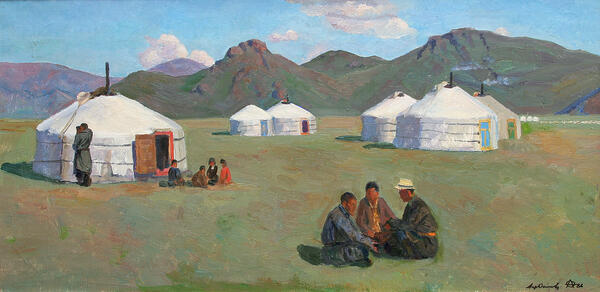
In the painting “In the Arkhangai Ail”, the artist captured scenes from the daily life of the Arats. A certain static nature of poses attracts attention. In Osipov’s Mongolian works, there is one and the same characteristic motif that he noticed, namely: the Arats in their invariable belted deles and characteristic headdresses talk sedately, thus habitually sitting on a patch of land near the yurts of their village.
Afanasy Osipov first came to Mongolia in autumn of 1977 as part of a Soviet delegation that arrived for the Days of Soviet-Mongolian Friendship. The following autumn, he made a creative trip to the famous Gobi Desert in Southern Mongolia. A year later, a traveling exhibition of Osipov was held in Ulaanbaatar. It was formed in Moscow in 1978. Then it came to Leningrad, Prague and Bratislava, after which it continued its route through Mongolia. In those days, Osipov made a short trip to the Gobi in the Altai Aimag. In a subsequent visit, the artist traveled to the Arkhangai Aimag, thus deeper comprehending of the favorite images of the country.
Works dedicated to Mongolia, Kyrgyzstan, Buryatia, Altai, and Nepal make up a whole cycle in the artist’s creative work. In 1986, there was a Mongolian series associated with a trip to the Arkhangai Aimag. A generalization of this series was the triptych ‘Arkhangai Arats’ created in 1986. This work was highly appreciated at the academic exhibition in Moscow and transferred to the collection of the State Tretyakov Gallery. The artist made an author’s copy for the National Art Museum of the Republic of Sakha (Yakutia). While working a lot from nature previously, the artist created a triptych in Yakutsk. Portrait “Brigadier Galbato”, “In the Arkhangai Ail”, and other etudes of Mongolian cycle served as working material for a painter.
In the painting “In the Arkhangai Ail”, the artist captured scenes from the daily life of the Arats. A certain static nature of poses attracts attention. In Osipov’s Mongolian works, there is one and the same characteristic motif that he noticed, namely: the Arats in their invariable belted deles and characteristic headdresses talk sedately, thus habitually sitting on a patch of land near the yurts of their village.