“Utyug” (clothes iron) is an ancient Turkic compound word that consists of two small words: “ut” — fire and “yuk” — to put. Which literally translates to “put fire” as in heat up.
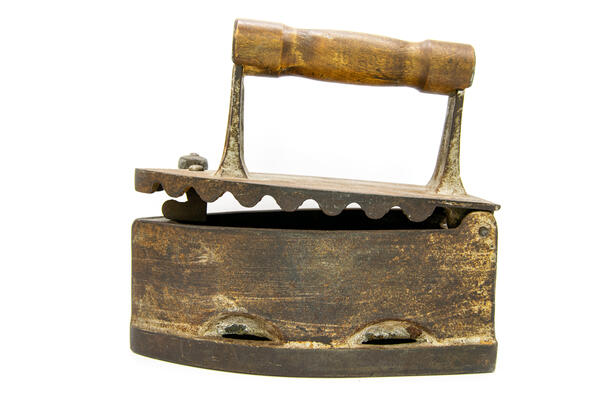
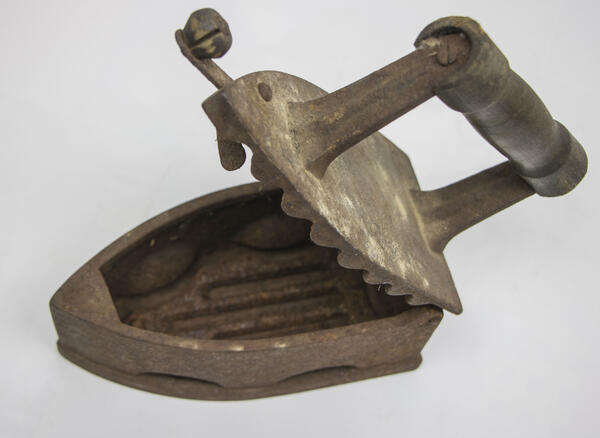
“The blacksmith Ivashka Trofimov was given 5 altyns, and for that money he arranged a clothes iron in the Tsarina’s chamber, ” was the first recorded mention of an iron in Russia. It was found in the book of expenses of tsar Mikhail Romanov’s court and dated February 10, 1636. By the 18th century, the production of charcoal irons was established in the country. Such irons looked like small stoves: special tongs were used to place hot birch coals inside the iron which had holes at the sides. When the charcoal inside the iron went out, the housewives blew into its holes or waved the iron from side to side to flare the coals back up. The lid of the iron was kept in place with a small latch.
Distant relatives of modern irons could weigh up to 12 kg. It is worth noting that only wealthy families could afford them. In the 18th century, while waiting for guests to arrive, housewives often put their utensils on display along with the samovar. Irons were often decorated with intricate patterns. When the iron wasn’t smoothing creases on clothes, it served as a kind of a mousetrap.
Before the famous invention of Ivashka Trofimov, women in Russia smoothed their laundry with a rubel (mangle board) — a “rolling stick”. The rubel was basically a slab of wood with a handle at one end. The hand-pressed laundry was wound onto such a device and rolled out. After this procedure, even poorly laundered garments and sheets became white as snow. This is where the well-known proverb “If not by washing, then by rolling” came from.
The iron is one of the oldest inventions of mankind, but the history of its development and improvement is not over yet. After all, before acquiring its contemporary design and becoming an ultramodern device — light, efficient and safe — the iron has undergone many changes. But regardless, this device has always been a person’s faithful companion, making their life much more comfortable. And what the future holds for the iron — only time will tell.
The exhibit is made of cast-iron and has a wooden handle. Before being donated to the museum by Irina Petrovna Gorskaya, it was used in her family for many years.