Font
Color
Graphics
Изображение точки

To see AR mode in action:

1. Install ARTEFACT app for iOS or Android;

2. Find the exhibition «Land of the Chudes»

3. Push the «Augmented reality» button and point your phone's camera at the exhibit;

Скрыть точки интересаПоказать точки интереса
Показать в высоком качестве

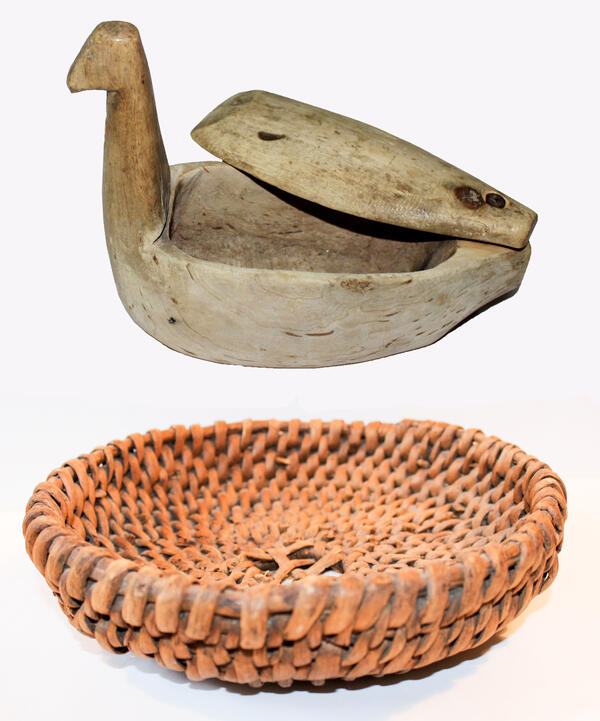
Duck salt cellar, Kornevatka vase, Painted tues

0
Open in app
#6
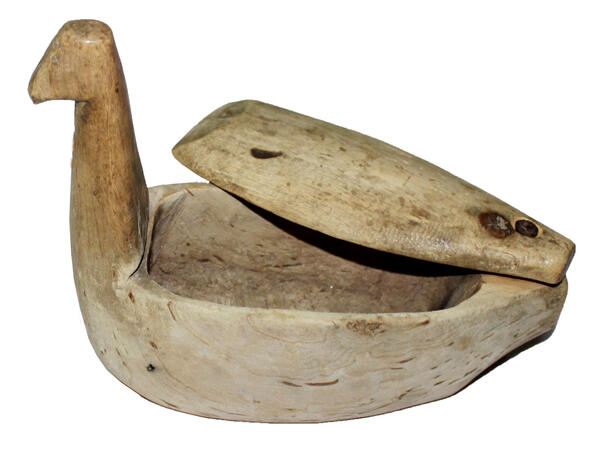
Duck salt cellar
#3
The salt cellar in the form of a duck is carved from a single piece of wood. Duck-shaped salt cellars were usually made of wood, birch bark and burl, tree outgrowths. The movable lid is fixed to a small tail with a metal nail. The eyes are marked with crosses, the inside of the body is crudely hollowed out and the outside is sanded and polished. This salt cellar was found by staff members of the Komi-Permyak Local History Museum in the village of Sepol, Perm Region, in 1970.

The bird is one of the main motifs in the decorative and applied arts in the culture of the Perm peoples. The first images of birds in the Kama region appeared in the 3dcentury BC. The image of a bird-shaped idol with a human head and bird’s wings is associated with human ideas of the afterlife, the flight of the soul. The Duck was known as the foremother of mankind: according to the legend, she dove into the sea, picked up some earth from the seabed and brought it in her beak. It marked the beginning of a new world, and her two sons, hatched from her eggs, became the supreme gods — En and Omol — the embodiment of good and evil. Many omens in the Komi-Permyak culture are connected with ducks: for example, if a duck crossed the road, it was a warning of impending hardships. The image of the waterfowl was often found in ornaments, sculptures, drawings and bronze castings in the Perm animal style.

There are certain tunes associated with salt cellars and salt among the Komi-Permyaks. Salt is one of the most effective magical substances, which was widely used to protect oneself from evil forces and cure illnesses and bad spells. Particularly effective was a combination of bread and salt — “nyan-sov”. This very phrase was not only an invitation for a visit, but also a good wish for happiness, prosperous life, health and joy.

A duck salt cellar was given to a young bride on her wedding day. The gift was carved for her by her father, elder brother or maternal uncle. Leaving her home, the girl would take the salt-cellar with her as part of her clan, a symbol of its vitality and protection, The figure of a duck was the embodiment of paternal blessing and a symbol of family happiness in the future. The duck salt cellars were an obligatory attribute in the wedding rituals of the Finno-Ugric tribes.
#7
Наименование: Duck salt cellar
Автор: Pyotr Salnikov
Дата создания: the late 19th century
Место создания: Sepol village, Perm Governorate, Russia
Техника: carving wood
Размеры: 23×16×0,5 cm
#8
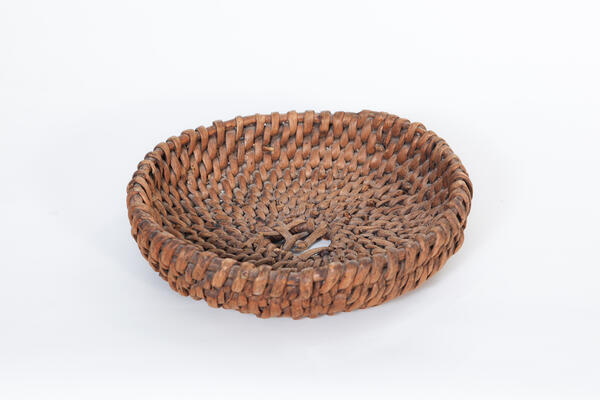
Kornevatka vase
#5
A kornevatka vase (from the Russian “koren'” — root) is a round dish with low sides, made of thin tree roots in a checkerboard pattern. It is a household item and an important exhibit of the collection of ethnographic items made of wood, including wicker baskets, boxes, vases, dishes, a fodder basket and a headdress. The kornevatka was found in 1999 in the village of Ust-Chukurya, Gainsky district, Perm region.

The first kornevatkas, kornevatikas, kornyatkas, became part of the museum collection one hundred years ago when they were transferred from the Kudymkar State Art and Industry Workshops, founded by Pyotr Ivanovich Subbotin-Permyak, an avant-garde artist and the founder of the local history museum. In 2014, the collection was expanded to include the works by the folk craftsman of Perm Krai Leonid Sergeevich Bychin from the village of Bychino. He is the only living artisan in the region who makes wicker works from roots. Leonid Sergeyevich donated to the museum a wicker cap, a fodder basket, boxes, and vases.

Kornevtkas are rare because of the complex production technology. Unlike basketry of willow twigs or vines, production of kornevatkas require time to extract and prepare roots, as well as some physical strength for braiding. Traditionally, it was men who produced items made of roots. First, they stocked sarga — thin shingle, twigs or roots. For this purpose, cedar, pine or spruce roots were split into four parts and then a few thin layers were removed from the outer surface of the wooden part. These ribbons were cleaned of slivers and, if necessary, cut into narrower ones. Sarga, rolled into rings, was dried and stored until needed. The material soaked in water had the same properties as fresh material.

The technique of making a kornevatka involves pulling a running ribbon through a slit made with an awl on the braiding. Ribbons of cedar root should completely braid the bird cherry rod. At the end of the work, it is necessary to tighten the braiding so that the dish remains solid when drying. The shape of the kornevatka — round or rectangular — is determined by the form of the base made of twigs. The lid is made separately and then fixed with lace leather straps. The same straps are used to make a handle to carry the product. The main advantage of kornevatkas is their durability, as well as the ability to keep a stable leak-proof form.
#9
Наименование: Kornevatka vase
Дата создания: the early 20th century
Место создания: Ust-Chukurya village, Perm Governorate, Russia
Техника: wickerwork
Размеры: 5,5×22,5 cm
#10
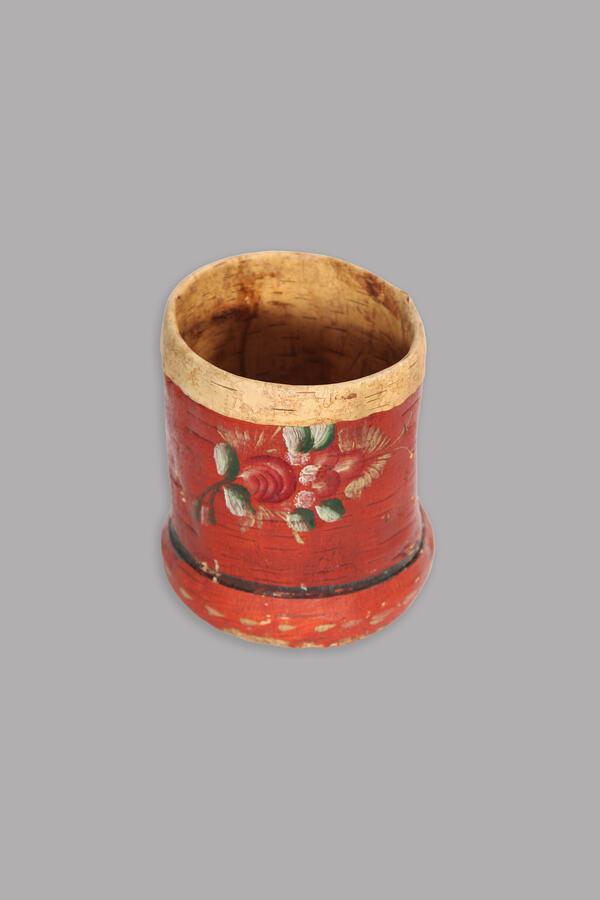
Painted tues. Birch bark container
#11
Beresta is the outer layer of birch bark, one of the most common materials in everyday life of Russian peasants. It was used to protect log houses and window sills from moisture, to repair broken clay pots and to weave ropes, to make musical instruments, grips for tools, toys for children and boxes. People also wrote on it: birch-bark letters are a monument of culture of the 11th century Old Rus. Birch bark was used to make kitchenware and utensils: baskets, bags, chests, boxes, horse harness, fishing tackle. The most common item made of birch bark was a tues, also called “tuesok” and “burak”.

A tues is a small birch bark container with a sturdy wooden bottom and a lid. The tues from the collection of the Komi-Permyak Local History Museum is made in a traditional way — it consists of two layers of birch bark similar to a thermos. The inner layer is one piece and solid, and the outer one is fastened with a zig-zag lock on top. Birch bark preserves the temperature inside the tues and keeps out moisture. People used to store salt, tea, butter, cottage cheese, sour cream in such containers. In winter, fresh berries remained fresh, while in summer kvass and milk were kept cool.

The burak was often decorated with carving or painting. This tues is decorated with a floral pattern: on both sides small bouquets of white and crimson roses and yellow cincfoils are painted on a red background. Such a pattern is characteristic of the Obvinsky painting, a folk craft of the Urals. The painting got its name from the river Obva, a tributary of the Kama River in the Perm region; it has been around since the second half of the 19th century. The patterns on the tues are made in the technique of “razbel”: the craftsman put whitewash on one edge of the brush, and paint of the primary color on the other. Smooth movement of the brush left a light stripe on the outer edge, softened the colors and increased the volume of the painting.

Tueses were not only widely used in the household, but also served as interior decor. A tuesok has always been a useful and beautiful gift, and it is still a popular souvenir from different regions of Russia. This red-colored tues was handed over to the Komi-Permyak Museum in the 1920s by Pyotr Ivanovich Subbotin-Permyak, the founder of the museum.
#12
Наименование: Painted tues. Birch bark container
Дата создания: the early 20th century
Место создания: Kama region, Russia
Техника: birch bark, wood, assembling, Obvinsky art painting
Размеры: 15,5×12,3 cm
#13
read morehide
00:00
00:00
1x

Duck salt cellar, Kornevatka vase, Painted tues

0
Point your smartphone camera to open in the app
Share
VkontakteOdnoklassnikiTelegram
Share on my website
Copy linkCopied
Copy
Open in app
To see AR mode in action:
  1. Install ARTEFACT app for 
  2. iOS or Android;
  3. Find and download the «Paintings in Details» exhibition
  4. Push the «Augmented reality» button and point your phone's camera at the painting;
  5. Watch what happens on your phone screen whilst you flip through the pictures.
 
We use Cookies
Cookies on the Artefact Website. We use cookies to ensure that we give you the best experience on our website. If you continue without changing your settings, we'll assume that you are happy to receive all cookies on the Artefact website. However, if you would like to, you can change your cookie settings at any time.
Learn more about useHide
Content is available only in Russian

X

Нашли опечатку?...

%title%%type%