Yakuts are a people with a rich material and spiritual culture, one of the elements of which are smoking pipes and related paraphernalia.
Probably the most ancient smoking pipe in Yakutia was found in a burial of the 18th century. In Siberia, such finds in archaeological sites date to the middle of the 17th century. The Yakuts probably began to use pipes for smoking after the Russian Cossacks came to the area.
As a rule, smoking accessories were used not only for their direct purpose, but also as jewelry. These items were considered to be personal things both in life and in the afterlife.
The smoking set also included a pipe cleaner, a tobacco pouch and a tinderbox. These items were made by blacksmiths who were highly respected by the people.
There are different kinds of smoking pipes: baldiy hamsa, dioquur hamsa, komys hamsa and others. For example, a baldiy hamsa is a smoking pipe made of burl, which is the root of a birch tree.
A dioquur hamsa is a pipe-shaped instrument that was intended for smoking dried plants, mainly tobacco. A komys hamsa is a pipe made of silver. There were also homemade pipes without a mouthpiece. They consisted of a bowl with a rounded bottom and a hollow for tobacco. At the bottom of the bowl there was a drilled hole for sucking out the smoke. Such pipes had a flat protrusion for better grip. Such items were carved from a piece of wood with a knife. The stem of the pipe was sometimes wrapped with a thin leather strap, to which a metal ring with pendants of beads and metal tubes was attached. Some of them were equipped with a pipe-cleaner to remove soot from the pipe. Richly decorated smoking pipes highlighted the status of the owner.
The collection of the Churapchinsky Museum includes
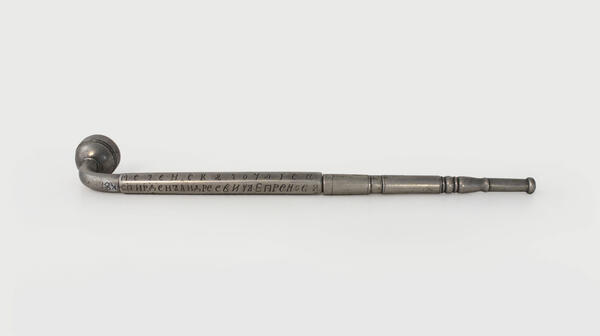
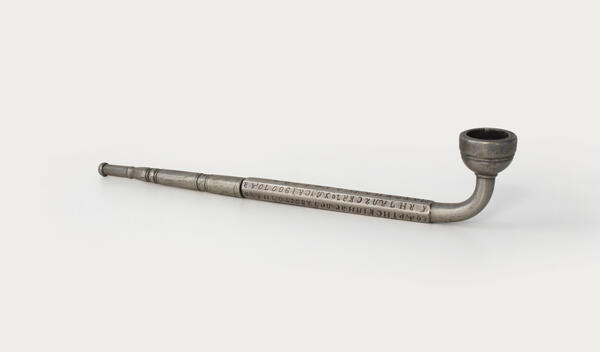
a silver smoking pipe, hamsa. According to the inscription on the long
mouthpiece, the piece belonged to Matryona Makarova, the wife of one of the
wealthy residents of Meginsky ulus. The pipe was made in 1900 by Spiridon
Efremov, a craftsman who lived approximately in the last quarter of the 19th —
early 20th centuries. He was a native of Khodorinsky settlement of
Vostochno-Kangalassky ulus. There is an engraved inscription on the mouthpiece.
The pipe has a miniature bowl and a long mouthpiece.